


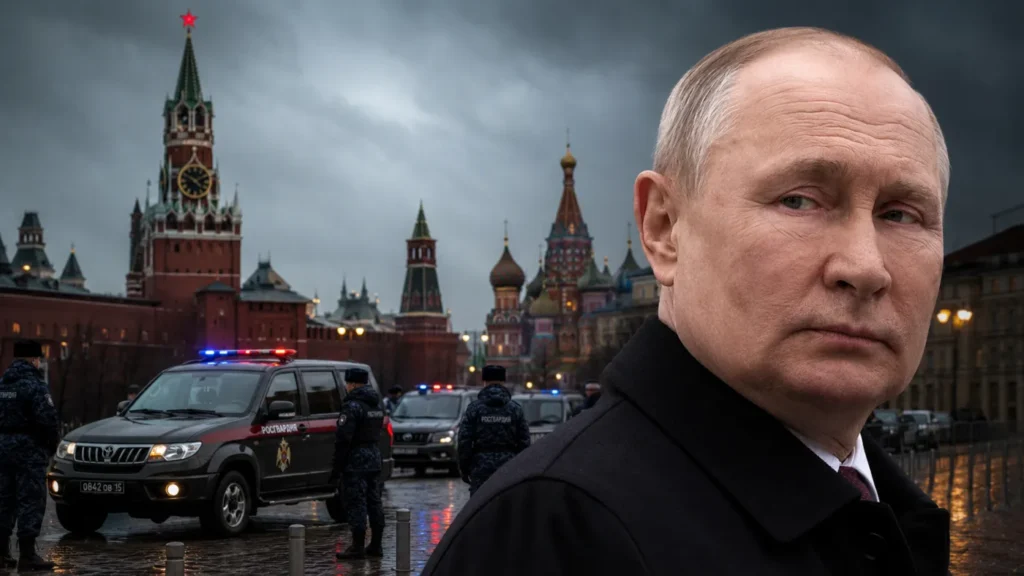
The Kremlin is intensifying security measures and restricting President Vladimir Putin’s public appearances following intelligence warnings of internal instability and successful Ukrainian special operations within Russian territory.
Growing Security Fears for Vladimir Putin
According to Russian and Western media, the Kremlin has spent months analyzing the risk of drone attacks, sabotage, and operations organized directly on Russian soil, with particular concern regarding potential actions in Moscow.
Security in the capital has been noticeably increased, including the deployment of mobile electronic warfare systems to disrupt drone communications, which has caused signal issues for residents near government buildings.
This nervousness was evident during this year’s Victory Day celebrations; officials considered limiting or canceling the Red Square parade, and the event ultimately took place under exceptionally strict security controls.
Impact of Ukrainian Special Operations
Ukrainian intelligence has conducted numerous special operations on Russian and occupied territories since the start of the full-scale war, including drone strikes and the elimination of military personnel.
Over the last two years, explosions at arms factories, attacks on military airports, and strikes on strategic infrastructure have fueled a sense of paranoia within the Kremlin.
Politologist Abbas Galliamow suggests that the effectiveness of Ukrainian services has led Putin to prioritize personal protection over his political image, as noted by Ekaterina Schulmann regarding his reduced public presence.
The Fall of Sergei Shoigu and Ministry of Defense Purges
A symbolic shift occurred with the weakening of Sergei Shoigu, a longtime confidant of Putin who was removed as Defense Minister and replaced by Andrei Belousov, moving to the role of Secretary of the Security Council.
A wave of arrests has hit the Ministry of Defense, including former Deputy Minister Ruslan Salikov, Timur Ivanov, and Pavel Popov, on charges of corruption and the embezzlement of state funds.
Analysts suggest these purges indicate a reconstruction of the influence network around the military and security services, as the war in Ukraine has weakened the position of traditional military elites.
Fragmentation of the Russian Elite
Expert Aleksandra Prokopienko describes the Russian power system as a collection of competing interest groups dependent on Putin, lacking a unified center capable of coordinating actions against the Kremlin.
The 2023 mutiny by Yevgeny Prigozhin is viewed as an exception rather than a trend, as the Wagner Group founder possessed his own independent military and financial resources.
While the current system still offers the elites more benefits than a change in power, this dynamic could shift if the Russian economy continues to weaken under the pressure of sanctions and war costs.
Economic Shifts and Psychological Warfare
The Russian economy is being subordinated to the military sector, creating sharp competition between military, administrative, and business groups fighting for survival and access to state resources.
British expert Mark Galeotti suggests that some reports of a “plot against Putin” might be elements of psychological warfare intended to deepen mistrust and suspicion within the Russian elite.
Regardless, the Kremlin’s actions—expanding protection, restricting Putin’s activity, and conducting brutal purges—demonstrate that the system has entered a period of severe tension and mutual distrust.