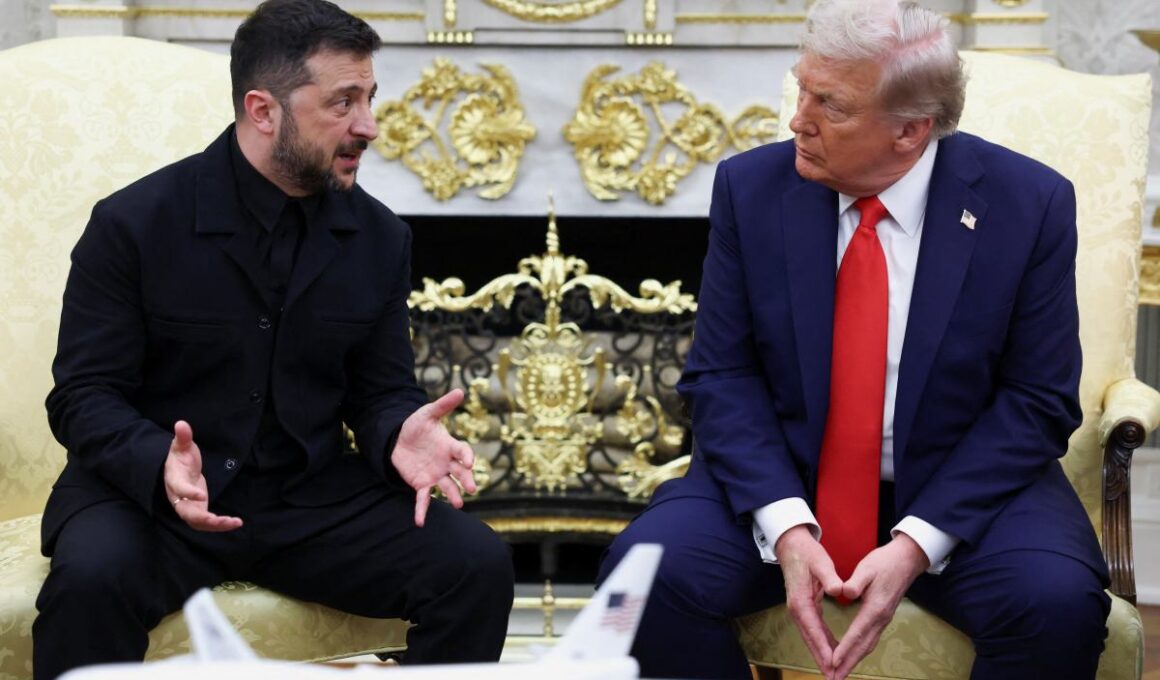
The meeting between President Zelensky and former U.S. President Trump exceeded expectations, as Ukrainian political scientist Ihor Rejterwycz noted. The challenge: Trump often endorses the latest narratives, so Ukraine must ensure he retains his stance.
The meeting went well, in a constructive, working spirit.
The most important thing was that from the very beginning we managed to give the conversations a constructive tone. All three formats—public meetings, face‑to‑face talks, and a gathering with European leaders—went quite successfully. Ukraine and Europe presented a unified position, which caused Trump to pay close attention to the arguments we raised.
It is a positive story. The key, however, is that it must continue. The problem is that Trump is a person who often supports what he hears most recently. And there will be some time before his next meeting with Putin. Ukraine and its partners must ensure that Trump does not lose his current position during this period.
We calculated that in the first few minutes of the meeting, Zelensky thanked Trump about 16 times. Such moments may seem a bit comical, but you should take a broader view. If they leave a positive impression on Trump and help steer the conversation in the right direction, creating a constructive mood, this is entirely justified.
There is nothing surprising about it—European leaders did the same: they constantly thanked Trump, emphasizing his exceptional role. He likes this and it indeed motivates him to act. Therefore, Zelensky’s conduct was fully justified and sound.
They are important. And in this case Ukraine acted appropriately. On one hand, Zelensky presented himself in an elegant, business‑like manner; on the other, he brought a symbolic gift that could make an impression on Trump. For him, such things are really significant, even if they may seem somewhat cynical on the surface.
From a communication point of view it is a perfectly effective move. It costs Ukraine little, but it creates a positive effect in Trump’s eyes. It is a thoughtful and good gesture.
They played a very important role. First, they strengthened Zelensky’s position. Second, they gave the meeting additional weight—and, we could say, overall European legitimacy. Third, they stood alongside the Ukrainian president on key issues.
Trump clearly saw that he was not just talking to Zelensky but to all of Europe. The Europeans made their position clear in favor of Ukraine. That is a huge plus, because it is much harder to ignore a consolidated position of many leaders than one person’s opinion.
Their support had a huge impact on the outcome of the meeting and confirmed the validity of the decision to send a large representative delegation there. In addition, Trump was pleased to accommodate several leaders at once, making the event feel special with him at the head of the table.
European partners also helped with details. During further talks with Trump, they and reinforced the points Zelensky presented. As a result, Trump understood that this was not the position of one country but that of all of Europe. And he could not ignore it, because these are his allies and NATO partners. It is harder to refuse them than a single state. Their role in this meeting was thus extremely important.
The conversation about security guarantees is already moving into concrete terms. There are several formats of such guarantees, and each partner country will choose which commitments it is ready to take on toward Ukraine.
It is important that the statement was also made that even Putin acknowledges: Ukraine should receive guarantees. Obviously it would be odd if he outright opposed it, because formally there is no veto power. But the very fact of announcing this matter is a very positive signal. Everyone understands that war could formally end, but as long as Putin and his regime exist, the danger to Ukraine remains. That is why support must be long‑term.
Zelensky talked about ten days that are planned to prepare specific documents. That means there may soon appear documents already signed, with guarantees clearly defined and assigned to each country individually. For Ukraine it will be an important starting point for further negotiations with Russia.
This is a combination of intermediary formalities and delivering concrete information. Trump could not dictate what Putin should do, but he could present Ukraine’s position. For example, that Ukraine does not agree to certain compromises, but is ready to consider other options for cooperation or meetings.
For Putin, this information was unpleasant—the fact he did not expect that thanks to Trump Ukraine could present its conditions directly. It gave Ukraine an advantage, because Zelensky’s position was clearly conveyed without distortion. When a document with guarantees or agreements is later prepared, it will be based on those talks, not on attempts to twist the situation by Putin.
The format and details have not yet been defined, but the meeting itself is practically inevitable because the topic had already been discussed. Putin probably expected a meeting on his terms, but the situation unfolded differently. Ukraine is ready to meet right away, and Putin will either have to agree or find a pretext to delay. This puts Ukraine in a more favorable position, as it controls the pace and preparation of the discussion.