German Chancellor Friedrich Merz calls for a new beginning in transatlantic relations at the Munich Security Conference.
Merz Advocates for Stronger European NATO Pillar
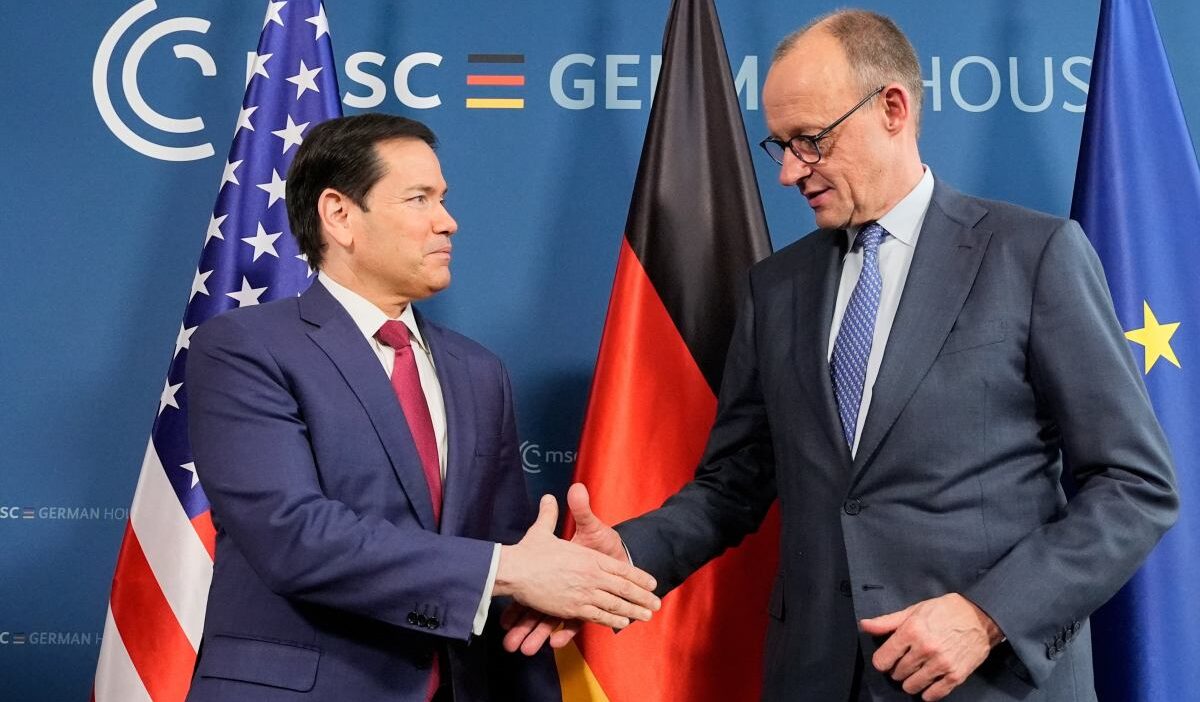
Opening the Munich Security Conference, German Chancellor Friedrich Merz called for a new beginning in Europe’s relations with the United States and the building of a strong, partially independent European pillar of NATO. “If our partnership is to have a future, we must reaffirm it in a double sense,” Merz said. “This consolidation must be concrete, not esoteric. On both sides of the Atlantic, we must come to the conclusion that together we are stronger.”
To achieve European military independence, Merz envisions a strong European pillar in terms of NATO nuclear deterrence. He has begun talks with French President Emmanuel Macron about European nuclear deterrence while noting Germany will observe its legal obligations regarding the ban on possessing its own nuclear weapons. Currently, NATO nuclear deterrence relies mainly on American nuclear weapons stationed in Europe, including in Germany.
Polish Thread in Merz’s Historical Reflections
Merz addressed Germany’s historical responsibility in his speech, mentioning the mutual military commitments of EU members in the Treaty on European Union. “We must re-read how we want to organize military support in Europe. Not as a substitute for NATO, but as an independent, strong pillar within the alliance,” he explained.
The Polish connection appeared when Merz recalled Radosław Sikorski’s 2011 words during the eurozone crisis: “I fear German power less than German inaction.” Merz noted this is “part of our responsibility, which results from the constitution, history and geography.” He also acknowledged Germany’s difficulty with trusting state power, rooted in post-1945 thinking about the need to control governmental authority.
Merz’s “Freedom Program” for Transatlantic Relations
Merz titled his speech “Freedom Program,” addressing turmoil in transatlantic relations. He mentioned the dispute over Greenland that shook NATO allies and Trump’s tariff threats, stating: “We don’t believe in tariffs, we believe in free trade.” The speech responded to US Vice President JD Vance’s 2023 criticism about the state of democracy in Europe, with Merz saying “a rift has emerged between Europe and the United States” and that “the MAGA cultural revolution” is not for Europeans.
Despite divisions, Merz emphasized mutual dependence in the transatlantic partnership. “In the era of great powers, even the United States will rely on this trust. Even they encounter the limits of their power when acting alone,” he stated. Merz believes Europe can defend itself in the new world order through economic strength, military power, and political determination, warning that “a world where only strength matters would be a dark place.”
New Partnerships to Reduce Dependence
Merz announced willingness to form new partnerships to reduce dependence on countries like China and the US. “Although European integration and transatlantic partnership remain very important for us, they are no longer sufficient to maintain our freedom,” he said. Merz explained that partnerships must also be possible with countries not sharing all Western values, mentioning Canada, Japan, Turkey, India, Brazil, South Africa, and Persian Gulf states as particularly important partners.
The crisis in transatlantic relations and the rise of great power politics is a leading topic at the Munich Security Conference. On Saturday morning, US Secretary of State Marco Rubio will speak, with Europeans expecting declarations in favor of NATO and a clear position on US troops and nuclear weapons in Europe.