


A decades-long legal battle over a 2000 Warsaw pub shooting, involving multiple trials and shifting testimonies, culminated in a final conviction for Marek N.
The Initial Attack and Investigation
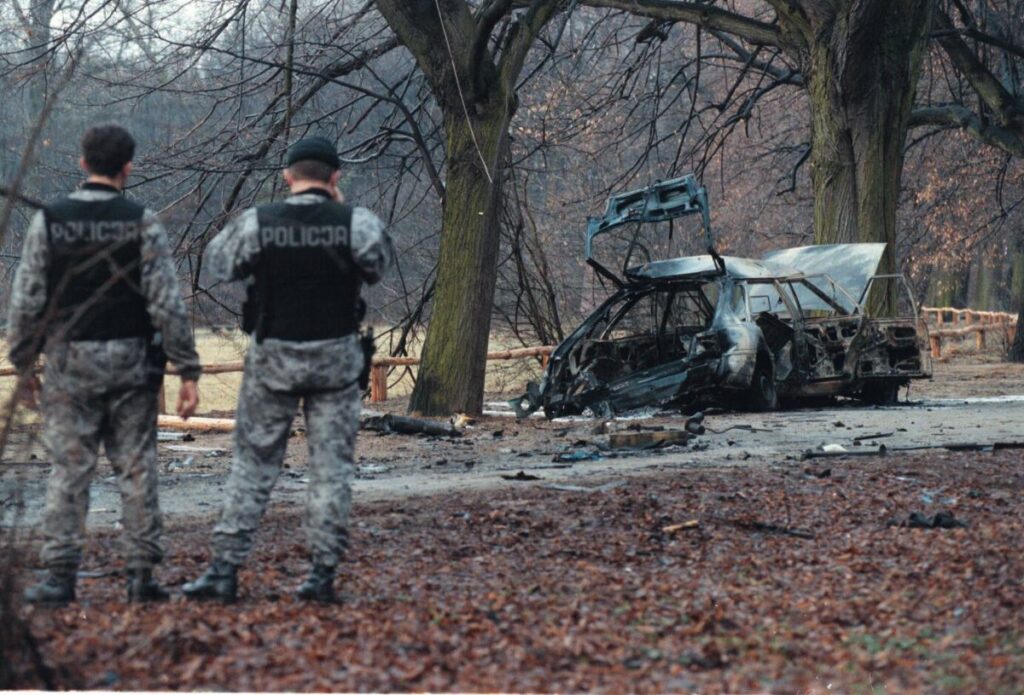
In 1999/2000, a pub owner in Nowy Dwór Mazowiecki was killed in an explosion while preparing for a year-end party. Three employees were also fatally injured. Initial investigations pointed to a settling of scores between rival criminal groups.
Police determined the bomb used in the pub explosion weighed over five kilograms and was intended to detonate during a meeting between Paweł G. (“Głębik”) and Krzysztof B. (“Szczurek”), members of the Nowodworski mafia.
A Second Attempt on Lives
In November 2000, G. and B., anticipating an attempt on their lives, wore bulletproof vests while gambling at the Tartak pub. They were ambushed by two masked gunmen who opened fire with machine guns, inflicting 34 gunshot wounds.
The attackers fled in a red Ford Sierra, leaving the wounded gangsters for dead. The scene revealed a brutal execution, with the assailants confirming the kill by repeatedly kicking the victims.
The Arrest of “Marek z Marek” and “Chulio”
Several months later, police arrested Marek N., alias “Marek z Marek,” and Daniel E., known as “Chulio,” on unrelated robbery charges. Both were linked to the Wołomin mafia and worked as hitmen for other gangs, including one led by the K. brothers from Modlin.
Authorities intercepted a letter from a K. brother attempting to establish an alibi for the pub bombing, providing a crucial lead in the investigation.
The Trial and Conflicting Testimony
In 2003, an indictment was filed against leaders of the Modlin criminal group, including the K. brothers, Marek N., and Daniel E. Charges included attempted murder, possession of explosives, and leading a criminal organization.
The primary evidence against Marek N. was the testimony of Agnieszka P., who claimed to have seen him near the Tartak pub shortly before the shooting. She identified him by his eyes and build, even though he was wearing a balaclava.
Gang Warfare and Further Violence
While the trial was underway, a power struggle erupted within the K. brothers’ organization. Andrzej B. (“Broda”) and Mariusz S. (“Skowron”) attempted to seize control, enlisting the help of Konrad O. (“Obój”) and Rafał Ł. (“Zwierzak”).
“Zwierzak” and his associates murdered “Broda” and “Skowron” before Konrad O. was himself killed in a hospital shooting. Rafał Ł. then consolidated power, demanding all members of the gang commit a murder to avoid becoming state witnesses.
Convictions, Appeals, and a Final Verdict
In 2008, Rafał Ł. received a life sentence. Marek N. and Daniel E. were also initially convicted to life, while Dariusz K. received a 25-year sentence. However, the convictions were overturned on appeal in 2013.
A retrial resulted in life sentences for Daniel E. and Dariusz K. in 2019, but Marek N. was acquitted due to lack of evidence. This acquittal was then overturned in 2020, leading to a third trial.
In March 2023, Marek N. was again sentenced to life in prison, with the court emphasizing the credibility of Agnieszka P.’s testimony, noting her professional experience in assessing silhouettes. N. went into hiding but was apprehended in November 2023 during a raid on an illegal cigarette factory.
Doubts and Expert Opinions
Marek N.’s defense team presented expert opinions questioning the reliability of the evidence, particularly the eyewitness testimony. Experts noted inconsistencies in witness statements and the potential for coercion during police interrogations.
Concerns were raised about the identification procedure, including the use of black-and-white photos alongside a color photo of N. and the significant differences in appearance between the men presented to the witness for identification.
The court also acknowledged the lack of corroborating evidence and the fact that many witnesses were themselves criminals with motives to lie. The defense argued that the investigation was flawed and focused on securing a conviction rather than uncovering the truth.