Poland’s thaw creates dangerous conditions on ice-covered water bodies as temperatures rise, increasing risk of ice collapse.
Thaw Creates Unpredictable Ice Conditions
Thaw currently covers all of Poland: on Monday, February 23, 2026, temperatures remain above 0°C during the day, with positive values appearing at night in some places almost all day. This gives the impression of a “safe” spring, but on many ponds, lakes and river sections, ice still remains – often uneven, undermined and weakened by thaws. It is precisely in such conditions that the risk of ice sheet breaking increases the fastest.
Meteorological and hydrological data and warnings indicate a period of snow and ice melting and rising water levels. IMGW reports the occurrence of ice phenomena on selected river sections – in some places, ice cover and shore ice are still observed. This is an important signal: even if thermometers show “plus”, a body of water may remain frozen while losing its load-bearing capacity hour by hour.
Rivers and Canals Pose Special Risks
During the thaw, ice ceases to be a uniform, “hard plate”. Thawing from below, cracks, constrictions and areas with completely different thickness appear just a few meters away. Particularly treacherous are areas near shores, mouths of channels and streams, bridges, piers and places with a current – there the ice is thinner because the water is moving. Additional load, such as snow on the sheet, makes it difficult to assess its condition and masks cracks.
It is worth remembering that rivers and channels are particularly risky: the water level can fluctuate, and under the sheet there are currents and undermining. During thaws, IMGW draws attention to the possibility of sudden rises in water levels and the formation of ice jams, which further changes conditions on the shores. If water, wet snow, dark discoloration or the “work” of the ice sheet is visible on the ice, this is a sign that the load-bearing capacity is already weakened.
Rescue Services Issue Safety Warnings
Despite warnings, situations still occur where pedestrians, anglers and children at play go onto the ice. Police and local governments in many regions remind that there is no “guaranteed” ice strength on natural bodies of water, and entering it carries a risk of losing health and life. Adults are also responsible for the safety of the youngest – children will not assess the actual thickness or what is happening under the surface.
Rescue services emphasize that a safe ice cover for a pedestrian is about 10 cm, but in thaw conditions even such a parameter does not provide certainty, as the ice may be locally weakened or layered. The key is one thing: if the body of water is not officially approved for use, you should not enter it.
2013 Tragedy Serves as Warning
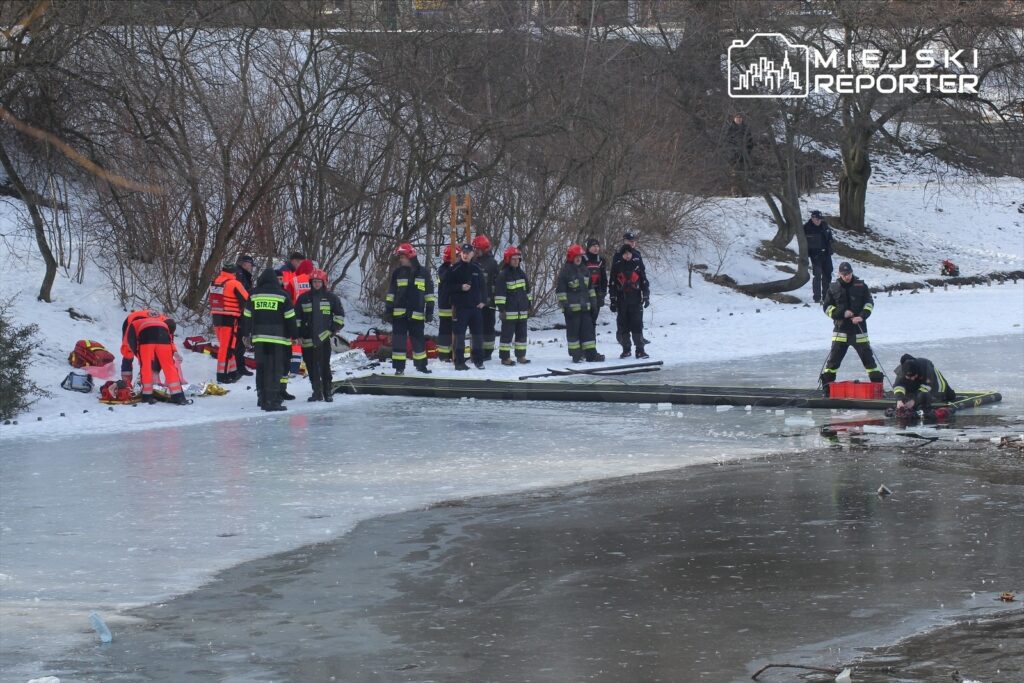
Warsaw has tragic experience that repeats in similar weather conditions. On March 27, 2013, in Moczydło Park in Wola, the ice on the pond broke under two teenagers. The report to the services came in at about 15:00. A rescue operation was conducted with firefighter-divers; the boys were pulled out from under the ice after several minutes and resuscitated on the shore, then taken to the hospital. Despite the rescuers’ efforts, both died. In accounts from that day, there was information that entering the ice might have been part of a bet – but regardless of the motivation, the outcome was the same: the fragile ice sheet turned out to be a trap.
How to Respond to Emergencies
Under current conditions – when temperatures are positive for a significant part of the day – a similar scenario could unfold in any locality. If someone falls into icy water, the body cools down very quickly, and heavy winter clothing can make it difficult to stay on the surface. Attempts at rescue “on foot”, i.e. running onto the ice, often result in another ice sheet breaking.
If you notice a person on dangerous ice or in water, you should call for help as soon as possible on 112. Water rescuers also remind about the number 601 100 100, used to coordinate WOPR rescue services. If you can help without risking your own life, you should act from the shore: provide a branch, scarf, rope, board or other long object, preferably in a lying position to distribute body weight. The safest approach is to avoid risky situations – keep children away from frozen bodies of water and choose places designated for recreation, such as supervised ice rinks.
Thaw does not “close” the season of winter dangers. On the contrary – it is a moment when thin, weakened ice is often the most unpredictable.