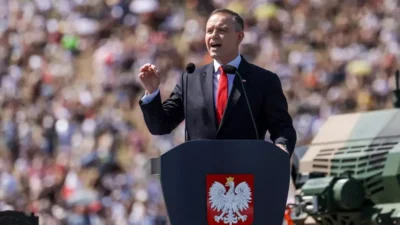
President Karol Nawrocki has vetoed another law, with a constitutional expert confirming the president faces no constitutional limit on veto powers.
Nawrocki’s Justifications and Veto Statistics
“My decisions are not aimed against anyone. They are made in the name of responsibility for the state. The president must say ‘yes’ when the law serves citizens, and say ‘no’ when it does not. I am guided exclusively by the interest of the Republic and its citizens,” President Karol Nawrocki explained in February.
The president has signed so far approximately 170 laws and vetoed 28. Less than a year into his presidency, Karol Nawrocki has already “surpassed” nearly all previous Polish presidents in terms of vetoes.
Historical Comparison of Presidential Vetoes
Lech Wałęsa, serving between 1990-1995, vetoed a total of 27 laws. Aleksander Kwaśniewski during his ten-year term – 37. Lech Kaczyński between 2010-2015 applied veto against 18 laws, and Bronisław Komorowski for the next five years – against four. Andrzej Duda between 2015-2025 used the right of veto 21 times.
Prime Minister’s Criticism
Prime Minister Donald Tusk, commenting on Karol Nawrocki’s decisions, stated that laws are vetoed for “extra-meritorious, purely political reasons,” and the goal is “to hinder the functioning of the government.”
Constitutional Analysis
“From a formal point of view, the Constitution does not limit the number of vetoes. Theoretically, a scenario would be possible in which the President vetoes all laws (with the exception of the budget law, to which veto does not apply). It would be difficult to consider the frequent use of veto itself a violation of the law – it is a competence granted directly by the Constitution. A constitutional offense would, however, be inactivity, or not taking any of the decisions provided for by law within the statutory deadline,” constitutional lawyer Dr. Kamil Stępniak conveyed to the Gazeta.pl portal.
“Massive, permanent vetoing of laws could be politically assessed as a form of obstruction, however, the mechanism of overriding the veto by the Sejm shows that the constitution-maker anticipated such a possibility and protected the system from prolonged paralysis,” added the lawyer.
“The scope of freedom is wide.” The expert reminds that veto can be rejected by the Sejm with a 3/5 majority vote in the presence of at least half of the deputies. This would therefore require, with a full house, 276 votes. Given the current distribution of seats in the Sejm, achieving such an agreement between deputies of the ruling camp and the opposition does not seem possible. In practice, therefore, the scope of the President’s freedom is wide, but balanced by the competences of the parliament and by the political responsibility of the head of state to the voters,” notes Dr. Kamil Stępniak.