


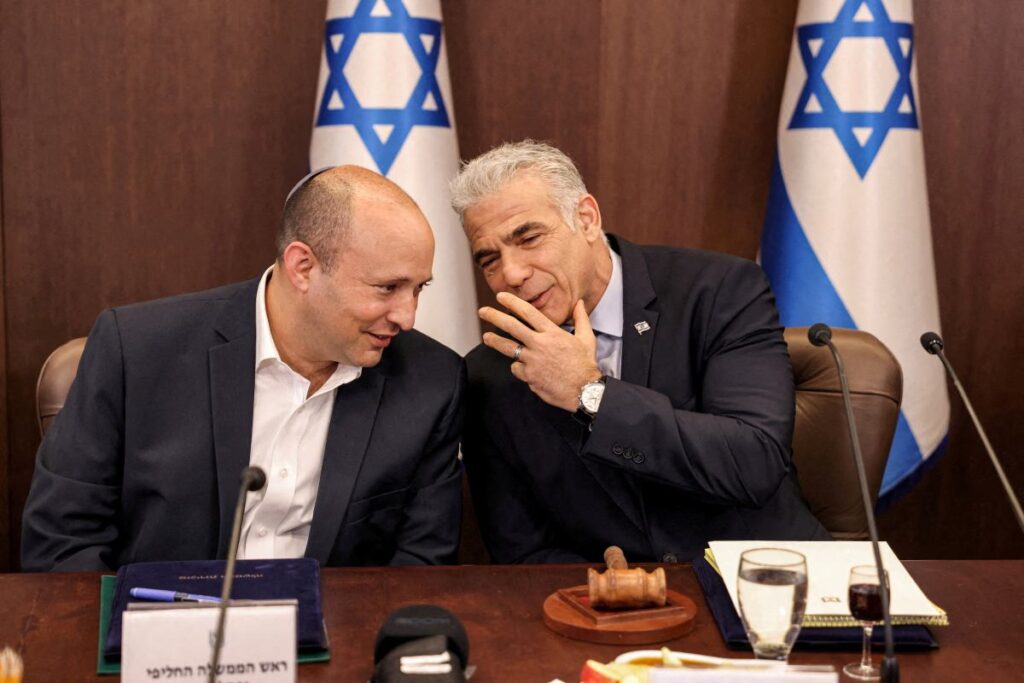
Rivals of Benjamin Netanyahu have formed a united front before October parliamentary elections, drawing parallels to recent Hungarian election results.
Opposition Forces Consolidate
Benjamin Netanyahu’s opponents announced on April 26th the consolidation of their forces ahead of the expected parliamentary elections in October. Lapid referenced the recent elections in Hungary.
“The opposition’s victory defied all polls and was larger than expected. After 16 years of rule, Orbán lost because people believed in the possibility of change. They united around one candidate, fought for their country, and won,” Lapid stated.
Key Opposition Figures: Bennett and Lapid
Naftali Bennett, a former commando and tech millionaire, currently polls second to Netanyahu. One poll from April 23rd suggests his right-wing party could win 21 seats in the 120-seat Knesset, compared to 25 for Netanyahu’s Likud.
Potential Coalition Dynamics
Netanyahu’s bloc, comprised of right-wing and religious parties, could secure approximately 50 seats. Conversely, Bennett and Lapid’s potential coalition could achieve at least 60 seats, despite Lapid’s centrist party only expected to gain seven seats with support from smaller factions.
Lapid’s Vision and Bennett’s Appeal
Yair Lapid, a former television presenter and writer, positions himself as representing Israel’s secular middle class, critical of unequal tax burdens and military service. “To win the elections, the Israeli center must stand behind Naftali Bennett. He will be an excellent prime minister – a liberal right-winger, honest and law-abiding,” Lapid asserted.
Netanyahu’s Image Challenges
Netanyahu’s ultra-Orthodox allies seek exemptions from military service for their communities, a matter gaining prominence due to army strain and rising casualties.
Lapid and Bennett criticize Netanyahu for failing to translate military successes into strategic gains against Iran and its proxies in Lebanon and Gaza – Hezbollah and Hamas.
Impact of October 7th Attacks
Netanyahu’s security image suffered following the Hamas attack on Israel on October 7, 2023, leading to war in Gaza and conflicts on multiple fronts.
Current Israeli Political Landscape
The current Israeli governing coalition consists of Benjamin Netanyahu’s right-wing Likud party, along with parties representing the ultra-Orthodox Jewish community and far-right religious-Zionist groups.
The largest opposition force is Bennett’s right-wing New Right party, alongside centrist and center-left factions, and Arab parties, which could serve as potential coalition partners.
Palestinian Situation Unlikely to Improve
A change in power is not expected to improve the situation for Palestinians. Bennett previously led the far-right Jewish Home party, opposing a Palestinian state, advocating for annexation of Palestinian lands, and supporting a complete blockade of Gaza. He stated in 2013, “I killed many Arabs in my life, I don’t have a problem with that.”
Lapid’s position on Palestinian territories is summarized as “as many Jews, on as much land, with as much security and as few Palestinians.” He also believes Israel should be expanded to the borders described in the Bible.
Gaza Conflict and Humanitarian Crisis
Medical services and police in Gaza estimate at least 800 people have been killed in Israeli attacks since October, even with the theoretical ceasefire. Hamas fighters have killed four Israeli soldiers during the same period. Analysts also believe the new authorities in Gaza, appointed under the auspices of Donald Trump’s Peace Council, have been stripped of agency and are currently in Cairo, with Israel preventing their return to Palestine.
Gaza was the target of an Israeli military offensive between 2023-2025, which the UN states led to a humanitarian catastrophe and leveled much of the enclave. At least 72,000 people are estimated to have been killed by Israeli forces during this period, in retaliation for the Hamas attack on Israel in early October 2023, which resulted in 1200 deaths.