


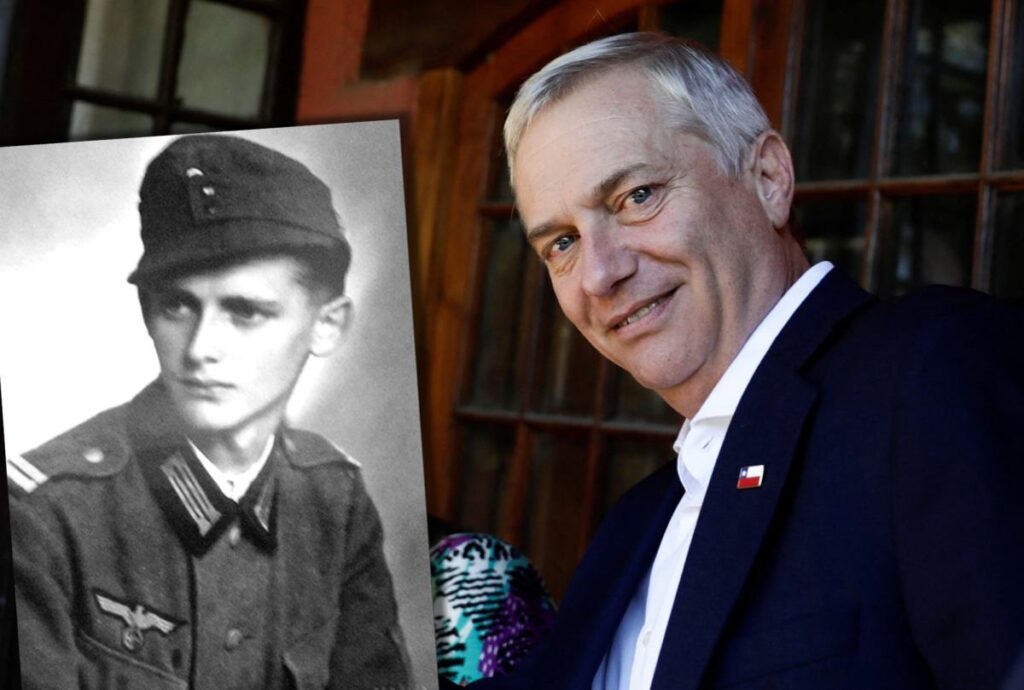
In Chile’s latest presidential election, José Antonio Kast—son of a Nazi war‑criminal who fled to South America—has been elected, marking a shift from leftist to far‑right politics.
Elected President’s Neo‑Fascist Views
German experts classify Kast’s political stance as extremist, ultra‑conservative, and even neo‑fascist. His family were active supporters of Augusto Pinochet’s military dictatorship in the 1970s and 1980s.
From the Nazi Party to Sausage Production
José Antonio Kast’s father, Jo Antonio Kast, joined the NSDAP at 17, served in the Wehrmacht, and fought in France, Italy, and Ukraine. He was captured by the Americans, adopted a Red Cross worker identity, destroyed his records, and fled to South America in 1950.
In Chile he ran a sausage‑manufacturing business, contributed to local community projects such as church building, earned recognition from the city of Buin and the local gendarmerie, and obtained a Chilean passport in 1995. Kast maintains that his father was forced into the army; however, NSDAP archives confirm Jo Antonio’s membership. His son’s victory is seen as a pivot toward far‑right politics in the country.
Rat Trails: Nazis’ Escape to South America
Chile was one of several Latin American countries that became a destination via the so‑called “rat trails” used by high‑ranking Nazis after World War II. Notably, Klaus Barbie, a former Lyon assassin, worked for the U.S. intelligence service, was protected by American officials, and eventually fled to Bolivia, where he later was extradited to France and eventually sentenced to life imprisonment in 2008.
The SS Community in Argentina
Josef Mengele escaped to Argentina with aid from Bishop Alois Hudal, lived there for a decade, moved to Brazil, and died in 1979 after drowning in the Atlantic Ocean. He never faced trial.
Adolf Eichmann also fled to Argentina, maintained contact with other SS officers, brought his family there, and was later located by the Mossad. He was tried in Jerusalem, convicted, and executed in 1962.
The Centenarian Nazi and Sadist from Sobibor
Other Nazi fugitives such as Ante Pavelic, Erich Priebke, and the late Sobibor commander who was sought for extradition by Poland also found refuge in Latin America, with some eventually extradited years later.