


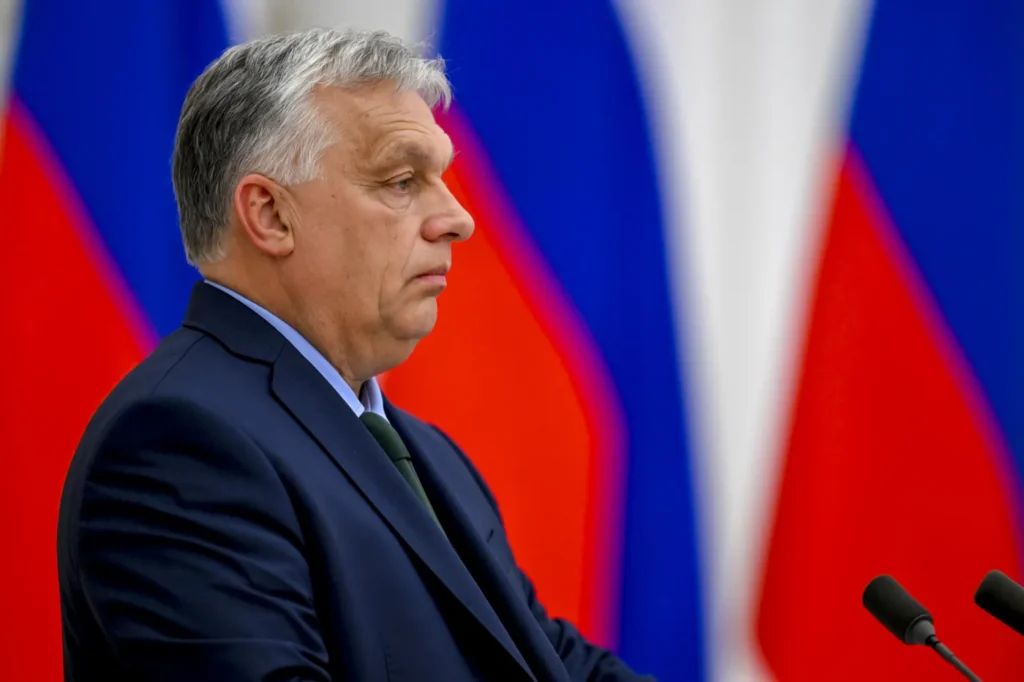
Hungarian Prime Minister Viktor Orbán will miss a key EU summit, and reports indicate his family has left for the United States following recent election losses.
Orbán’s Absence and Family’s Departure
Viktor Orbán’s decision not to attend the EU summit coincides with a significant shift following Hungary’s parliamentary election results, signaling a major political upheaval. The outgoing prime minister has scaled back public appearances and declined participation in the crucial meeting of EU leaders.
Rumors have surfaced suggesting that Orbán’s family has left the country.
Reduced Activity Following Election Results
Following the announcement of the election results, Viktor Orbán and his allies have drastically reduced their public activity. Previously regularly updated social media profiles have become largely inactive, marking a distinct change in communication style that was a cornerstone of his political strategy.
Orbán Acknowledges ‘Painful’ Election Outcome
Viktor Orbán has described the election result as “painful,” while noting that his party secured over 2.25 million votes. However, this support did not translate into retaining power, despite previously guaranteeing victory.
Silence from Szijjártó and Diplomatic Void
The lack of activity from Péter Szijjártó is particularly noticeable. The Hungarian Foreign Minister, previously a prominent figure in the government, has not made any public appearances or statements since the election results were announced.
His activity has been limited to symbolic gestures, and the absence of a statement from the Ministry of Foreign Affairs has deepened uncertainty and fueled speculation about chaos within the government structures.
Orbán Family’s Departure from Budapest
Prior to the official announcement of the election results, members of Viktor Orbán’s family reportedly left Budapest, interpreted as preparation for a potential loss and its possible political consequences.
This move raises questions about the future of individuals associated with the outgoing government in light of calls for accountability from the new parliamentary majority.
Orbán Will Not Attend EU Summit
A significant development is Orbán’s decision to forgo participation in the informal EU leaders’ summit in Cyprus, scheduled for April 23–24. This marks the first instance in years where the Hungarian prime minister will not attend a European Council meeting.
Orbán will be replaced by another leader, with Slovak Prime Minister Robert Fico, a political ally, being the most likely candidate to represent Hungary.
Symbolic Impact of Orbán’s Absence
The decision carries symbolic weight, as Orbán has been a highly active, yet controversial, figure in the European Council for years. He frequently used his veto power, blocking decisions related to sanctions against Russia and support for Ukraine.
During a recent summit, European Council President Antonio Costa sharply criticized Orbán’s actions as “blackmail” and “completely unacceptable,” highlighting the tensions between Budapest and the rest of the EU.
Péter Magyar’s Victory and Transition Timeline
Péter Magyar’s victory signifies a fundamental political change in Hungary. His party secured a constitutional majority, winning 137 mandates according to nearly complete results. The Fidesz-KDNP coalition obtained 56 seats, and the Mi Hazánk party won six. A repeat vote is necessary in one district.
Péter Magyar has begun discussions to form a new government, meeting with President Tamás Sulyok, who pledged to entrust him with the task of forming a cabinet.
Magyar stated that the President indicated the first parliamentary session could be held as early as May 4, but May 6 or 7 is more realistic, with a government swearing-in potentially occurring in mid-May, or even before May 10.
Hungary’s Relations with Russia and Election Impact
Relations between Hungary and Russia were a key issue during the campaign. Péter Szijjártó maintained frequent contact with Sergey Lavrov, and the Orbán government expanded energy cooperation with Moscow despite EU policies aimed at reducing reliance on Russian resources.
Agreements encompassed the gas, oil, and nuclear sectors, viewed by some voters as a symbol of excessive dependence on Russia.
Trump’s Silence and Weakening Alliances
Viktor Orbán’s defeat has not prompted a clear response from Donald Trump, who previously offered him political support. The lack of comment is seen as a signal of distancing from the losing ally.
This may indicate a weakening of the international connections that have bolstered Orbán’s position on the global stage.
Fidesz Reorganization
Viktor Orbán has announced a reorganization of Fidesz’s structures, including meetings in electoral districts, mobilization of activists, and preparation for continued opposition activity.
However, his political future remains uncertain. After 16 years of uninterrupted rule – the longest in Hungarian history – Orbán must rebuild his position from the ground up.