


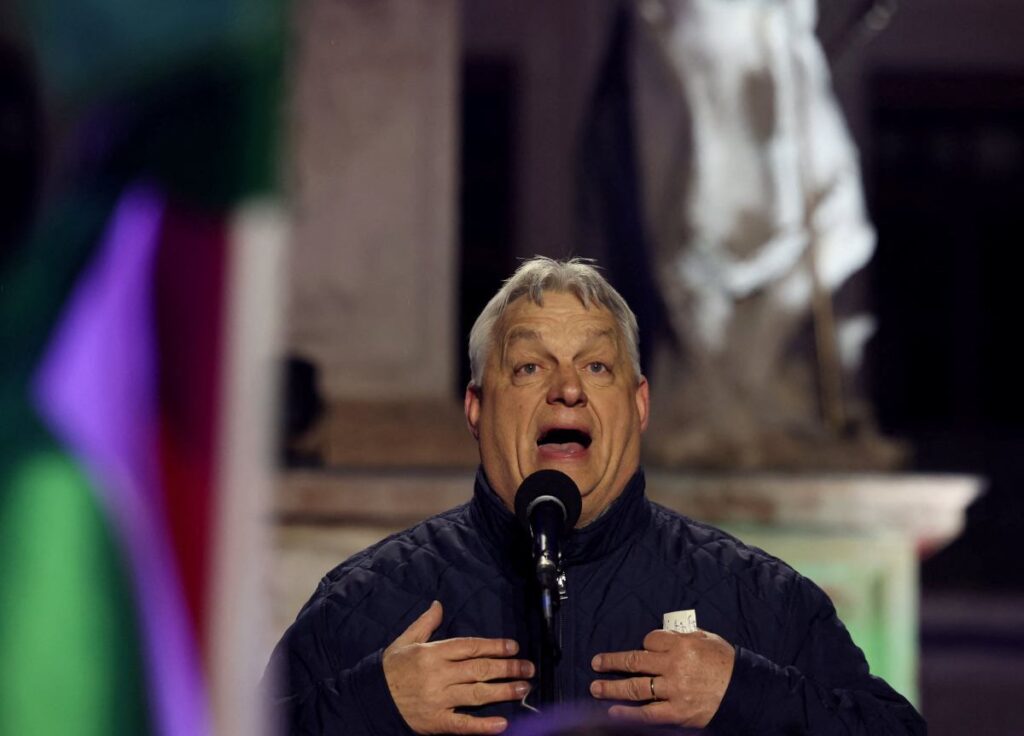
Politico reports on Viktor Orbán’s transformation from a young dissident demanding freedom from Moscow to a self-proclaimed anti-liberal and close friend of the Kremlin.
Early Opposition and Rise to Power
In 1989, a 26-year-old Orbán gained popularity demanding free elections and the withdrawal of Soviet troops during the reburial of Prime Minister Imre Nagy, a figure from the 1956 revolution against the USSR.
Zsuzsanna Szelenyi, a founding member of Fidesz and former MP, noted Orbán’s swift dominance over the party after becoming its chairman in 1990, and her subsequent departure with others when he shifted its ideology from liberal to national-conservative.
Years in Opposition and Subsequent Consolidation
After a period in power at the turn of the millennium, Orbán spent years in opposition, attempting to obstruct the socialist-liberal government. Upon regaining office in 2010, he “decided never to lose again,” rewriting the constitution and limiting democratic checks and balances, according to Politico.
Szelenyi attributes Orbán’s ideological shift to personal ambition and a “will to power.”
The Russian Model and the Paks II Deal
Politico identifies 2014 as a turning point, when Budapest signed a loan agreement with Moscow for the expansion of the Paks II nuclear power plant, signaling both pragmatic reliance and the beginning of an ideological relationship.
Six months later, Orbán presented his vision of a “non-liberal state” based on Christian values, explicitly citing Putin’s Russia as a model.
Ambition and the Pursuit of Power
Peter Molnar, a former Fidesz MP and Orbán’s classmate, believes the prime minister’s path reflects his international ambitions, aiming to make Hungary “great again” in a similar vein to Donald Trump’s slogan.
Molnar suggests that Orbán would have remained liberal if that path offered him more power.
Shifting Political Space and European Perceptions
Journalist Pál Dániel Renyi argues Orbán recognized the need to move rightward to gain political space, and was fascinated by the career of former Italian Prime Minister Silvio Berlusconi, emulating his closing phrase “Előre Magyarország” (“Forward Hungary”).
Frank Furedi suggests the EU’s undermining of national sovereignty influenced Orbán, leading him to view Brussels as a new “occupying force” replacing Russia.