


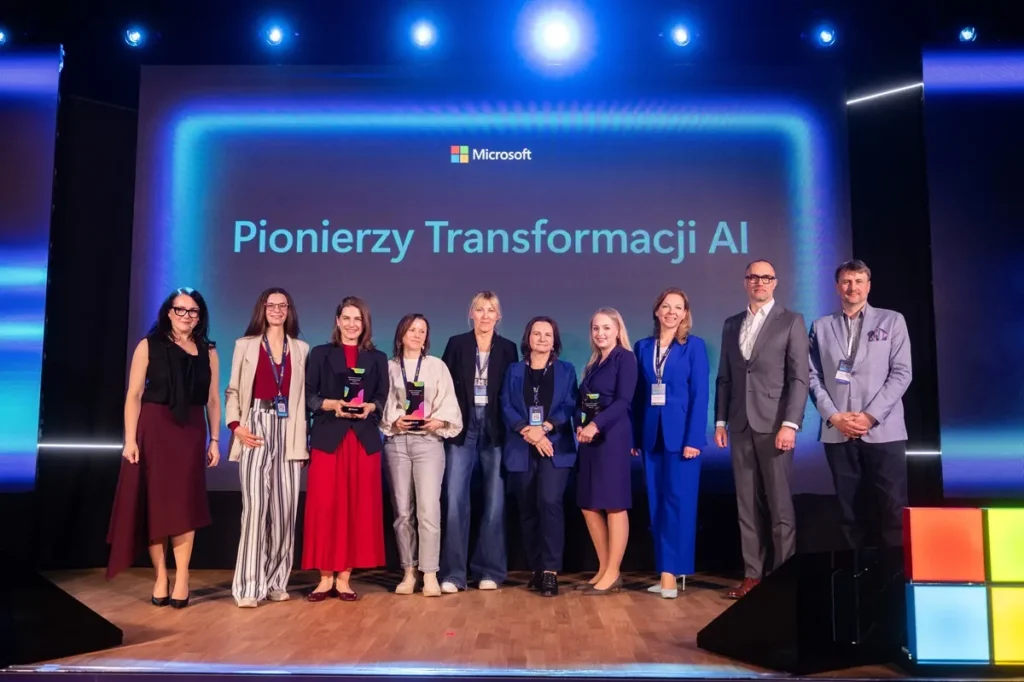
ORLEN, Bank Pekao S.A., and the Zwolnieni z Teorii Foundation received Microsoft’s “AI Transformation Pioneers” award for their contributions to AI development in Poland.
Pioneering AI Transformation Recognized
Grupa ORLEN, Bank Pekao S.A., and Fundacja Zwolnieni z Teorii have been honored by Microsoft with the “Pioneers of AI Transformation” award in three areas: “AI Future Vision,” “AI Value Power,” and “AI Competency Power.”
The awards recognize responsible, long-term transformation utilizing artificial intelligence and a real contribution to the development of AI competencies in Poland. These organizations are setting the direction by integrating AI into key business and educational processes and consistently building a lasting advantage.
Holistic Approach to AI Integration
The awardees demonstrate a holistic, pioneering approach to AI transformation, encompassing the entire organization – from strategic decisions and competency development, through a culture of innovation, to the creation of new services and products, and scaling AI where it delivers the greatest value.
This example shows that pioneering AI transformation is not a single technological implementation, but a consistent process involving strategy, people, and innovation, requiring consistency at scale, not just isolated actions.
AI as a Foundation for Long-Term Change
The awarded institutions share a common trait: they treat artificial intelligence as the foundation for long-term change. They can move from declaration to practice – effectively scaling AI solutions and building sustainable business and social value based on technology, competencies, and responsible decisions.
“AI Value Power” Award – Grupa ORLEN S.A.
The “AI Value Power” award went to Grupa ORLEN S.A. for transitioning from a strategic vision to consistent, real-world use of artificial intelligence in building a lasting business advantage. ORLEN is among the organizations that have been able to turn AI concepts into working, scalable solutions that streamline processes, increase operational efficiency, and generate measurable business value throughout the organization.
ORLEN’s AI Investment Strategy
“By investing in solutions based on artificial intelligence, we gain access to tools that increase efficiency in all areas of our operations – from production, through analytics, network management, cybersecurity, to customer service,” says Robert Soszyński, ORLEN’s Vice President of Operations.
“The AI Agent Factory being built at ORLEN will systematically create and scale intelligent agents supporting key processes, enabling automation at a level previously unavailable. Data remains a key asset, today fueling the transformation of the entire ORLEN Group and enabling the development of advanced AI models. Today, it is hard to imagine competing in the global market without the solutions we are implementing at ORLEN with Microsoft.”
“AI Future Vision” Award – Bank Pekao S.A.
The “AI Future Vision” award was given to Bank Pekao S.A. for its strategic approach to transformation in the field of artificial intelligence, which goes beyond individual implementations and encompasses the entire organization.
Bank Pekao demonstrates that AI can become a long-term engine of change, influencing how it operates, develops competencies, and strengthens competitiveness in a responsible and secure manner.
Bank Pekao’s Perspective on AI Adoption
“AI is no longer a futuristic vision – it has become a key factor determining competitive advantage. The use of artificial intelligence is not an option. It is a necessary condition for the bank to maintain the pace of market changes and remain a significant player in the coming decade,” says Marcin Zygmanowski, Vice President of Bank Pekao S.A., supervising the Technological Transformation and Innovation Department.
“In banking, innovation must go hand in hand with security, regulatory compliance, and customer trust. Those who can combine the courage to implement new technologies with proper, ‘banking’ prudence in risk management will win. At the same time, simply providing AI tools is only the first step. Equally important is their adoption throughout the organization – preparing employees to use these solutions consciously, responsibly, and in a way that guarantees data and process security. Only then does AI become a real support for efficiency and work quality, not an unused potential.”
“A bank is an institution built on trust. New technologies that streamline processes and improve the customer experience can strengthen this trust and help build it. However – like any novelty – AI must not undermine this trust.”
“AI Competency Power” Award – Fundacja Zwolnieni z Teorii
The “AI Competency Power” award was presented to Fundacja Zwolnieni z Teorii for its consistent implementation of its mission to develop future competencies and digital maturity among young people and educators throughout Poland.
The Foundation systematically supports students and teachers in the conscious, responsible, and practical use of AI, engaging over 900 schools and strengthening key skills needed in the age of artificial intelligence.
Addressing the Skills Gap in AI Education
“One of the biggest challenges in modern education is maintaining a sense of learning among young people. Thanks to research conducted as part of the “Youth Diagnosis,” we know that 70% of students aged 13-16 use artificial intelligence, the question is whether the school can keep up?” reflects Klaudia Wyszyńska, a member of the Zwolnieni z Teorii Foundation’s board.
“The pace of technological development means that without the support of a responsible partner, it is difficult to talk about effective integration of AI tools into the educational process. The “Ready for Tomorrow” project, which we are implementing with Microsoft, is an opportunity for students and the entire school community to safely enter the world of AI and be prepared for the change that is happening now.”
AI as a Strategic Business Imperative
The awarded organizations treat artificial intelligence as a foundation of their business strategy and integrate it into their daily work processes. Microsoft and IDC analyses show that companies in this group achieve up to three times the return on investment in AI than organizations that implement it more slowly, using artificial intelligence in an average of seven key business functions – from customer service and marketing to IT, product development, and cybersecurity.
Characteristics of Pioneering Firms
Pioneering firms also stand out for their approach to technology implementation: they invest in employee competency development, support innovation throughout the organization, and build strong foundations in security, data management, and regulatory compliance. This makes artificial intelligence an integral part of daily work processes, supporting people in decision-making and accelerating organizational development.
Trends in AI Adoption and Workforce Transformation
According to the Microsoft Work Trend Index 2025, 33% of business leaders in Poland already declare the use of AI agents to automate team work, and as many as 84% of them plan to implement these solutions to relieve their teams and increase work efficiency in the coming months.
At the same time, 73% of leaders in Poland indicate that this year is a key moment to rethink the basic strategies of organizations in the context of AI development. These data show that artificial intelligence is becoming an integral element of the modern work model, and organizations face the need to accelerate technological transformation.
The study also shows that companies that are the first to introduce artificial intelligence are increasingly organizing hybrid teams combining people with AI agents. This work model moves away from traditional hierarchy, focusing on flexible, agile structures focused on results. In these teams, AI agents take over repetitive tasks, freeing up employees’ time for activities requiring creativity and strategic thinking. Importantly, more than half (55%) of employees in “future firms” indicate that thanks to AI they can perform more tasks and more often engage in work that is meaningful to them.