


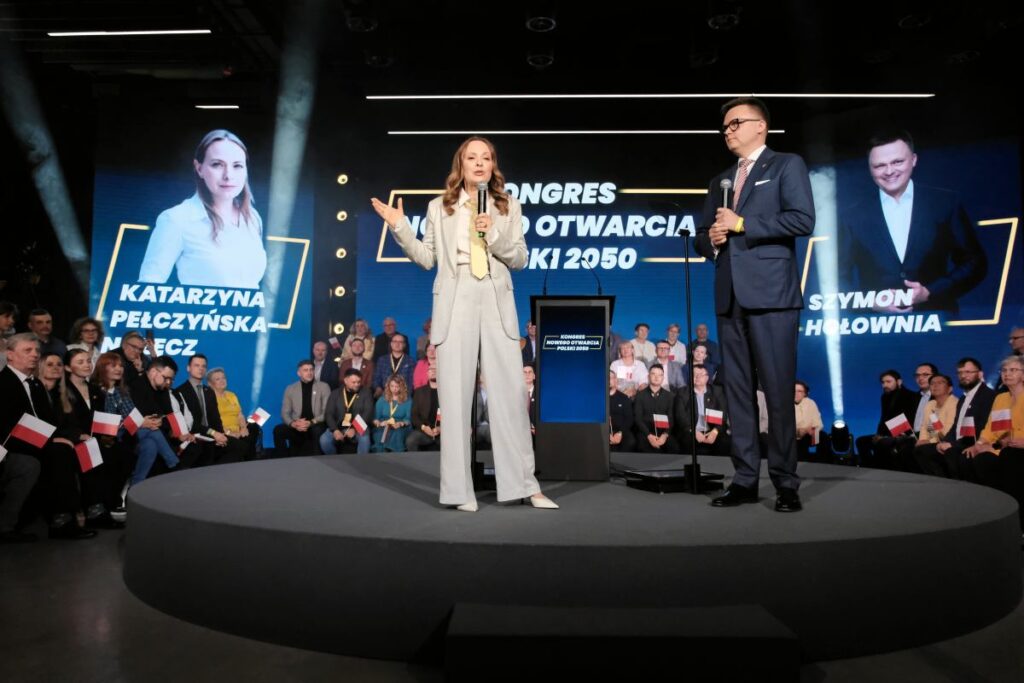
Poland 2050, led by Szymon Hołownia, announced a name change and new policy proposals during a national congress in Warsaw on Saturday.
Poland 2050 Announces Rebranding
During a national congress and convention in Warsaw on Saturday, Szymon Hołownia’s Poland 2050 announced a change in its name. Party leader Katarzyna Pełczyńska-Nałęcz has consistently stated the group aims to appeal to voters as a “distinct center.”
Key projects proposed by the party include increasing excise taxes on alcohol, regulating short-term rentals, and banning smartphones in schools, all intended to reverse negative trends in polling data.
Focus on the Middle Class and Tax Reform
Pełczyńska-Nałęcz stated at a press breakfast on Friday that her party seeks the support of “the majority that carries Poland today.” She offered voters a “very simple combo” of raising the second tax bracket, providing relief to the middle class.
Critique of Tech Giants and Tax Privileges
Pełczyńska-Nałęcz also argued for limiting tax privileges for millionaires and implementing a digital tax. She criticized large technology companies (“Big Tech”) for profiting in Poland without contributing adequately through taxes.
Willingness to Negotiate Tax Changes
She expressed readiness to discuss tax changes with all potential coalition partners, stating that a joint project would be pursued if they are open to the idea. Otherwise, her party will independently submit a bill on the matter.
Party Origins and Recent Developments
Poland 2050 is a centrist party founded by Szymon Hołownia after he secured third place in the 2020 presidential election, receiving 13.87% of the vote. In the 2023 parliamentary elections, the party ran as part of the Third Way coalition with the PSL, achieving 14.4% of the vote.
The Third Way dissolved in June 2025, and subsequent polls have analyzed Poland 2050 and the PSL separately. Recent surveys indicate both parties are below the 5% electoral threshold.
In mid-February, a split occurred within Poland 2050 when Climate and Environment Minister Paulina Hennig-Kloska announced her departure with a group of around fifteen parliamentarians to form a new parliamentary club, Centrum.