


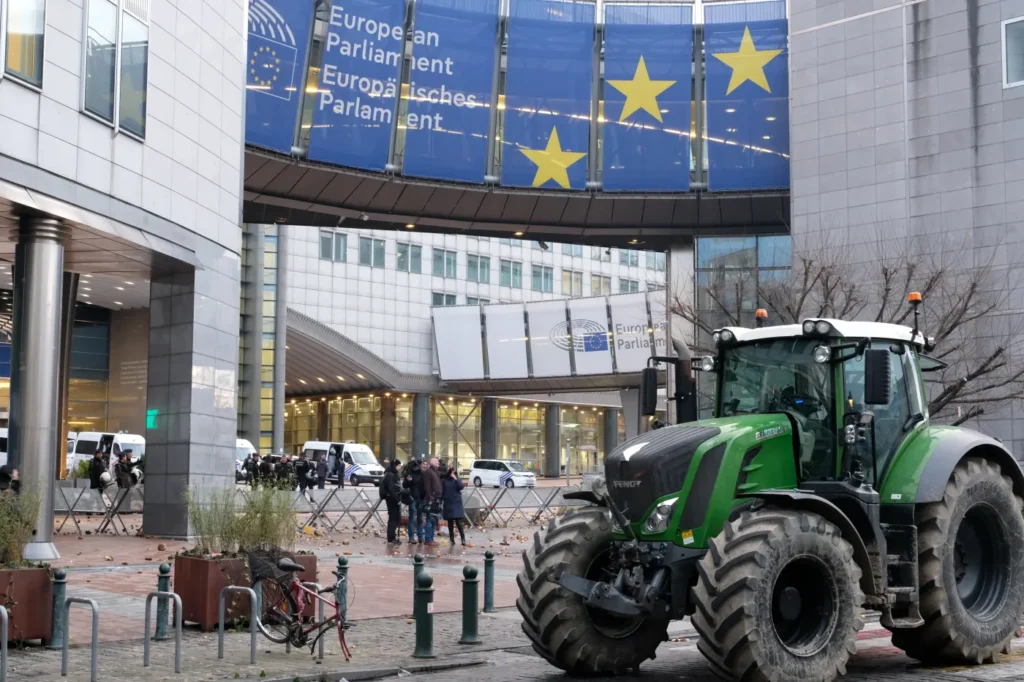
Poland is preparing a legal challenge to the EU’s trade agreement with Mercosur countries, aiming to file it with the Court of Justice of the European Union (TSUE) before May 1st.
Inter-Ministerial Cooperation and a Race Against Time
The Polish lawsuit against the TSUE regarding the Mercosur agreement is being developed in collaboration between the Ministries of Agriculture, Development and Technology, and Foreign Affairs. Minister of Agriculture Stefan Krajewski stated on Saturday in Białystok that efforts are underway to submit the complaint before May 1st.
“Today we are preparing this complaint. We, as the Ministry of Agriculture, provide substantive input, but the Ministry of Development and Technology, responsible for trade agreements, and the Ministry of Foreign Affairs, responsible for foreign policy, are also working on it. We are in contact with these ministries to prepare the best possible complaint, which will be processed. This is one of the legal tools we want to use further,” Krajewski said at a conference with regional PSL activists.
Deadline and Provisional Application
The deadline for submitting the complaint is May 26th. However, Poland is striving to file it before May 1st, when the provisional application of the agreement will begin, according to Minister Krajewski.
Protecting Against Pesticide-Laden Products
The Minister of Agriculture emphasized that regardless of whether the complaint is accepted or not, it is important to work on other solutions to protect the interests of Polish farmers, processors, and consumers.
A regulation is being developed with the Ministry of Health to prohibit the introduction of products containing residues of pesticides banned for use in the EU, Krajewski added.
Complaint’s Impact and Procedural Concerns
On Friday, the Minister of Agriculture stated in Warsaw that the complaint to the TSUE may, but does not necessarily, block the agreement with Mercosur, as the decision rests with the European Commission. Poland disagrees with the way the agreement was processed and its partial application from May 1st, and wants the TSUE to review how these decisions were made. The Polish government has opposed the EU agreement with Mercosur countries from the beginning.
Political and Formal Context
At the end of January, the European Parliament submitted a request to the TSUE to examine the agreement’s compatibility with EU treaties. In mid-March, the Sejm adopted a resolution calling on the government to file a complaint with the TSUE in the name of Poland, independently of the complaint filed by the EP. At the beginning of April, President Karol Nawrocki sent a letter to Prime Minister Donald Tusk demanding an immediate appeal to the TSUE regarding the EU-Mercosur agreement.
Agreement Details and Opposition
On January 17, 2026, representatives of the EU and Mercosur countries signed a partnership and interim trade agreement. The majority of the EU Council approved this on January 9th, with opposition from Poland, France, Ireland, Hungary, and Austria. The partnership agreement still needs to be ratified by all EU member states.
Effects of the Agreement from May 1st
From May 1st, it will be possible to import products such as beef, poultry, dairy, sugar, and ethanol into the EU at more favorable rates for South American producers. However, this reduction will only apply to specific quantities of each product defined in the agreement. In return, Mercosur countries will lower tariffs on European industrial goods, including cars.
From May, the provisions of the agreement relating only to trade will be in effect, as this is the competence of the European Commission. This means the immediate elimination of tariffs and trade barriers. Other issues, such as investment protection and public procurement, will await full ratification, requiring approval from the European Parliament and member states.
Safeguard Clause as a “Fuse”
A safeguard clause will also be in effect from May 1st, intended to address concerns from farmers who fear an excessive influx of products from Mercosur into the EU. It will be triggered if prices for a given product in the EU fall by 5% as a result of imports from Mercosur, potentially leading to increased tariffs or even import bans.