


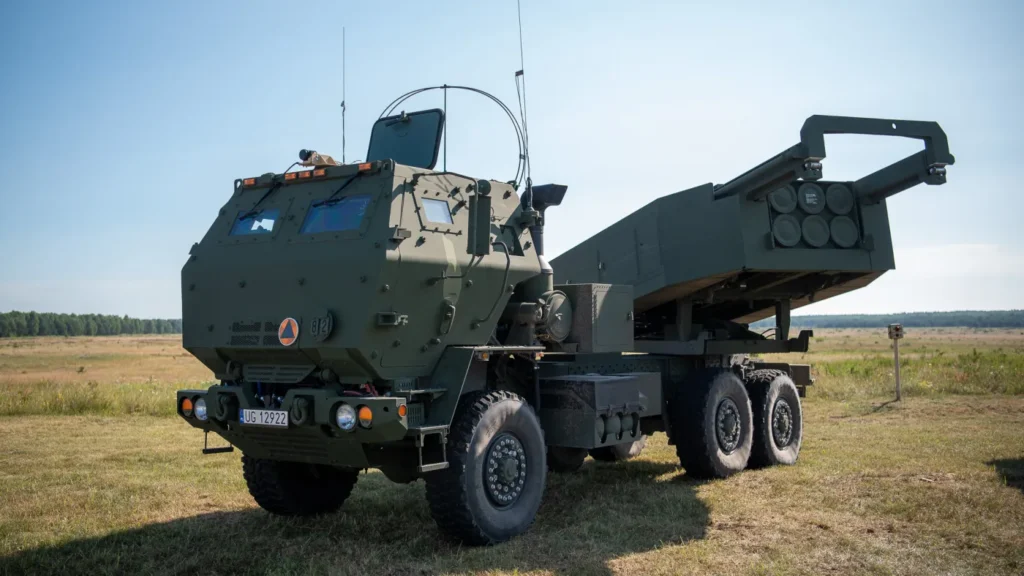
A key dispute with the U.S. over ammunition production is hindering Poland’s ability to fully utilize its newly acquired HIMARS rocket launchers.
HIMARS Program Faces Hurdles
Over two years after securing one of its largest defense contracts, Poland’s HIMARS acquisition program is encountering significant difficulties. The primary issue remains a disagreement with the U.S. regarding the establishment of rocket ammunition production within Poland—without which, the system’s full potential is limited.
In September 2023, Poland finalized a framework agreement for the purchase of nearly 500 HIMARS launchers, intended to substantially enhance its rocket artillery capabilities. The project was designed from the outset to include not only equipment procurement but also extensive industrial cooperation, including the transfer of some production to Poland.
Technology Transfer Blocked
Despite over two years of negotiations, Poland has failed to secure U.S. approval for the transfer of technology required to produce the rockets. Representatives from the Armaments Agency confirm discussions have been ongoing since 2023, but no agreement has been reached on key issues. Obtaining consent from countries co-participating in the GMLRS program—the UK, Germany, France, and Italy—adds another layer of complexity.
Dependence on Foreign Supply
The lack of a decision means Poland remains reliant on foreign ammunition supplies, a critical factor for sustained operational capability in the event of armed conflict.
Homar-A Program and Polish Industrialization
The Homar-A program, based on the HIMARS system, is a cornerstone of the modernization of the Polish Armed Forces’ rocket artillery. It aims to integrate American launchers with Polish technological solutions, including the Topaz battlefield management system developed by the domestic defense industry.
A key goal of the program is “Polonization,” increasing the involvement of Polish facilities in the production and servicing of equipment, striving for independence from foreign suppliers of critical components, especially ammunition.
Undermining Strategic Goals
The denial of GMLRS rocket production technology undermines this strategy. Without indigenous production capabilities, Poland will be unable to fully leverage the potential of the purchased launchers, particularly during intense conflict.
Lessons from Ukraine
Experiences from the war in Ukraine have significantly influenced Warsaw’s approach to ensuring the security of arms supplies. The Ukrainian army, utilizing HIMARS systems, is heavily dependent on ammunition deliveries from the U.S., which can be a serious limitation during periods of political or logistical tension.
Poland seeks to avoid a similar situation, with military officials emphasizing the importance of ensuring the ability to independently produce ammunition, especially that consumed in large quantities. General Krzysztof Król has stressed that there are no guarantees of full allied support or a short conflict duration.
Chunmoo and South Korean Cooperation
Unlike the HIMARS program, cooperation with South Korea regarding Chunmoo systems is progressing smoothly. Poland is implementing the Homar-K project, which involves the purchase of Korean launchers and the establishment of a joint venture to enable domestic ammunition production.
The model of cooperation with Seoul involves a broader transfer of technology and greater engagement of Polish industry, potentially serving as a benchmark for future negotiations with the U.S. This could result in Poland possessing two rocket artillery systems—one dependent on foreign supplies and another, more nationally controlled.
Modernization and Self-Sufficiency
The current situation highlights a broader challenge in military modernization—balancing the acquisition of advanced equipment with the development of indigenous production capabilities. For systems like HIMARS, ammunition availability is as crucial as the number of launchers.
Experts point out that the intensity of modern conflicts leads to enormous consumption of rocket ammunition, requiring consistent and reliable supplies. Without domestic production, Poland remains vulnerable to limitations imposed by the political decisions and industrial capacities of its partners.