


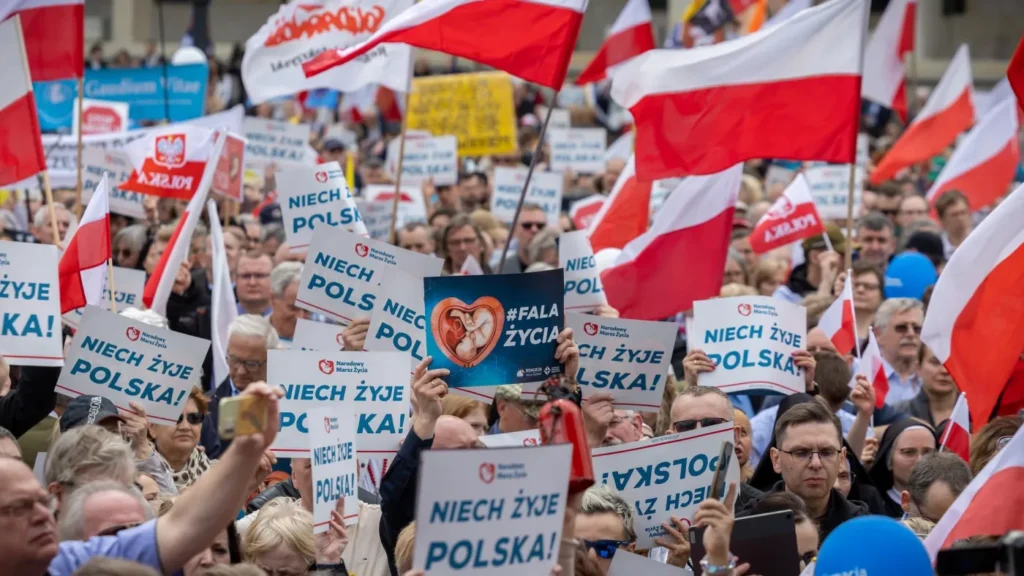
A large pro-life march in Warsaw, attended by President Nawrocki, highlights a distinct Polish model rooted in Christian values and tradition.
Civilization of Natural Law and Its Surprising Allies
For decades, dominant forces in Western civilization have attempted to neutralize the social significance of pro-life movements and their place in debate. However, the sustained engagement of so many people should prompt both the political class and opinion leaders to recognize that this represents something more than a fleeting intellectual fashion or ideology.
Pro-Life Movements as an Emblem of Christian Opinion
Today, pro-life movements largely constitute a social banner and emblem of what is known as Christian opinion. Given that this opinion does not seem likely to disappear, even in the most secularized countries in Europe, after an event like the National March for Life, it is necessary to return to the hypothesis that protecting key achievements of the civilization inherited by Christians is in the well-understood social interest—both for believers and those who approach faith with distance.
Christianity’s Enduring Influence
Although God has become a great silent figure in our culture—or perhaps more accurately, a great silenced one—Christianity continues to have an impact, evidenced by surprisingly diverse individuals. American actor Jonathan Roumie, who experienced a life transformation playing Jesus in “The Chosen,” warned against forces wanting us to believe that abortion does no harm. French writer Michel Houellebecq calls euthanasia a civilizational decline, and feminist intellectual Ayaan Hirsi Ali has converted to Christianity.
Liberalism’s Moral Debt
French philosopher Chantal Delsol argues that liberalism lives only thanks to the moral principles that preceded it and that it could not devise itself, stating that the unity of liberal society is based on a moral structure inherited from a non-liberal period.
The National March for Life as a Social Diagnosis
In this context, the National March for Life should be seen as a response to a number of phenomena weakening the cohesion of Polish society and the condition of the state, analogous to what Delsol points out. Those behind the March see it as a public reminder that Poland’s sovereignty and future depend on preserving its own, centuries-old way of understanding the world and organizing collective life.
Three Pillars of the Polish Model
Three principles underpin the specificity of the Polish model of life, developed over centuries of historical experience. The first is respect for human life—from conception to natural death. While Poles debate the extent of legal protection for the unborn, society still opposes abortion as a mere entitlement. This respect for life is a real source of Polish strength and development.
The second pillar is the family and home as the best form of human life. The constitutional definition of marriage—between a man and a woman—reflects a natural basis for human community. A strong family fosters cohesive relationships and solidarity, something no redistribution policy can fully replace.
The third pillar is understanding the role of the state—not as an instrument in the hands of powerful interest groups, but as an institution committed to protecting the common good. The dream of a just republic, accompanying Poland’s rebirth in 1918 and its liberation in 1989, stems from a Christian and classical understanding of politics.
Poland as a Reference Point
The fact that the head of “One of Us” came to Warsaw for hope is a sign that Poland has the potential not only to maintain a good life but also to influence Western societies undergoing their own awakening. Tens of thousands of young people in Europe are returning to Christianity, and Polish Christians represent an underutilized soft power.