


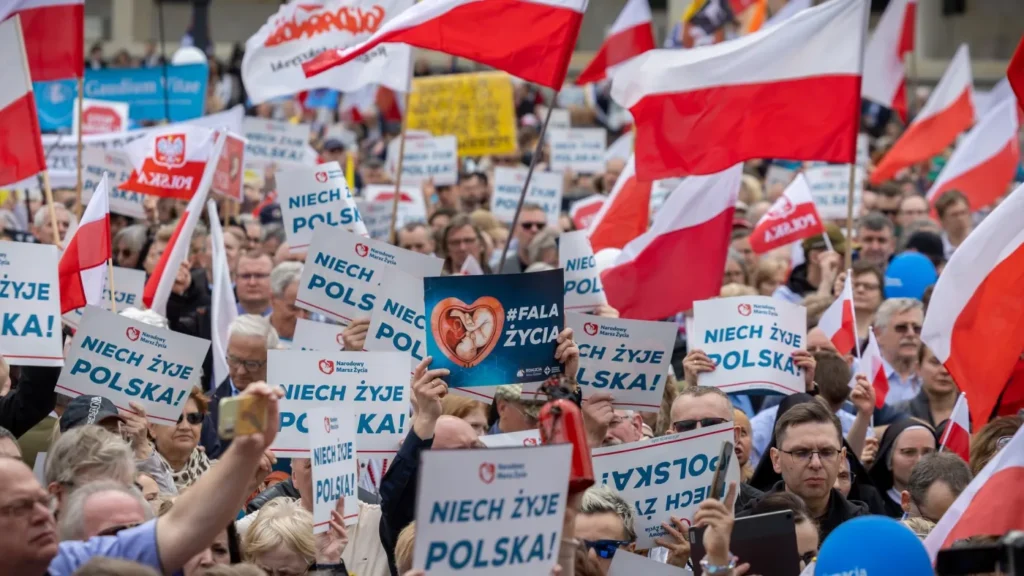
A large pro-life march in Warsaw, attended by President Nawrocki, highlights a distinct Polish model rooted in Christian values and tradition.
A Civilizational Model and Its Appeal
Poland is perceived externally as an attractive country: safe, economically developing, hospitable, and attached to community ties. The source of this appeal extends beyond post-1989 transformation and integration with the liberal West.
The National March for Life and Its Significance
The National March for Life, organized by the Saint Benedict Foundation, drew tens of thousands of participants on April 19, 2026, including President Karol Nawrocki. Former EU Commissioner Tonio Borg, head of the European pro-life federation “One of Us,” attended to express hope for Europe.
Reducing the march’s importance solely to the issue of protecting unborn life would be a serious analytical and political misjudgment.
The Civilization of Natural Law and Unexpected Allies
For decades, dominant forces in Western civilization have attempted to neutralize the social significance of pro-life movements and their place in debate. However, the sustained engagement of so many people should prompt political leaders and opinion formers to recognize this as more than a fleeting intellectual trend or ideology.
Pro-Life Movements as an Emblem of Christian Opinion
Pro-life movements largely represent a social banner and emblem of what is known as Christian opinion. Given that this opinion does not appear to be disappearing, even in the most secularized European countries, the National March for Life necessitates revisiting the hypothesis that protecting key achievements of the civilization inherited by Christians is in the social interest—both for believers and those skeptical of faith.
The Enduring Influence of Christianity
Although God has become largely silent in our culture—or rather, silenced—Christianity continues to exert influence, evidenced by diverse individuals. American actor Jonathan Roumie, transformed by playing Jesus in “The Chosen,” warned against forces seeking to convince people that abortion is harmless. French writer Michel Houellebecq surprisingly calls euthanasia a civilizational decline, while Ayaan Hirsi Ali, a feminist activist, converted to Christianity and publicly debates the issue with Richard Dawkins.
These diverse figures demonstrate the vitality of this “civilization of natural law,” more often than might be assumed.
Liberalism’s Moral Foundations
French philosopher Chantal Delsol argues that liberalism relies on moral principles that predate it and that it could not invent itself, stating that the unity of liberal society rests on a moral structure inherited from a non-liberal period.
The National March for Life as a Social Diagnosis
The National March for Life, according to its organizers, is a response to phenomena weakening Polish society and the state, analogous to the concerns raised by Delsol. Participants view it as a public reminder that Poland’s sovereignty and future depend on preserving its centuries-old worldview and collective organization.
A Call for Cultural Continuity
This is not a call for nostalgia or isolation, but a conscious assertion of cultural continuity, essential for the durability of any nation and community. This continuity in Poland has a Christian character. While Polish Christianity may seem localized amidst cultural diversity and Western liberal democracy, it provides Poles with wisdom from universal sources and remains foundational to Polish habits of the heart.
Three Pillars of the Polish Model
The Polish model of life, developed over centuries, rests on three principles. The first is respect for human life, from conception to natural death. While Poles debate the extent of legal protection for the unborn, society generally opposes abortion as a mere entitlement, rejecting its presentation as a condition of modernity and civilizational progress.
Where respect for the lives of the weakest diminishes, care for the elderly, families, and those needing community solidarity inevitably weakens. These forms of social care, deeply rooted in Polish Catholic culture, are not sentimentality but a real source of Polish strength and development.
Family and the State
The second pillar is the family and home as the best form of human life. The constitutional definition of marriage—between a man and a woman—reflects a widespread recognition of the natural basis of human community, not ideological rigidity. When the family weakens, the ability of future generations to build cohesive relationships and solidarity declines—something no redistribution policy can fully replace.
The family-centered ethos of Poles has been a significant, often underestimated driver of collective success and ambition for decades.
The Role of the State
The third pillar is understanding the role of the state: not as an instrument of powerful interest groups, but as an institution obligated to protect the common good—the weak against the strong, the poor against the rich, ordinary life against ideological agendas representing foreign political and economic interests. The dream of a just republic, accompanying Poland’s rebirth in 1918 and liberation in 1989, stems from a Christian and classical understanding of politics deeply embedded in Polish culture.
The political shift of 2015, with all its imperfections, was primarily a civic response to a lack of solidarity and governments indifferent to the exclusion of social groups from development benefits. Programs like 500+ and a dignified minimum wage arose from Polish Christian republicanism and egalitarianism.
Resisting Imposition and Preserving Sovereignty
This shift also opposed state imposition in protecting unborn life, government acquiescence to ideologies targeting family and religion, and uncritical acceptance of European immigration policies. It was not xenophobia—Poland’s hospitality towards Ukrainian war refugees in 2022 is undeniable—but a defense of the community’s right to decide who, when, and how many can become its members.
Religious Culture as a Civilizational Asset
These principles are not random beliefs but stem from the Polish model of life, which has proven practically effective. Foreign observers recognize in Poland what Poles often fail to appreciate: safety, good relations, real prosperity, and attachment to religion. This is not coincidence, but our tradition, adapted to new historical conditions and sustaining, as Delsol writes, the “unity” of modern Poland, even that embracing liberal order.
Poland as a Point of Reference
The fact that the head of “One of Us” came to Warsaw for hope is not mere courtesy, but a sign of Poland’s potential to sustain good Polish life and influence Western societies undergoing their own awakening. Tens of thousands of young Europeans are returning to Christianity, and Christians are a consistently underutilized Polish soft power. Religious revival statistics, like those in France today, are unprecedented.
A Center for Discussion
Dr. Ségolène du Closel from the Jérôme Lejeune Foundation, a central intellectual hub for the European pro-life movement, views Poland not as a periphery but as a key center for discussing the continent’s future—a place where a social formation has endured long enough to survive the waning hopes placed in a helpless liberalism facing contemporary challenges. As the West falters and the East descends into chaos, Poland has the opportunity to lead Europe not only economically but also politically, morally, and spiritually—issues that are always closely linked.
The Importance of Continuity
Therefore, the National March for Life connects issues whose relationship is often overlooked but is profound: protecting the weakest with remembering Poland’s cultural and historical continuity. This year’s edition, themed “Faith and Fidelity 966–2026,” commemorated the 1060th anniversary of Poland’s baptism on April 14, a date the current government deemed unworthy of state remembrance. Mieszko’s baptism was not merely a religious act but a civilizational one that determined what Poland is and, as is often said, what Poland would be without it. Looking to the future and considering demographic erosion, our problems do not seem so different.
A Legacy of Strength
Poland’s current successes would not be possible without the continuity of its heritage. Polish Christian and pro-Christian opinion (not necessarily confessional) is essential for our sovereignty. State, security, strong culture, and citizen well-being are not as self-evident in Poland as they might seem. We have them thanks to our inherited “moral structure.” However, we must not only look at what we had and what was, but continue to strive for what endures.