


Poland’s voluntary deposit system for beverage packaging will penalize producers who fail to meet collection targets with fees of up to 3 zł per missing kilogram in 2026.
Collection Targets and Voluntary Participation
Magdalena Markiewicz, president of PolKa–Polska Kaucja operator, considers achieving a 77% collection rate in the first year ambitious. Despite steadily growing packaging collections, there remains a significant gap to reach the statutory threshold. Similar rates were typically achieved in other countries during the second year of operation, when all producers were simultaneously obligated to join the system.
Poland has adopted a voluntary model. Beverage producers may choose not to join the deposit system, but must then pay a product fee. The Ministry of Climate has announced that starting in 2026, this fee will increase to encourage businesses to sign agreements with system operators.
Financial Penalties for Non-Compliance
The lack of mandatory participation by all companies causes both covered and non-covered packaging to coexist on store shelves, extending the process of achieving system universality and hindering rapid attainment of required collection levels. Markiewicz notes that the system’s full effectiveness will only emerge when the vast majority of producers introduce deposit packaging.
Legislators have established a financial pressure mechanism. If businesses fail to achieve the 77% collection target in 2026, they will pay 1 zł of product fee for each missing kilogram of packaging. For companies without agreements with system operators, the rate will be three times higher, amounting to 3 zł per kilogram.
The Role of the System Operator
The deposit system operator manages the entire process, from finances to logistics. PolKa–Polska Kaucia collects packaging from collection points, transports it to sorting facilities where PET bottles are separated from aluminum cans. The plastic is then sorted by color—clear material has higher market value and greater recycling potential.
The operator also serves as a financial intermediary. Producers transfer funds to cover system operation costs, including deposits for packaging introduced to the market. Operators settle with stores by reimbursing amounts paid to consumers. Unclaimed deposits fund the system budget and cover its costs. Additionally, beverage companies pay a producer fee financing the operator’s current operations. The system operates on a non-profit basis.
The Recycling Process
After compression, the raw material goes to recyclers who process it into PET flakes. These become preforms—semi-finished products that are blown into bottle shapes on filling lines. The material thus returns to circulation and re-enters the market as beverage packaging.
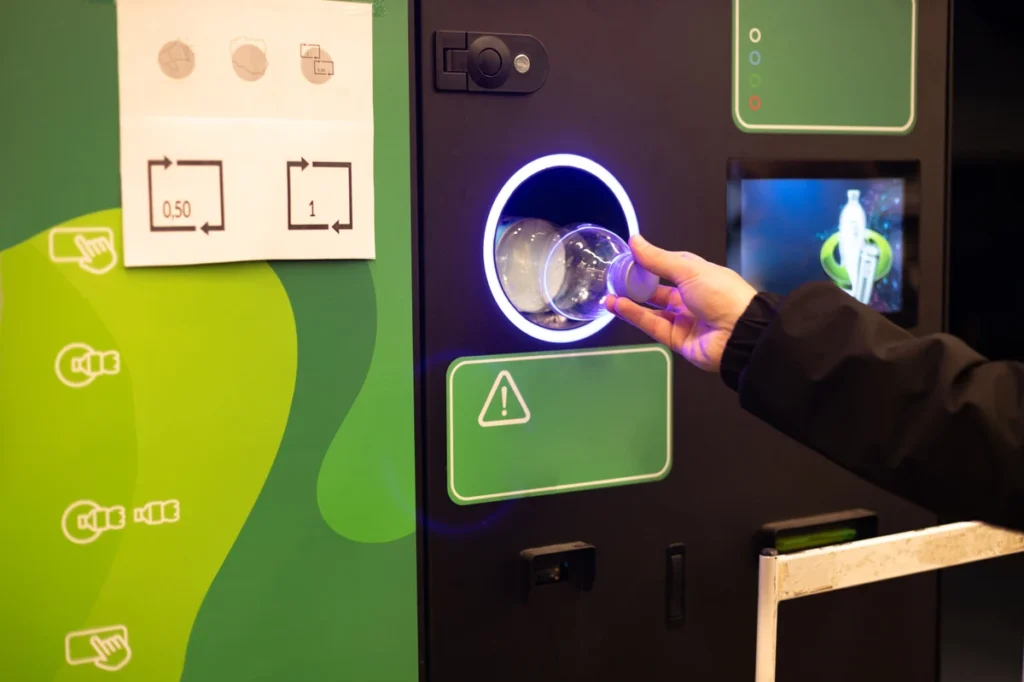
Consuments should remember not to crush bottles and cans before returning them. Reverse vending machines scan barcodes and analyze packaging shape to prevent abuse. A crushed bottle may prevent proper scanning and result in rejection of the return.
Consumer Guidelines and System Challenges
Seven deposit system operators currently operate in Poland, creating one system that necessitates close cooperation in financial settlements and data exchange. Stores sell beverages from various producers who work with different operators, requiring complex settlement mechanisms.
The industry proposes establishing an umbrella organization that would establish uniform standards for safety, transparency, reporting, and technical machine parameters. Such an entity could ensure consistency and transparency across the entire system, reducing risks of discrepancies between competing operators.
Special Provisions for Glass Bottles
The system also includes reusable glass bottles. Under amendments signed by the president in February 2026, beverage producers in returnable glass bottles—mainly breweries—may operate their own collection systems independent of the national mechanism until the end of 2028. The condition is no requirement to show a receipt when returning bottles.
This solution allows the beer industry to maintain existing packaging circulation models while adapting to new deposit requirements.