


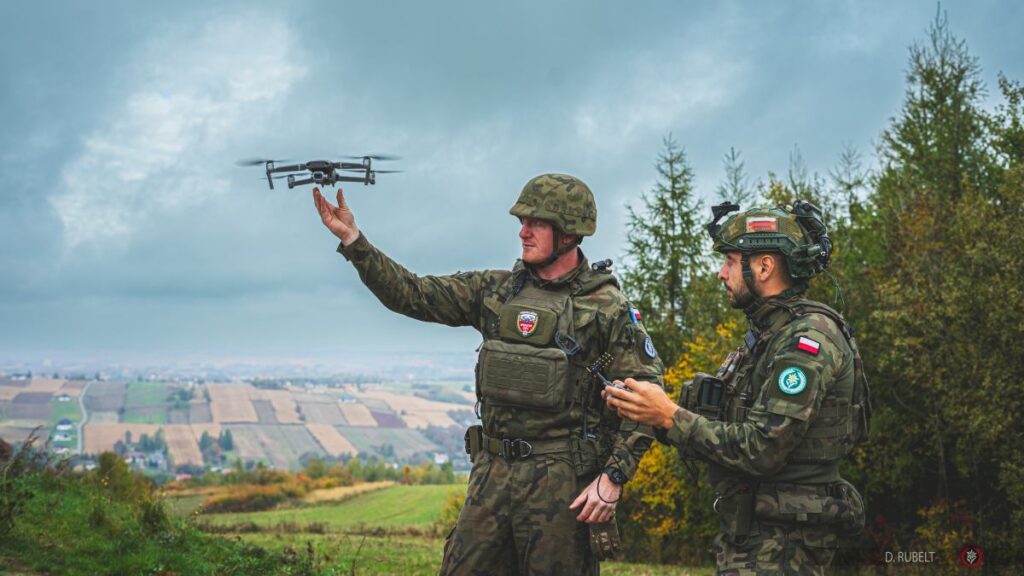
Ukrainian troops received drone‑driving lessons in Poland, but instructors relied on outdated 1990s doctrine, leaving soldiers ill‑prepared for modern battlefield conditions.
Outdated Training Materials
Polish instructors tasked with training drone operators had to improvise, providing only airspace and using their own 12‑15 DJI Mavic drones for reconnaissance. The effort was led by Ukrainian Major known as “Osiemnasty,” who enlisted a Czech veteran from Afghanistan to help organize a joint exercise.
During the drill, Czech paratroopers were to storm drone‑targeted positions. After several raids, the Czech officer suggested scrubbing the drones from the plan, claiming they were detected too quickly. Major Osiemnasty replied that warfare preparation was not yet realistic, highlighting the gap between training and field needs.
Summarizing the mismatch, Major Osiemnasty described the operation as a clash between textbook doctrine and the harsh battlefield reality.
Doctrine Stuck in the 1990s
Both Polish and Czech training programs claim adherence to NATO standards, yet they still mirror a 2013 Ukrainian army curriculum rooted in lessons from the 1990s and early 2000s, following General Waldemar Skrzypczak.
An anonymous experienced soldier notes that no significant updates have been made to procedures, making it difficult to alter entrenched lessons.
Ukrainian trainees report that these books are labeled “Grunwald era,” underscoring their obsolescence.
Drone Training Lacks Practical Adaptation
Polish and Czech programs teach concepts such as armored transport crossing water obstacles. In one theoretical scenario, four vehicles positioned at a riverbank, one crossing a bridge for reconnaissance; the drill ended in an uneasy silence, revealing unrealistic assumptions.
In a war dominated by drones, the idea of “toy” vehicles moving at 10 km/h is impractical, yet training still ignores these constraints.
Ukrainian Perspectives on Polish Training
Major Osiemnasty reported on field‑medicine training that still uses the “golden hour” model from Afghan and Iraq wars—a model that is costly‑ironic on a drone‑filled front where evacuation timing is unpredictable.
Soldier “Kastet” described clashes with Polish instructors over outdated trench assault tactics, criticizing the reliance on 20‑year‑old doctrine and highlighting the mismatch with current realities.
He noted that Polish training is valuable for staff and non‑frontline troops, offering a safer environment away from Russian attacks; however, overall training remains disconnected from frontline needs.
Seeking Improvements and Collaboration
Ukrainian fighter “Żurek” emphasized that NATO training quality depends on NATO and Ukrainian command, urging the latter to clearly define needs and explain front realities to instructors.
He stressed that situational briefings are essential for training relevance and that Ukrainian leadership should coach instructors on real‑world conditions.
In October 2023, the Jomsborg training center opened in Lipa, funded by Norway and other NATO states, involving Ukrainian instructors to adapt the curriculum to Ukraine’s war realities. Ukrainian staff continuously collect feedback and adjust modules accordingly.