


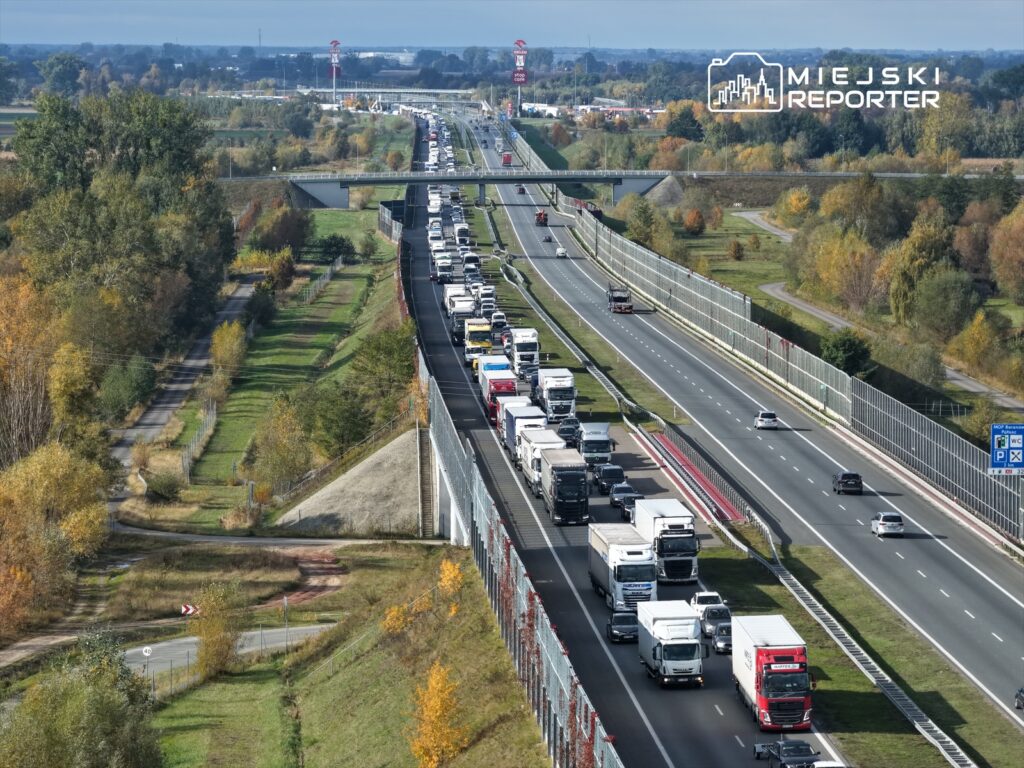
A new Polish road traffic survey reveals a 10% increase in vehicle volume nationwide, with the Warsaw metropolitan area experiencing the highest congestion levels.
National Road Traffic Growth
Road traffic on Poland’s national roads continues to rise, with the latest General Traffic Survey 2025 showing the greatest congestion on highways, expressways, and around Warsaw.
The General Directorate for National Roads and Highways (GDDKiA) reports an average annual daily traffic of 14,880 vehicles, a roughly 10% increase compared to the 2020-2021 measurement.
Survey Methodology and Scope
On April 16th, GDDKiA published the synthesis of the GPR 2025 results. This is the first comprehensive report following last year’s measurement, which covered the network of national roads managed by GDDKiA, excluding sections within county-level cities.
The surveyed network was divided into 2424 measurement sections, with basic traffic parameters calculated for 2402 sections totaling 18,249 km.
Traffic by Road Class
The highest traffic volumes remain concentrated on the highest-class roads. Average annual daily traffic on highways reached 38,518 vehicles, and on expressways, 27,083 vehicles.
Highway length increased from 1712 to 1886 km, while expressway length grew from 2567 to 3444 km. GDDKiA notes that over 60% of all transport work on the national road network is concentrated on 4518 km of routes, with highways and expressways handling nearly 90% of this work.
Regional Traffic Variations
The Silesian Voivodeship experiences the highest traffic loads nationally, exceeding 25,000 vehicles per day. The Podlaskie Voivodeship recorded the lowest, at 7,865 vehicles per day, almost half the national average.
Traffic on national roads forming part of international connections increased by 19% to 30,248 vehicles per day.
Warsaw Area Congestion
The most congested sections nationwide are located in the Warsaw metropolitan area, specifically on the S8 route from the Konotopa junction to the Marki junction, or on Aleja Piłsudskiego, with SDRR ranging from 111,895 to 195,600 vehicles per day.
Other heavily congested areas include the S2 route from the Konotopa junction to the Wał Miedzeszyński junction (107,550-161,367 vehicles), the S7 route from Aleja Jerozolimskich to the Opacz junction (116,450 vehicles), and the A2 between the Pruszków and Konotopa junctions, as well as the S8 from the Wypędy junction to the Opacz junction.
Growth Factors and Infrastructure Impact
Traffic increases in the Mazovian Voivodeship are among the largest in the country. GDDKiA indicates a significant increase in traffic on the Warsaw section of the S2 from the Konotopa junction to the Lubelska junction, ranging from approximately 30,000 to 80,000 vehicles per day depending on the segment.
Substantial growth was also recorded on the S8 between the Głębocka and Marki junctions, on the S79 from the Warszawa Lotnisko junction to the Warszawa Południe junction, and on the S7 from Aleja Jerozolimskich to the Opacz junction. GDDKiA attributes this primarily to the completion of key investments, including the Southern Warsaw Bypass on the S2 and sections of the S7 south of the capital.
Vehicle Composition
Passenger cars dominate traffic, accounting for approximately 74% of the total. The second largest group is heavy goods vehicles with trailers or semi-trailers, representing almost 14% of the total.
Bus traffic increased significantly – by 57% – which GDDKiA links to the recovery of transport after the pandemic. The number of passenger cars increased by 13%.
Nighttime Traffic Patterns
Average nighttime traffic volume was 1676 vehicles over eight hours, representing 11.3% of the average annual daily traffic. GDDKiA notes that the share of freight transport is particularly visible at night.
Light trucks and heavy trucks with or without trailers account for almost 40% of nighttime traffic, compared to 25% in the 24-hour traffic structure.
Data Collection and Future Reports
The 2025 measurement was conducted exclusively using automatic methods or video recording, often supported by artificial intelligence tools for vehicle classification and counting.
GDDKiA emphasizes that the GPR results are the basis for investment decisions, safety analyses, traffic management, and environmental assessments. The final report “Road Traffic 2025” for national roads will be published in the third quarter of 2026, with summaries for voivodeship roads appearing at the end of June. This year’s publication also marks the 100th anniversary of the first general road traffic survey in Poland.