


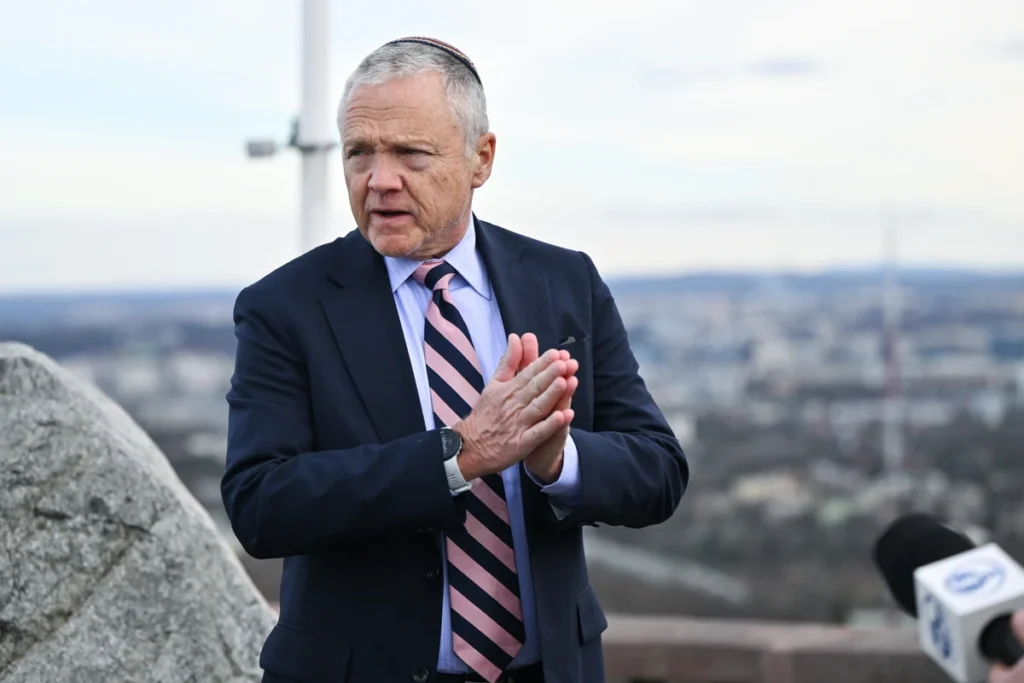
Polish survey reveals divided public opinion on US ambassador’s diplomatic spat with Polish marshal, with 67% aware of the conflict but only 19% supporting the ambassador’s stance.
Diplomatic Conflict Erupts
The conflict began after US Ambassador Tom Rose publicly announced in a social media post that he was cutting ties with Sejm Marshal Włodzimierz Czazasty. The diplomat justified his decision with “outrageous and unprovoked insults” directed at President Donald Trump. This declaration sparked immediate public reaction and opened debate about the boundaries of diplomatic responses and the influence of foreign representatives on political relations in Poland.
Public Awareness of the Conflict
A survey conducted by Wirtualna Polska on February 11-12, 2026, among 1,045 Polish adults shows that the diplomatic conflict did not go unnoticed. 67% of respondents confirmed they had heard about the US ambassador’s statement published on the X platform. This indicates the issue quickly penetrated public consciousness and became one of the most discussed political topics in recent days.
Meanwhile, 33% of those surveyed admitted they had no knowledge of this incident. This result shows that despite wide publicity, one-third of society does not follow diplomatic tensions closely or does not consider them significant in daily life.
Negative Reactions to Ambassador’s Actions
The most controversial aspect was the American diplomat’s method of action – publicly announcing the termination of contacts with one of Poland’s most important politicians. 47% of respondents negatively evaluated this decision.
In this group, 26% of respondents believed the ambassador should have exercised more restraint and not moved the conflict into the public sphere. Meanwhile, 21% evaluated Tom Rose’s actions even more harshly, stating they constitute an unacceptable interference in Poland’s internal affairs.
Positive Reactions to Ambassador’s Actions
A significantly smaller group of respondents took a favorable position toward the American diplomat. 26% of respondents believed the ambassador had the right to such a reaction, interpreting it as a defense of democratic values or a justified expression of concern by a representative of an allied state.
High Level of Uncertainty
However, it is worth noting the very high level of uncertainty. 27% of respondents could not clearly evaluate the ambassador’s actions. This shows that part of society perceives the issue as complex or lacks sufficient information to form a definitive opinion.
Whom Poles Side With
In the question about evaluating the merits of both sides, Sejm Marshal Włodzimierz Czazasty gained the advantage. 31% of respondents believed he has the right in the dispute, including 22% who gave this answer decisively.
Significantly fewer respondents sided with the US ambassador. Support for Tom Rose was declared by 19% of those surveyed. This difference indicates that Polish public opinion is more inclined to side with the domestic politician than with the foreign diplomatic representative.
At the same time, a large portion of society did not clearly side with either side. 29% of respondents could not indicate who is right in the dispute. Meanwhile, 21% of respondents believed the conflict is unnecessary and neither side is behaving properly.
Conflict Viewed as Unnecessary Escalation
Such a high percentage of undecided and critical respondents toward both sides shows that the conflict has not been clearly evaluated by public opinion. Many Poles perceive it more as an unnecessary escalation of relations rather than a justified reaction from either side.
Survey Methodology
The survey was conducted on the Ariadna National Research Panel on February 11-12, 2026. It used the CAWI method, an online questionnaire. The sample included a representative national group of 1,045 people aged 18 and over.