


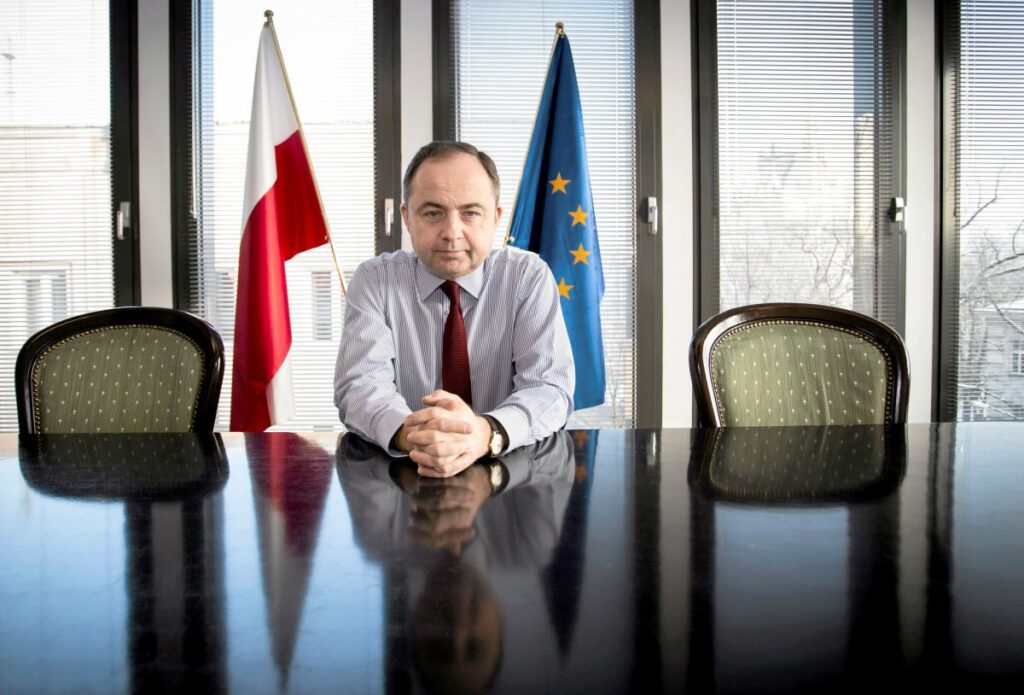
Former PiS minister warns polexit risk, comparing Poland’s EU debate to Brexit’s origins and citing “slipping beyond control.”
Poland and the Brexit Lesson
Former minister Szymański draws parallels with the UK, noting Brexit did not start with the referendum but with simplified portrayals of EU integration and growing Brussels disillusionment. He warns similar mechanisms could develop in Poland.
Focus on Funds vs. Political Vision
Szymański argues Poland’s EU debate has long been overly simplistic, emphasizing funds, subsidies, and economic benefits rather than the project’s political dimensions—security, European influence, and shared continental responsibility. This approach, he contends, becomes problematic during complex disputes on climate, migration, trade, or rule of law, fueling disappointment and euroscepticism.
Rising Euroscepticism on the Polish Right
Szymański repeatedly compares Poland’s situation to earlier UK Conservative stances, where deeper explanations of integration were avoided, allowing euroscepticism to grow until a pro-EU party became a Brexit party. He suggests similar risks exist on Poland’s right, where distrust of the EU is rising and debate language increasingly shifts towards resentment and simplification.
“Slipping Beyond Control”
“If membership in the EU slipped beyond control in a seemingly stable democracy like the UK, it will slip away even more easily in a neurotic Polish democracy. David Cameron was also a sincere supporter of UK membership in the EU,” Szymański writes.
Disputes Over Climate and Migration
Significant attention is given to EU climate and migration policies. Szymański contends some Polish objections to Brussels actions were justified, noting the EU itself later adjusted its approaches. He highlights a shift in climate policy towards economic realism, competitiveness, and energy security, and in migration towards border protection and limiting illegal migration.
Rule of Law as Anti-EU Sentiment Source
A separate section focuses on the rule of law dispute. The former minister in Szydło and Morawiecki governments identifies the conflict over judicial changes and relations with the European Commission as a major factor amplifying distrust in the EU on the political right. While complex, he argues the Polish debate reduced it to a simple narrative of sovereignty violations by EU institutions, fueling a strong anti-European narrative that spread to other EU policy areas.
Polling and Voter Sentiment
Szymański cites a December 2025 United Surveys poll showing 24.7% support for starting Poland’s exit process from the EU, with higher support among PiS voters than Confederation voters. He emphasizes growing support for polexit, particularly within parties formally supporting EU membership, suggesting the issue is no longer marginal but could become a major political axis. He believes Poland is on a path potentially leading to exit, though not at an immediate decision point.
Tusk: “Real Threat”
On March 15, Prime Minister Donald Tusk addressed polexit: “Polexit is a real threat today! Both confederations and most PiS want it. Nawrocki is their patron. Russia, American MAGA, and European right with Orban at the helm want to destroy the Union. For Poland, it would be a catastrophe. I will do everything to stop them.” Confederation MP Grzegorz Braun responded: “Despite your stubborn propaganda, about 25% of Poles openly support Polexit. There will be more. We will continue to educate Poles on what Brussels is today, who runs it, and what the EU is. Polexit will happen sooner or later. It’s a matter of time.”
Will Polexit Happen?
A January CBOS report found 82% support for Poland’s EU membership, 14% oppose it, and only 5% desire leaving as a desired change. CBOS also noted 32% want to maintain the EU status quo, while 26% favor deeper integration.