


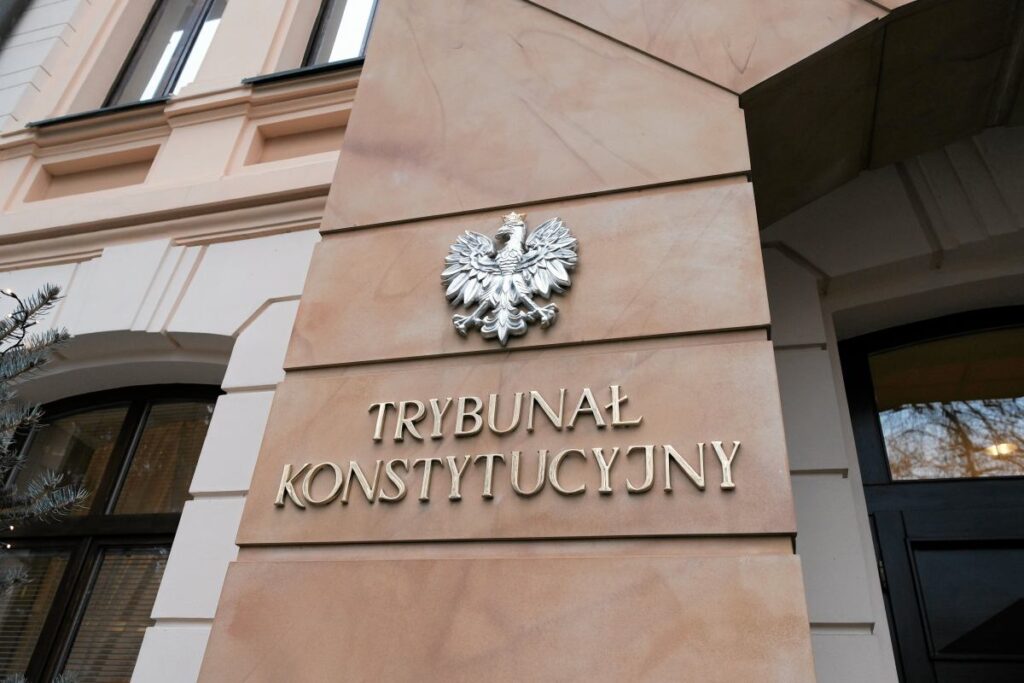
Poland’s Constitutional Tribunal will hold a hearing on May 12th regarding a complaint filed by PiS lawmakers concerning the law on the status of Constitutional Tribunal judges.
PiS Complaint and Presidential Response
The Chancellery of the President of the Republic of Poland submitted a response to the Constitutional Tribunal on Monday, confirmed by the Tribunal’s press spokesperson, Weronika Ścibor.
A one-page letter from the Head of the President’s Chancellery, Zbigniew Bogucki, was published on the Tribunal’s website. The President believes that, in the current situation, it is appropriate to refrain from presenting a position that could be interpreted as an additional element of the ongoing political dispute.
Bogucki added that the President’s intention is not to escalate tensions surrounding the proceedings before the Tribunal, but rather to enable the Tribunal to conduct its work with the greatest possible autonomy and focus on the merits of the case.
The Core of the Complaint
In March, the Constitutional Tribunal began reviewing a motion submitted in February by a group of PiS lawmakers. The lawmakers challenged provisions relating to the procedure for the election of Constitutional Tribunal judges by the Sejm.
The case is being considered by a five-member panel of the Tribunal, chaired by President Święczkowski, with Vice-President Bartłomiej Sochański as rapporteur. The panel also includes judges Jarosław Wyrembak, Rafał Wojciechowski, and Andrzej Zielonacki – all of whom were selected during the PiS government.
Challenged Provisions of the Law
One of the challenged provisions states that “a judge of the Tribunal is elected by the Sejm,” that “a judge’s term lasts 9 years,” and that “the rules for election and related procedural deadlines are determined by the Sejm’s Rules of Procedure.”
The challenge focuses on the extent to which it grants the Sejm the “competence to regulate in a resolution (…) the rules and procedures for submitting candidates and electing a judge of the Constitutional Tribunal.” It is argued that the procedure for submitting candidates should be “fully and transparently regulated by law,” not, as currently, by the Sejm’s rules of procedure.
Objections to Presidential Oath-Taking
Another challenged provision stipulates that “a person elected to the position of a Constitutional Tribunal judge takes an oath before the President of the Republic of Poland.”
The challenge concerns the extent to which it “imposes on the President of the Republic of Poland the obligation to take the oath from a person elected by the Sejm even in the event of objective doubts as to the circumstances surrounding the election, and even in the case of an election carried out on the basis of unconstitutional provisions, to ‘take’ the oath.”
The lawmakers argue that the President, as guardian of the constitution, should “refrain from taking the oath until doubts are clarified,” and, if the unconstitutionality of the provisions forming the basis of the election is established, the President should refuse to take such an oath.
The Oath Dispute and Recent Appointments
The case stems from a dispute over the appointment of six new Constitutional Tribunal judges elected by the Sejm on March 13th. In early April, two judges elected by the Sejm took the oath of office in the Presidential Palace at the invitation of President Nawrocki.
Representatives of the President’s Chancellery stated that the situation of the remaining four was being analyzed. On April 9th, during a ceremony in the Sejm’s Column Hall, those four judges took the oath with the formula that they were doing so “before the President.” The two judges who had previously sworn in before Karol Nawrocki also retook the oath.
Two of the judges, Dariusz Szostek and Magdalena Bentkowska, assumed office at the Constitutional Tribunal on the same day. Tribunal President Bogdan Święczkowski stated that the remaining four individuals – Krystian Markiewicz, Maciej Taborowski, Marcin Dziurda, and Anna Korwin-Piotrowska – had not assumed office because the events in the Sejm with their participation could not be recognized as an oath “before the President.”