


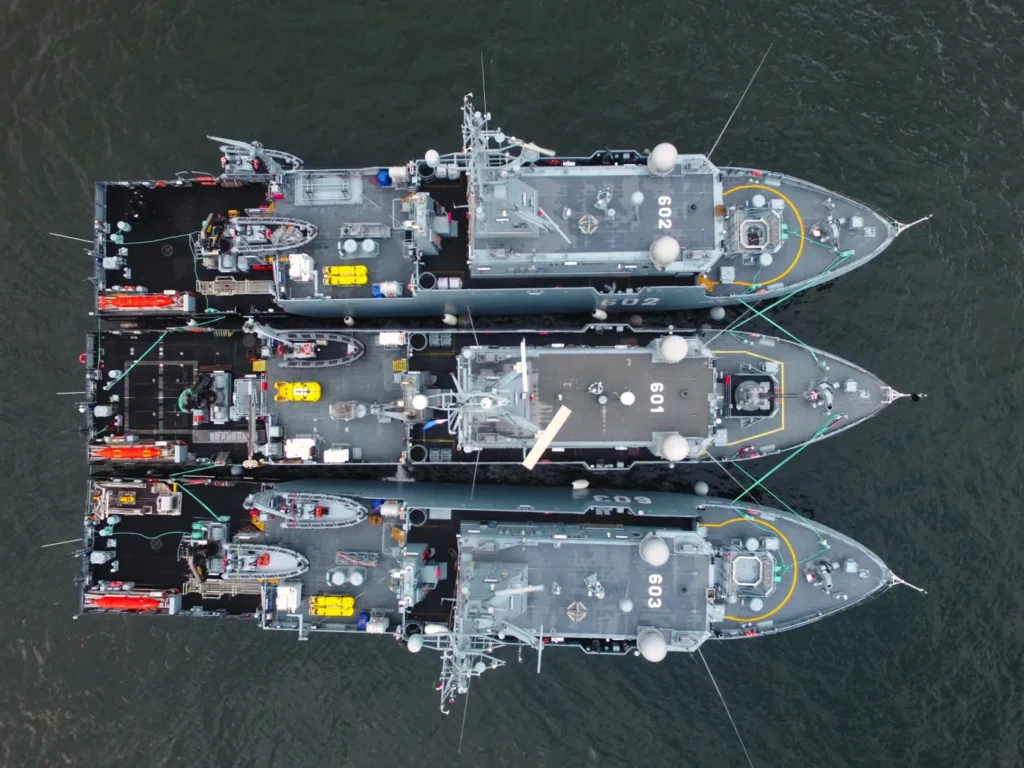
Poland may be asked to deploy its Kormoran II minehunters to the Strait of Hormuz amid escalating tensions with Iran, potentially under U.S. pressure.
Polish Minehunters and the Strait of Hormuz
The Polish Navy faces a potentially controversial decision regarding the possible deployment of its Kormoran II-class minehunters to the Strait of Hormuz, amidst rising tensions in the Middle East and escalating concerns surrounding Iran. Analyses, including those published by “Dziennik Bałtycki” and opinions from Professor Mickiewicz of the University of Gdańsk, suggest this scenario carries significant political, military, and logistical consequences.
U.S. Posture and Strategic Importance
The proposal for Polish naval support in the Persian Gulf region emerged within the context of the Trump administration’s efforts to secure key energy routes. The Strait of Hormuz handles approximately one-fifth of global oil supplies, making it a crucial strategic point worldwide.
Kormoran II Capabilities
Poland’s Kormoran II-class minehunters are considered among the most modern of their kind globally, according to Professor Mickiewicz, as cited by “Dziennik Bałtycki.” Their capabilities in detecting and neutralizing sea mines make them valuable assets in securing shipping lanes.
U.S. Pressure for Deployment
This unique capability may subject Poland to strong pressure from allies, particularly the United States, to make these units available for a broader operation.
Technical and Logistical Limitations
Despite their advanced technology, the Kormoran II-class vessels were designed for operations in the Baltic Sea. They measure 58.5 meters in length, exceed 10 meters in width, and have a displacement of approximately 830 tons. Their steel hulls minimize mine detection risk, and sonar systems and unmanned underwater vehicles enable precise countermine operations.
However, these are units with limited range. Deploying them to the Strait of Hormuz would require a lengthy voyage and extensive logistical support along the way. Experts estimate the transfer operation itself could take a month.
Historical Precedent and Crew Strain
Polish naval history demonstrates that similar challenges can be overcome, as seen with the Kobben-class submarines reaching the Mediterranean Sea. However, this came at a significant cost to crew and equipment, a situation likely to be repeated with the Kormorans.
Political Risks of Involvement
The greatest concerns revolve around the political implications. Deploying Polish units against Iran would effectively involve Poland in a conflict that does not directly concern its interests.
Professor Mickiewicz, in his analysis cited by “Dziennik Bałtycki,” argues that such involvement would yield no tangible benefits for Poland, either politically or militarily. It could even weaken the country’s international standing, particularly in relations with Middle Eastern nations.
Alternative Approaches: Regional Invitations
An alternative would be to operate at the invitation of regional states, such as Saudi Arabia, the United Arab Emirates, or Oman. This model was used in 1991 during operations against Iraq, where Polish ships operated under Saudi Arabian command, rather than directly within the war coalition.
U.S. Strategy and Geopolitical Rivalry
Escalating tensions around Iran stem from broader geopolitical interests. The United States has long been concerned about Iran’s nuclear program and its influence on regional power dynamics. Simultaneously, Iran is a key oil supplier to China, adding a global rivalry dimension to the conflict.
Analyses suggest Washington aims not only to limit Iran’s potential but also to indirectly weaken Beijing by disrupting energy supplies. Securing navigation in the Strait of Hormuz becomes a strategic priority in this context.
Lack of UN Mandate and Ad Hoc Coalitions
Experts also point to the lack of a United Nations mandate for military action in the region. This means any operations would likely be conducted as an *ad hoc* coalition, where each nation independently decides on its participation.
NATO Limitations and Transatlantic Tensions
The situation surrounding a potential operation in the Strait of Hormuz also highlights the limitations of the North Atlantic Treaty Organization. NATO, according to the Washington Treaty, is primarily a defensive alliance operating within the territory of member states.
Engagement outside this area requires broad consensus and, in practice, a UN mandate. Without it, member states act individually, weakening alliance cohesion and creating tensions between Europe and the United States.
Washington’s expectations of European allies, including Poland, may be difficult to reconcile with previous declarations of limiting NATO activity outside its area.
Possible Scenarios and Consequences
Deploying the Kormorans to the Strait of Hormuz would involve logistical and operational challenges related to transport and maintenance in a remote region, as well as political implications of aligning with a side in the conflict.
There is also a risk that the situation in the region could change before the ships arrive, especially given ongoing diplomatic talks involving Oman and Saudi Arabia.
Therefore, experts suggest limiting Poland’s involvement to protective actions, carried out only at the invitation of regional states and outside the direct structure of war operations.