


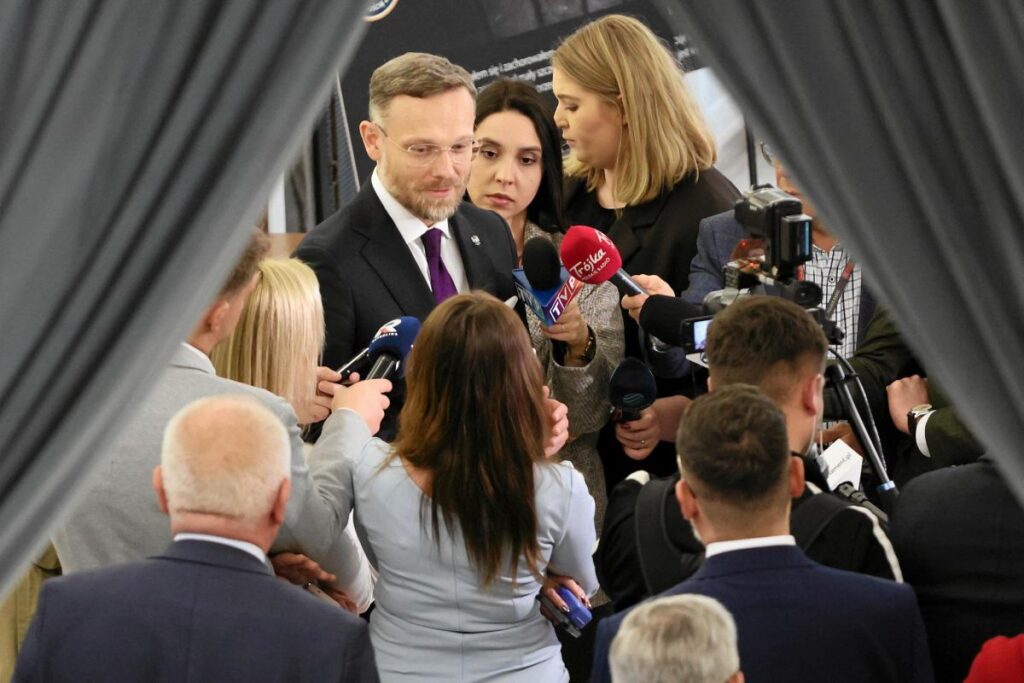
Poland’s Sejm and Senate swiftly passed a fuel package aimed at lowering prices, with Prime Minister Tusk warning of potential escalation in the Middle East.
Parliament Approves Fuel Package, Tusk Warns of Escalation
The Sejm began the day by working on the government’s “CPN” package, or “Lower Fuel Prices,” focusing on reducing fuel excise duties and controlling gasoline and diesel prices at stations. Before noon, lawmakers approved a law concerning oil reserves and responses to fuel market disruptions, with 428 votes in favor and 12 against.
Shortly after, the Sejm unanimously adopted an amendment to the excise tax law, receiving 436 votes in favor. Prime Minister Donald Tusk stated the government acted quickly due to the pessimistic international situation, citing information from allies suggesting instability in the Middle East and a potential for escalation in the coming days and weeks.
Government Package Details and Objectives
The government package includes reducing VAT on fuels from 23% to 8%, lowering excise duties to the minimum permitted by EU regulations, and introducing maximum fuel prices at stations. During the parliamentary debate, coalition representatives emphasized the package as a swift and crisis-driven protective measure.
Energy Minister Miłosz Motyka assured that Poland’s energy security remains intact and fuel reserves are adequate despite geopolitical tensions, adding the project aims for a real reduction in prices at the pump. The government stressed the temporary nature of the regulations, responding to the extraordinary situation caused by the war in the Middle East, with validity until June 30th.
Tusk also announced that if high prices generate excess profits for oil companies, the government is prepared to implement additional measures, including a tax on windfall profits.
Senate Unanimously Approves Package
The Senate subsequently approved both bills without amendments and unanimously. The first vote saw 73 senators participate, and the second 75, with all voting in favor. This sends the package to the President’s desk.
Senate Speaker Małgorzata Kidawa-Błońska stated that the government, Sejm, and Senate acted responsibly, expressing hope that the President would sign the legislation before departing for the United States. She also noted that acting too hastily in such an unstable situation is unwise, responding to opposition criticism of the government’s timing.
PiS Supports Price Cuts, Criticizes Government’s Delay
Law and Justice (PiS) announced support for measures lowering fuel prices while sharply criticizing the government for the delay in action. Jarosław Kaczyński acknowledged the price reduction as a positive step but cautioned that some decisions were left to ministers’ discretion instead of being directly in the law.
PiS politicians argued their own proposals were presented earlier, and the government only adopted opposition solutions after weeks of inaction. PiS senators strongly criticized Speaker of the Sejm Włodzimierz Czarzasty for blocking a project submitted by Przemysław Czarnak, which was sent for consultation and will not conclude until April 9th.
PiS Accusations and Coalition Responses
PiS spokesman Rafał Bochenek accused the Donald Tusk cabinet of causing billions of złoty in additional costs for Poles at gas stations due to the delay. Zbigniew Kuźmiuk pointed out the impact of rising fuel prices on farmers, affecting diesel and fertilizer costs. Coalition lawmakers countered that the fuel crisis stems from international tensions, not the Polish government’s actions, and that the priority is to quickly introduce protection for drivers.
President Nawrocki’s Decision on Fuel Law
A key question was whether President Karol Nawrocki would sign the law before departing for the US. Marcin Przydacz assured that there were no formal obstacles, as the President could make a decision even on the plane or abroad, possessing an electronic signature.
However, Przydacz cautioned that the final decision would depend on the law’s final form, stating that the President supports lowering energy prices if the legislation solely concerns energy. He also suggested the government might attempt to add other solutions to the law.
Pressure for Swift Presidential Approval
The Polish People’s Party (PSL) urged the President to promptly approve the legislation, with Energy Minister Miłosz Motyka calling it “the strongest protective shield among all European countries” and hoping for swift enactment. The President is en route to the US, holding the final decision.
Tusk: No Quick Improvement Expected
Prime Minister Tusk also cautioned that even with government intervention, a quick stabilization of the fuel market should not be expected. He stated that information from allies indicates a potential for further escalation in the Middle East, risking continued pressure on oil and fuel prices.
Analyst Forecasts and Market Tensions
Analysts at Reflex predicted that if the government package is quickly implemented, the average price of Pb95 could fall to 5.98 zł per liter, Pb98 to 6.67 zł, and diesel to 7.56 zł. However, they cautioned that drivers may not see real effects before March 31st, and the global market remains highly tense.
Sejm Fails to Override Nawrocki’s Veto on KPK
Concurrently, the Sejm attempted to override President Nawrocki’s veto on the amendment to the Code of Criminal Procedure, but failed to achieve the required 3/5 majority. 244 voted to uphold the law, 180 against, and 16 abstained, falling short of the 264 votes needed.
This resulted in the President’s veto being maintained, sparking a political exchange between the ruling coalition and PiS. Tusk criticized PiS and the President for clinging to “bad solutions,” while the head of the KPRP, Zbigniew Bogucki, claimed Tusk suffered another political defeat.