


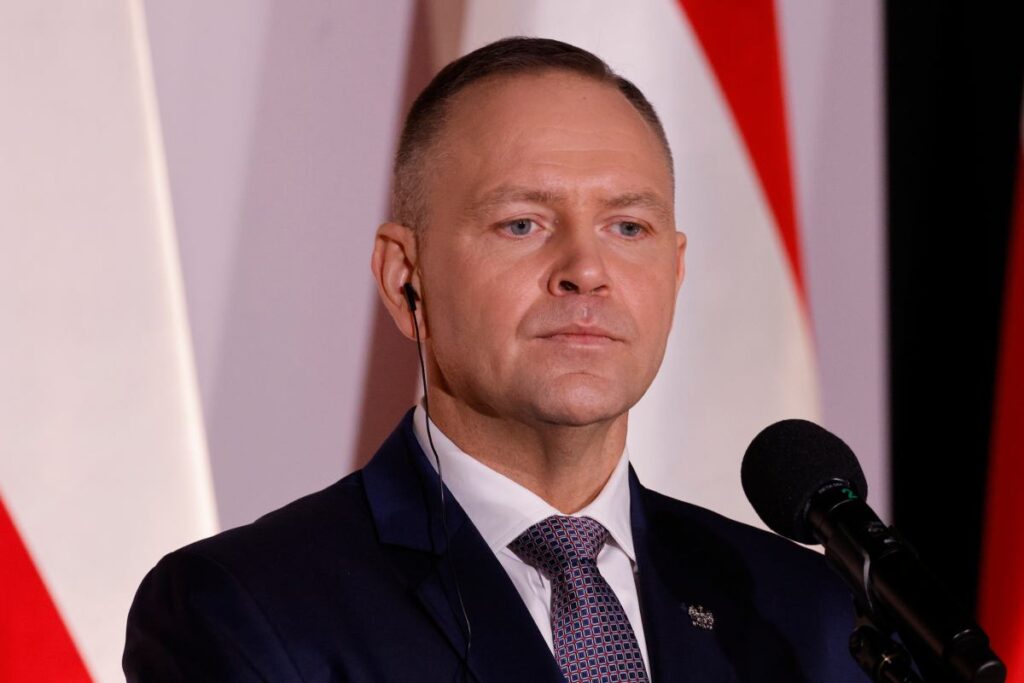
During commemorations in Warsaw on April 13th, Polish President Karol Nawrocki stated Katyn symbolizes the murder of 22,000 Poles and decades of Soviet lies.
Katyn as a Symbol of Crime
April 13th is observed in Poland as the Day of Remembrance for the Victims of the Katyn Massacre. President Karol Nawrocki, speaking at the Katyn Museum in Warsaw, stated that Katyn has become a symbol of the “terrible crime against 22,000 Poles who faithfully served the Republic.”
He emphasized that the crime was “formalized, planned” and aimed at the Polish nation to “permanently erase Poland from the map of memory.” The president added that Katyn represented an attempt to break the chain of generations of Poles.
Nawrocki noted the victims were representatives of Polish intellectual and state elites, those “on whose foundation we could build a free, independent, and sovereign Poland.” He began his speech by quoting Zbigniew Herbert, speaking of the “powerful voice of silenced choirs” echoing from objects recovered from the crime scene: buttons, prayer books, and personal mementos.
Katyn: Foundation of Communist Lies
The President strongly emphasized the second dimension of Katyn – the decades-long lie surrounding the massacre. For decades in the Polish People’s Republic, a false narrative blaming the Germans prevailed, with the truth subject to censorship.
Nawrocki stated, “Katyn is also a symbol of lies, Soviet propaganda.” He quoted Father Zdzisław Peszkowski, a survivor of the Katyn massacre, who said Katyn must be explained because it was a terrible lie. He added it was “a lie that became the foundation of communist Poland, a colonial Poland after 1945.”
The Cost of Post-War Europe
The President also spoke about the experience of Central and Eastern Europe after World War II. He assessed that countries like Poland, Lithuania, Estonia, Romania, and the former Yugoslavia paid the price for the possibility of Western Europe’s development after 1945.
“We paid because we had to live in lies, in enslavement,” he stressed. He added that the post-war order came at a cost borne by nations within the Soviet sphere of influence.
Russia and the Contemporary Threat
In the presence of ambassadors and foreign representatives, Nawrocki also addressed contemporary issues. He spoke of the “Soviet soul of our eastern neighbors” and asserted that Central and Eastern European states are well aware of Russia’s mechanisms of operation, having experienced them before 1939, in Katyn and after the war.
“The Russian Federation is a threat to the free world, and Vladimir Putin is repeating the activities of the Soviet Union on our land,” the President said. He underscored that understanding the modern world of democratic values requires the perspective of states in this part of Europe.
Commemorations and Remembrance
The Day of Remembrance for the Victims of the Katyn Massacre was established by the Sejm in 2007. It commemorates nearly 22,000 officers of the Polish Army, police officers, officials, foresters, clergy, and representatives of the intelligentsia murdered by the NKVD on the orders of the Soviet authorities on March 5, 1940. The Soviet authorities admitted responsibility for the crime only on April 13, 1990.
In the evening, commemorations moved to the Presidential Palace in Warsaw, where an illumination with the word “Katyn” and lines from Zbigniew Herbert’s poem, “Katyn is a powerful voice of silenced choirs,” was displayed.
Archbishop Galbas: Memory Obliges Peacebuilding
On Monday in Warsaw, funeral ceremonies for the remains of Victims of the Katyn Massacre were held at the Church of St. Charles Borromeo on Stare Powązki. Warsaw Metropolitan Archbishop Adrian Galbas stated that remembering the victims is necessary for the living, as it helps understand one’s own identity and build the future.
“Memory adds nothing to the deceased, but it is essential for us, the living. Without memory, a person does not know who they are or where they are going,” the cleric said. Referring to contemporary conflicts, including the war in Ukraine, he also called for prayer for peace and emphasized that “peace begins in the heart of man.”