


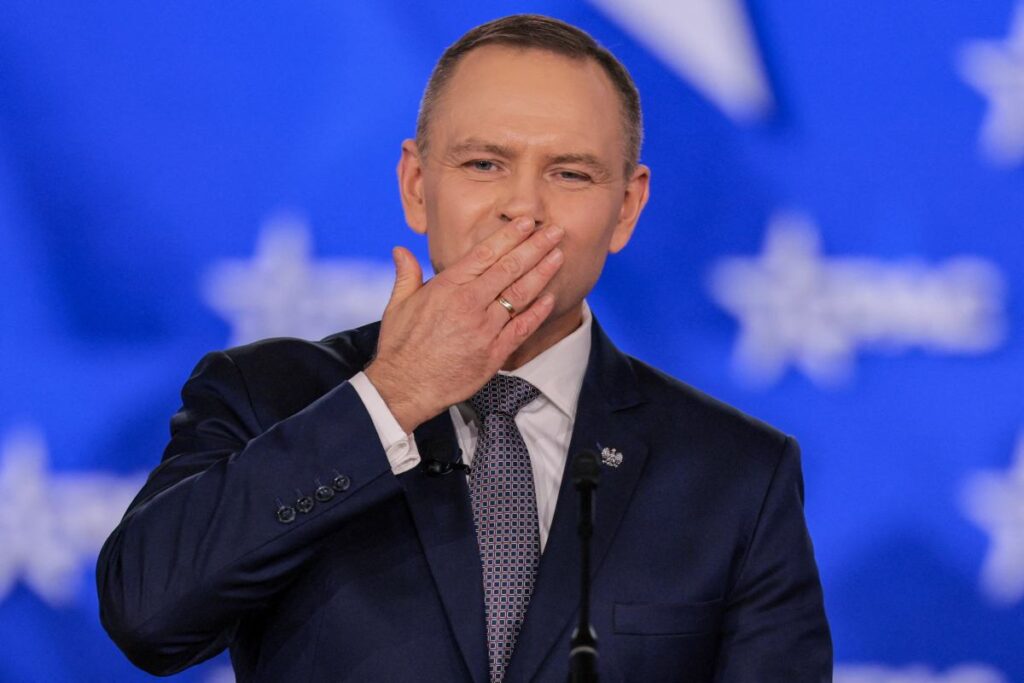
Polish President Karol Nawrocki has sworn in only two of six judges selected by Parliament for the Constitutional Tribunal, sparking a constitutional debate.
Constitutional Tribunal Crisis and Presidential Rationale
Judges Magdalena Bentkowska and Dariusz Szostek of the Constitutional Tribunal took their oaths of office before President Karol Nawrocki on Wednesday. The remaining four judges, chosen by the Sejm in March, await an invitation to the Presidential Palace, with no confirmed date for their oath-taking.
Zbigniew Bogucki, Head of the Presidential Chancellery, explained that the President accepted the oaths from two individuals due to chronological order, noting the President’s inauguration on August 6th and the subsequent vacancies within the Tribunal.
Bogucki also stated that the first vacancies in the Tribunal arose in December 2024, attributing the previous governing coalition’s delay to an attempt to dismantle the Tribunal and obstruct its operations.
Tribunal Composition and Legal Requirements
Bogucki emphasized that the Constitutional Tribunal currently has only nine judges, falling short of the constitutional requirement of fifteen. He also pointed out that a full Tribunal requires a minimum of eleven judges according to current legislation.
Constitutionalist: President Acting Beyond Authority
Marcin Kozłowski of Gazeta.pl questioned President Nawrocki’s decision to administer oaths to only two of the six selected judges.
Constitutional law expert Dr. Kamil Stępniak criticized the President’s actions, comparing him to a team captain arbitrarily selecting players. He asserted that the President has no discretionary power regarding the appointment of Constitutional Tribunal judges.
Stępniak maintained that the President’s role is purely ceremonial, limited to accepting the judges’ oaths, and lacks any constitutional or statutory authority to evaluate or select judges appointed by the Sejm.
Constitutional Silence on Presidential Role
Stępniak argued that the Constitution is silent on the President’s role in the appointment process of Constitutional Tribunal judges, dismissing the President’s justification as invalid.
Past Delays and Political Motivations
The previous governing coalition delayed the selection of judges, with the first vacancy appearing in December 2024. The current assessment views this delay negatively, acknowledging that the United Right also experienced similar shortcomings, albeit to a lesser extent.
The Constitutional Tribunal is perceived as a sensitive issue for lawmakers, as it possesses significant power, making it unpopular among those in power.
President’s Position and Legal Limits
Stępniak likened the President’s position to that of a theatergoer who may dislike a performance but has no influence over its direction.
He suggested the President believes his mandate grants him quasi-royal authority, attempting to exceed the boundaries of his constitutional prerogatives. However, the Constitution explicitly defines the President’s powers and does not include matters related to the oath-taking of Constitutional Tribunal judges.
Even if the President were granted some authority in this matter, a formal refusal to administer the oath would require the Prime Minister’s countersignature.
Future Tribunal Functioning and Potential Obstacles
Judges Dariusz Szostek and Magdalena Bentkowska are expected to begin work at the Constitutional Tribunal after the holidays, potentially restoring normal functionality and the publication of Tribunal rulings.
Concerns remain regarding rulings from international tribunals concerning “duplicate judges,” and whether these rulings apply to the newly appointed judges considered politically motivated. The current government has adopted a theory of “infection” of the entire Tribunal, rendering it incapable of ruling.
Challenges and Alternative Oath-Taking
The governing coalition faces a difficult situation, needing to decide whether to continue considering the Tribunal “infected” or to recognize rulings issued with the participation of the two newly appointed judges.
The situation is complicated by the remaining four judges awaiting their oath-taking. It is anticipated that if not invited to the Presidential Palace, these judges will seek to take their oaths before the National Assembly or a notary public.
Even if the four judges take their oaths before a notary or the National Assembly, the current President of the Tribunal, Bogdan Święczkowski, could still block their work.
Legal and Political Perspectives
The fate of these judges will depend on the political message conveyed, potentially involving rhetoric about the unlawful seizure of the Tribunal and the spread of lawlessness.
The effectiveness of an oath taken by a Constitutional Tribunal judge is debatable, with some arguing for solutions based on private law principles. Differing opinions exist on whether such an oath aligns with the Constitution.
Even an oath taken in the presence of the Pope, followed by documentation sent to the President, may be disregarded by some politicians.
Long-Term Prospects and Political Influence
Poland has reached a point where politics regulates law, rather than the other way around. The newly appointed judges may be considered “non-judges” if there is a change in government in 2027.
A potential right-wing government could use this as justification to continue not publishing Tribunal rulings and undermine its activities, particularly those of the new judges. The Sejm could potentially declare them ineligible and appoint new judges, leading to further “duplicate” appointments.
Potential Solutions and Political Impasse
A resolution could be achieved through a meeting between Donald Tusk and Jarosław Kaczyński, reaching an agreement to reform the Tribunal. However, such cooperation is unlikely.
Marginalization of the Tribunal is expected to continue, with some politicians seeking to use it selectively, only when it suits their needs.
The current situation lacks a clear solution, with potential options including transferring the Tribunal’s tasks to the Supreme Court or a constitutional reset, neither of which are currently feasible.