


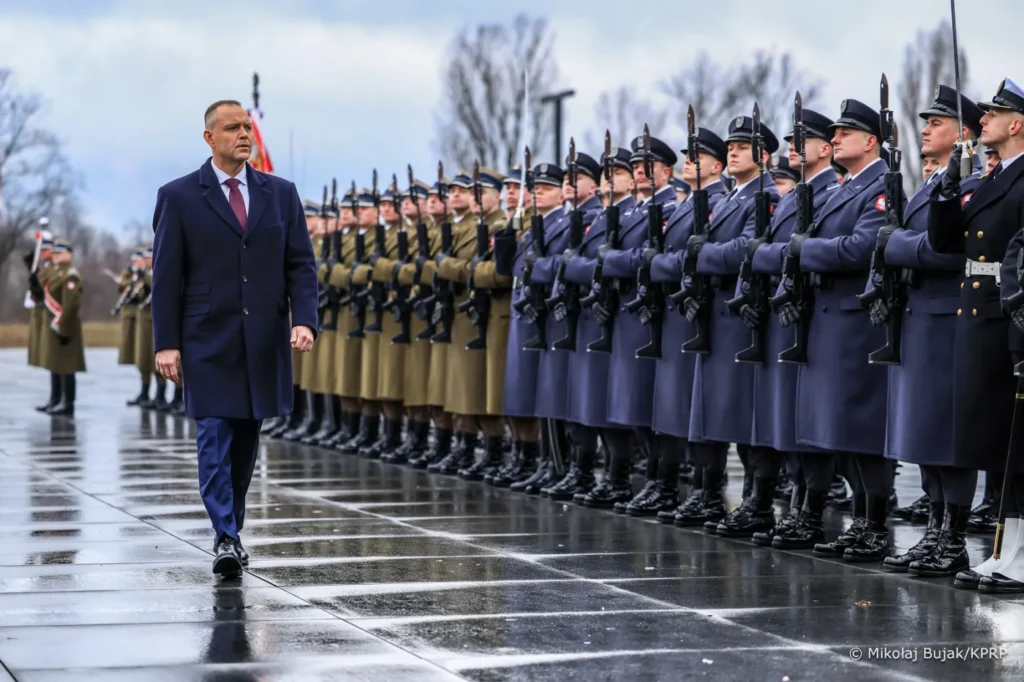
German media report escalating political conflict in Poland between President Karol Nawrocki and the government of Donald Tusk, raising concerns about economic stability and EU relations.
German Media Report on Rising Political Conflict
German media directly address the growing political conflict in Poland and its potential consequences for the economy and relations with the European Union. A commentary published by Frankfurter Allgemeine Zeitung noted that the dispute between President Karol Nawrocki and the government of Donald Tusk is becoming increasingly sharp and beginning to affect the country’s stability.
Warsaw Tensions Closely Watched in Berlin
Andreas Mihm points out that tensions in Warsaw are being closely monitored in Germany, as Poland remains a key trading partner and one of the most important investment markets in Central and Eastern Europe. He believes that the current escalation could undermine the country’s political stability and affect its credibility.
Dispute Over Arms Funding and EU Relations
One of the main points of contention has become the issue of financing the modernization of the army. The government of Donald Tusk advocates for the use of EU financial instruments to support the development of defense capabilities of member states. President Karol Nawrocki opposes this solution, raising arguments regarding sovereignty and the risk of excessive dependence on European structures.
A Fundamental Challenge to Poland-EU Cooperation
The German commentator assesses this dispute as particularly important because it concerns the foundations of Poland’s cooperation with the European Union. He points out that the conflict fits into a broader context of tensions between Warsaw and Brussels, which have included issues of the rule of law, the judiciary, and climate policy for years.
Anti-German Rhetoric Complicates Bilateral Relations
The text also emphasizes that the anti-German rhetoric appearing in public debate further complicates bilateral relations. The author believes this could weaken economic cooperation with Germany, which remains Poland’s most important trading partner.
PiS and Nawrocki Aim to Weaken Tusk’s Government Before Elections
According to the commentator, the actions of the political camp around Law and Justice (PiS) and President Karol Nawrocki have a clear political goal: to weaken the government before the upcoming parliamentary elections.
Maintaining Dominance on the Right
The analysis indicates that PiS is trying to maintain dominance on the right side of the political scene and simultaneously prevent the strengthening of more radical groups. Escalating the conflict with the government is intended to mobilize the electorate and strengthen the political message.
Criticism of a Potentially Damaging Strategy
However, there is clear criticism of this strategy. The author of the commentary assesses that these actions could harm the country’s interests, negatively affect the economy, and weaken political stability. In his opinion, the escalation of tensions goes beyond standard political competition and begins to affect the functioning of state institutions.
NBP’s “SAFE 0 Percent” Plan and Adam Glapiński’s Role
The involvement of the National Bank of Poland (NBP) in the current political conflict was particularly critically assessed. NBP Governor Adam Glapiński presented an alternative concept for financing arms purchases called “SAFE 0 Percent.”
Concerns Over the Plan’s Vagueness and Central Bank Independence
According to the commentator, the problem is not only the project itself but also its ambiguity. It was pointed out that, apart from the name, it is difficult to indicate specific mechanisms of this solution. This raises doubts among experts and foreign observers. Even more serious concerns relate to a possible violation of the principles of the central bank’s operation. The NBP, as a formally independent institution, should remain outside the current political dispute. However – according to the German newspaper – Adam Glapiński’s involvement may indicate a blurring of the lines between politics and monetary policy.
Risks Associated with Gold Reserves
Additionally, attention was drawn to the risks associated with the use of gold reserves. In a situation of falling prices of the precious metal, observed since the beginning of March, such actions could lead to losses and increase financial uncertainty.
NBP, Investors, and a Warning Signal for the Economy
Foreign observers are increasingly pointing out that the situation in Poland may be a warning signal for investors. Although the economy is growing at a rate close to 4 percent, the escalating political conflict is beginning to affect the perception of the country as an investment location.
Erosion of Institutional Boundaries and Investor Uncertainty
A key problem is the blurring of boundaries between state institutions. This applies not only to the relationship between the government and the president but also to the role of the central bank and the functioning of the legal system. The president’s veto of laws limits the parliament’s ability to act and slows down the legislative process. The commentator assesses that this situation increases the level of uncertainty. Investors, when making decisions, pay attention not only to economic indicators but also to political stability and regulatory predictability. Rising tensions could therefore negatively affect the inflow of capital.
Institutional Chaos and Power Struggle Ahead of Elections
It is becoming increasingly clear that the conflict between the most important centers of power is translating into the functioning of the entire state. Disputes over competence, blocking of laws, and the escalation of political rhetoric cause the decision-making process to become less effective.
Destabilization as a Political Strategy
The commentary emphasizes that the actions of President Karol Nawrocki may be an element of a broader political strategy aimed at destabilizing the situation before the parliamentary elections. This tactic, although it may bring short-term political benefits, carries the risk of deepening institutional chaos.
Increased Political Risk for Foreign Partners and Investors
From the point of view of foreign partners and investors, this means an increase in uncertainty. Poland, despite its relatively good economic condition, is beginning to be perceived as a country with growing political risk.