


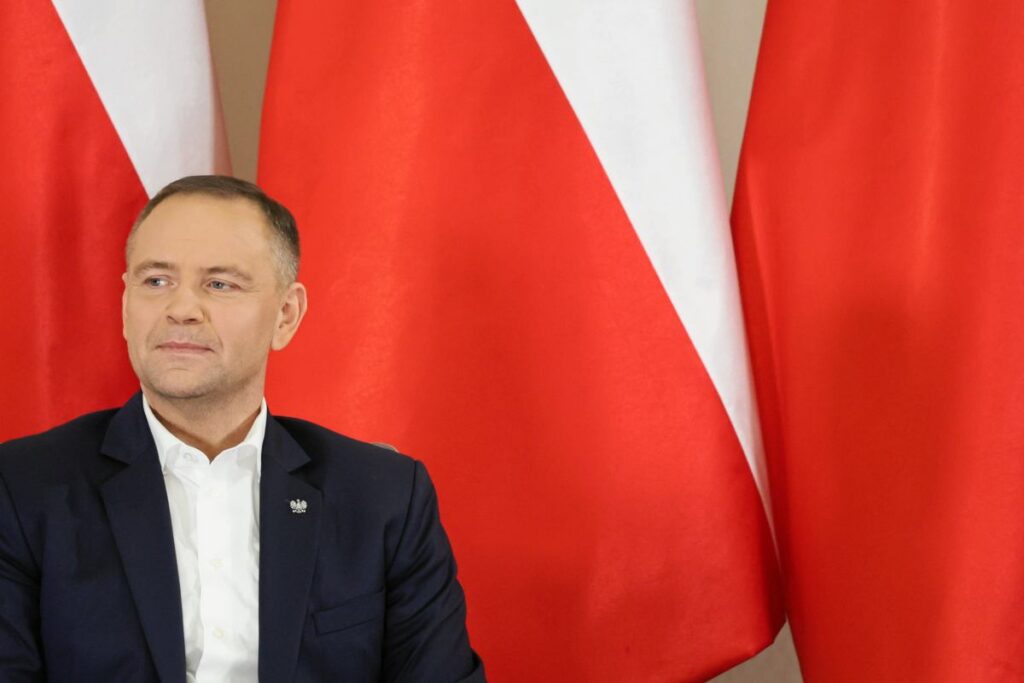
Polish President Karol Nawrocki’s statements about Poland potentially joining a nuclear program have drawn worldwide media coverage after his comments on Polish television.
Nawrocki Advocates for Poland’s Nuclear Program
On Sunday (February 15), Karol Nawrocki was a guest on “Śniadanie Rymanowskiego” on Polsat News. During the conversation, the president admitted to being “a great supporter” of Poland’s accession to a nuclear program. As he explained, “our country is on the border of an armed conflict.” We know what the attitude of the aggressive, imperial Russian Federation towards Poland is, he added. The president clarified that Poland should follow the path of developing its own nuclear potential, respecting all international regulations. Building Poland’s security even based on nuclear potential is a direction I support, he emphasized.
When asked whether Warsaw, as a signatory to the Nuclear Non-Proliferation Treaty, would allow Poland to develop such a project, Nawrocki responded: I don’t know, but we need to act in this direction so we can begin work. The president’s statements about Poland’s accession to a nuclear program quickly circulated in world media.
International Media Connects Statements to German Chancellor
Bloomberg agency reminds that in May 2025, Donald Tusk and Emmanuel Macron signed a treaty which, as politicians emphasized, tightens cooperation in security, defense, economy and culture. The Polish prime minister then said the agreement would open the way for potential sharing of protection (e.g., a “nuclear umbrella”) from French missiles as part of a common strategy. It should be emphasized, however, that in practice this does not mean that Poland has formally joined the French nuclear program or has French missiles.
Bloomberg notes that Poland spends 5% of GDP on defense and is the biggest beneficiary of the EU’s SAFE program. According to the plan, it will receive approximately €43.7 billion from a €150 billion pool. As Bloomberg emphasizes, Karol Nawrocki spoke about Poland’s accession to a nuclear program right after German Chancellor Friedrich Merz confirmed during the Munich Security Conference that he is holding talks with French President Emmanuel Macron on a potential European nuclear defense as part of Europe’s future security architecture.
The Politico portal also mentioned the correlation with the German chancellor’s statement. Furthermore, it writes that Nawrocki’s comment “appeared against a backdrop of a growing debate in several European countries about developing their own nuclear weapons, in the face of increasing threats from Moscow and erosion of trust in the United States.” According to Politico, when asked how Moscow might react to a Polish nuclear arms program, Nawrocki “dismissively replied that Russia might react aggressively to anything.”
Russian Response to Polish Statements
There is already a response from Russia. Kremlin propagandist Vladimir Solovyov wrote on social media that Nawrocki’s statement confirms Poland’s aspirations to possess nuclear weapons on its territory. The Russian agency RIA Novosti agreed with his assessment. A Polish newspaper “Metro Moscow” published an article titled “Polish President Nawrocki Announces Country Desires to Possess Nuclear Weapons.” The author recalls that in 2024, Andrzej Duda spoke about Poland’s readiness to accept American nuclear weapons on its territory. Senator Alexei Pushkov, in turn, stated that “excessive ambitions have historically ruined Poland.”
New START Treaty Expires Amid Global Shifts
Ukrainian media, meanwhile, are drawing attention to the New START treaty. “For the first time since the end of the Cold War, Europe is considering developing its own nuclear weapons because it currently relies on the US ‘protective umbrella.’ The reason is that Washington is no longer seen as a reliable partner,” writes Ukrainian weekly “Lustro Tygodnia” about Nawrocki’s words.
The Unian agency reminds that the agreement between Russia and the United States on reducing strategic offensive weapons (New START Treaty) officially expired on February 5. To date, no agreement has been reached on its extension or the conclusion of a new agreement. It should be recalled that the end of the New START Treaty could also undermine the effectiveness of the 1968 Nuclear Non-Proliferation Treaty (NPT). Its foundation is the principle that states that do not possess such an arsenal will not develop it, while nuclear powers will aim at disarmament. “The collapse of the New START Treaty without its replacement makes the prospect of nuclear disarmament even more distant, which undermines the basic agreement,” assessed Karim Haggag, director of the Stockholm International Peace Research Institute (SIPRI). According to the expert, for this reason, one can expect an intensification of debates about the need to invest in nuclear weapons in countries such as Poland, Ukraine, Japan, and South Korea.