


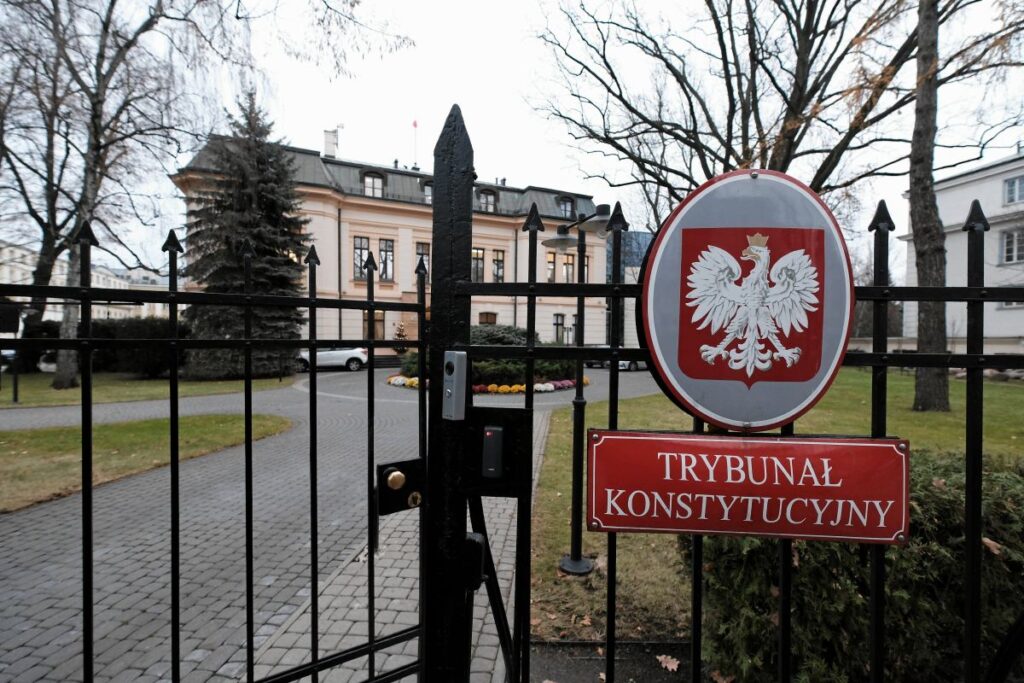
Polish President Karol Nawrocki swore in only two of six judges elected by Parliament to the Constitutional Tribunal, prompting accusations of overreach from the Sejm.
Sejm Challenges Presidential Action
On Wednesday, President Karol Nawrocki administered oaths to Magdalena Bentkowska and Dariusz Szostek, two of the six judges selected by the Sejm in March for the Constitutional Tribunal. Presidential Chief of Staff Zbigniew Bogucki justified the action, stating that two vacancies existed within the Tribunal during President Nawrocki’s term and swearing in two individuals would fulfill the statutory requirement of an 11-member full composition.
At the time the Sejm elected the judges in March, the Tribunal consisted of nine members.
Sejm Maintains Valid Elections
The Sejm’s Chancellery stated on Friday (April 3rd) that the Sejm effectively elected six Constitutional Tribunal judges, and the President has yet to fulfill the “statutory obligation” of administering oaths to all of them.
Eight Candidates Considered
The procedure for selecting the six judges – as stated in a communiqué – “raised no doubts not only from the parliamentary majority but also from the parliamentary opposition, which nominated candidates and then supported them throughout the entire procedure.” The PiS Club nominated Professor Artur Kotowski and Dr. Michał Skwarzyński, who were ultimately not selected by the Sejm.
Parliamentary Review Process
A total of eight candidates were submitted during the procedure and subsequently reviewed by the Sejm’s Justice and Human Rights Committee. During this time, lawmakers had the opportunity to question the candidates.
Expedited Voting Procedure
On March 13th, the Sejm, “in the absence of objection, consented to the conduct of the election of Constitutional Tribunal judges without observing the seven-day period.” The Chancellery emphasized that this decision is based on the provisions of the Chamber’s regulations and that the solution has been used repeatedly in previous terms.
Individual Voting and Legal Standing
“Each candidate was subjected to an individual vote for the six vacant positions,” the Chancellery noted. Consequently, all individuals elected as Constitutional Tribunal judges on March 13th “are judges of the Constitutional Tribunal and are in the same legal situation.”
Sejm Condemns Presidential Action as Abuse of Power
“Administering the oath of office to only two of these individuals has no legal basis and constitutes an abuse of power,” the Chancellery assessed.
Minister of Justice Criticizes President
Minister of Justice Waldemar Żurek responded to the Sejm Chancellery’s communiqué.
“The Sejm elected six Constitutional Tribunal judges. The President took the oath from only two. Not because that is what the law provides. But because he made it up himself,” the minister stated on X. “Mr. President, please open the calendar and set a date while you have a free moment. Violating the Constitution is a serious matter,” he added.
Constitutional Authority of the Sejm
The Sejm Chancellery emphasized in its communiqué that, according to the constitution, the Sejm elects the judges of the Constitutional Tribunal, and the President’s role, as stipulated by law, is to administer the oath to all of them.
“The head of state has no authority to assess the validity of the election. Refusal to administer the oath to some of the elected judges has no legal basis and constitutes an usurpation of power by the President of the Republic of Poland,” the communiqué reads.
Precedent and Timing of Appointments
The Chancellery assessed that appointing Constitutional Tribunal judges after the expiration of the previous judge’s term – a point raised by the KPRP in connection with the Sejm’s March election – “is nothing extraordinary” in the Polish legal system.
Historical Examples of Delayed Appointments
As an example, the Chancellery pointed to the position following the expiration of Leon Kieres’ term in July 2021, which the Sejm filled approximately 200 days later – in February 2022 – by electing Bogdan Święczkowski (a national prosecutor during the PiS government, currently the President of the Constitutional Tribunal). Despite the more than six-month gap, the President did not question the validity of Święczkowski’s election.
Simultaneous Elections Not Unusual
The Chancellery also stated that the election of several Constitutional Tribunal judges at a single Sejm session does not constitute an “extraordinary situation.” In November 2001, the Sejm elected four Constitutional Tribunal judges (Marian Grzybowski, Marek Mazurkiewicz, Mirosław Wyrzykowski, and Bohdan Zdziennicki) in a single day, and on October 27, 2006, three (Maria Gintowt-Jankowicz, Wojciech Hermeliński, and Marek Kotlinowski). On December 8, 2006, the Sejm also elected Judge Teresa Liszcz and Judge Lidia Bagińska. Similarly, on November 26, 2010, Stanisław Rymar, Piotr Tuleja, and Marek Zubik were elected as Constitutional Tribunal judges.
Past Sejm Practices
Furthermore, the Chancellery emphasized that the Sejm of the VIII term elected five Constitutional Tribunal judges in one day, “while also electing three judges to positions that had already been filled.” This refers to the election of Henryk Cioch, Lech Morawski, and Mariusz Muszyński in December 2015.
Shortened Candidate Review Periods
The Chancellery also pointed out that the regulatory period between the nomination and election of candidates – a point also raised by critics of the March election of six Constitutional Tribunal judges – was shortened in previous terms, such as in 2019 during the election of Krystyna Pawłowicz and Stanisław Piotrowicz.
Lack of Nominations Before Vacancies
Another argument raised by the Chancellery is that in 2024, no authorized entities submitted nominations for the election of Constitutional Tribunal judges 30 days before the expiration of the terms of three Constitutional Tribunal judges, although – as noted – this deadline “arises by virtue of law itself and does not require any action by the Speaker of the Sejm.” The Chancellery indicated that such nominations were not submitted by the current opposition group either.
“For this reason, Sejm Speaker Szymon Hołownia consistently set […] a deadline for submitting candidacies, as there was a circumstance other than the expiration of terms that necessitated the election,” it was noted.
Repeated Candidacy Submissions
Marek Ast and Artur Kotowski were submitted as candidates a total of four times. However, they did not receive the required support in Parliament.
Sejm’s Exclusive Right to Elect
The Chancellery responded in its communiqué to arguments made by the President’s Chancellery, presented by its head, Zbigniew Bogucki, that President Nawrocki administered the oath to two judges because two mandates had become vacant during his term (Krystyna Pawłowicz and Michał Warciński retired in December 2025).
According to the Sejm Chancellery, this reasoning is “not only extra-legal but also leads to unacceptable consequences” – including the assumption that the remaining four positions vacated during the term of the previous President Andrzej Duda cannot be filled. The Sejm Chancellery believes this situation causes an “obvious obstruction of the Tribunal’s operation” and “clearly” and “without any legal basis” limits the Sejm’s creative function. It emphasized that, according to the constitution, the Sejm has the right to elect the judges of the Tribunal.
“He Just Made It Up”
Justifying the administration of oaths to only two Constitutional Tribunal judges, the head of the President’s Chancellery cited “serious, intentional, and conscious procedural errors” by the Sejm, because in the case of none of these judges was it indicated on what basis they are entering office, or when their term begins. Bogucki also stated that the motion to elect judges should be made 30 days before the end of the term, not a year and three months after its expiration.
Minister of Justice and Prosecutor General Waldemar Żurek assessed that the President took the oath from two, and not more judges “only because he made it up himself” and that this is a “usurpation of powers that he does not have.” He also emphasized that the Sejm elects the judges of the Constitutional Tribunal, while the President “has no right to select them, as at the gate.”
Six Vacancies Exist
Deputy Minister Dariusz Mazur also supported the arguments of the Sejm Chancellery. “All currently questioned practices have already been used in the past and, on the basis of none of them, has the invalidity of a judge’s election been determined,” he wrote on X.
In addition to Szostek and Bentkowska, the Sejm elected Krystian Markiewicz, Maciej Taborowski, Marcin Dziurda, and Anna Korwin-Piotrowska as Constitutional Tribunal judges in March. These four individuals sent letters to President Nawrocki on Wednesday afternoon requesting the date of their oath-taking.
At the time the Sejm made the election of judges, there were six vacancies in the Constitutional Tribunal. The Tribunal therefore consisted of 9 judges out of 15 judicial positions. After assuming office in the Constitutional Tribunal by the judges who took the oath on Wednesday, there will be 11 people in the Tribunal, although the current ruling party does not recognize Justyna Piskorska and Jarosław Wyrembak as judges of the Constitutional Tribunal, as expressed in a recent Sejm resolution.
Tribunal President Extends Invitations
The President of the Constitutional Tribunal, Bogdan Święczkowski, sent invitations on Friday to the two judges who previously took the oath before the President. According to TVN24, this is to begin their duties in the Tribunal.
This concerns the two newly elected Constitutional Tribunal judges – Magdalena Bentkowska and Dariusz Szostek. Both took the oath on April 1st before President Karol Nawrocki, while the remaining judges elected by the Sejm were not invited to the Presidential Palace at that time. As reported by TVN24, citing a press spokesperson for the Constitutional Tribunal, Bogdan Święczkowski sent invitations to the two of them to begin their service in the Tribunal in accordance with their obligations.