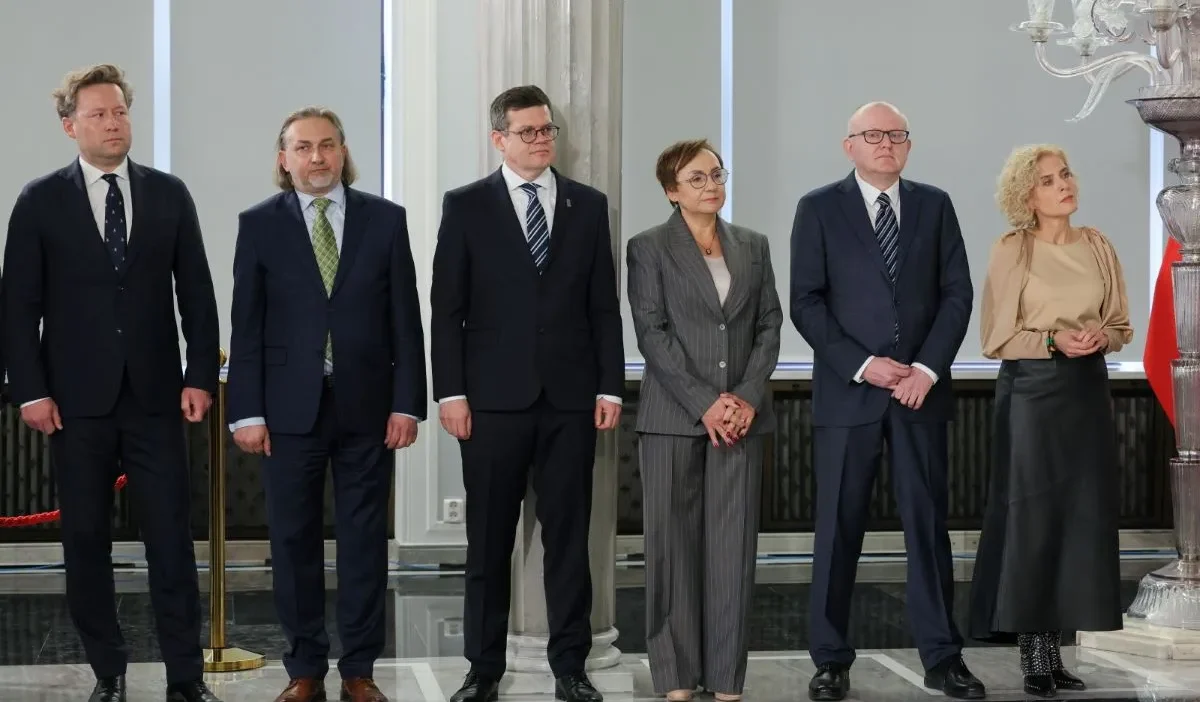
The Helsinki Foundation for Human Rights is calling on the Polish President to promptly swear in judges selected by the Sejm, warning of potential constitutional violations.
Constitutional Obligation to Administer Oath
The Helsinki Foundation for Human Rights (HFPC) reminds the President of the Republic of Poland of their constitutional duty to administer the oath of office to judges of the Constitutional Tribunal elected by the Sejm. The organization asserts that any delay or refusal could be considered a violation of the Constitution, known as a constitutional delict.
The dispute surrounding the swearing-in of Constitutional Tribunal judges has reignited debate about the limits of the President’s powers and the state of the Polish legal system.
Selection Process and Tribunal Rulings
The Foundation emphasizes that, according to Article 194, paragraph 1 of the Constitution, judges of the Constitutional Tribunal are elected exclusively by the Sejm. The procedure does not involve any other state bodies in the act of election itself. This means that a person indicated by the parliament gains the status of a Constitutional Tribunal judge at the moment the Sejm passes a resolution.
Crucially, the Constitutional Tribunal’s own jurisprudence is relevant. In one ruling, a provision that made the start of a judge’s term dependent on taking the oath before the President was deemed inconsistent with the Constitution. The justification stated that such a solution would indirectly involve the executive branch in shaping the composition of the Tribunal, violating the principle of the separation of powers.
Oath’s Significance and Presidential Discretion
In practice, a judge’s term begins at the moment of election by the Sejm or, in the case of filling a vacancy, when the predecessor’s mandate expires.
While the oath before the President is formal, it is not merely symbolic. The Constitutional Tribunal has indicated that it is necessary to begin exercising adjudicative duties. Without it, a judge cannot effectively participate in the Tribunal’s work.
Experts point out that the regulations do not give the President the right to block the effects of an election made by the Sejm. The oath cannot be treated as a political tool or an instrument to influence the composition of the Constitutional Court.
Exceptional Circumstances and Political Disputes
The Constitutional Tribunal has allowed for a delay in administering the oath, but only in exceptional and clearly defined situations. These include cases where there are obvious doubts about the act of election itself or the person elected to the position of judge.
Such situations include, for example, a lack of legal capacity to hold office, permanent obstacles resulting from the candidate’s personal situation, or serious procedural irregularities that undermine the validity of the Sejm’s resolution. However, these circumstances must be unambiguous and raise no doubts.
The HFPC notes that no such grounds exist in the current situation. No arguments have appeared in public debate that would obviously and indisputably challenge the legality of the election of Constitutional Tribunal judges.
Impact of Ongoing Proceedings and Need for Reform
One of the arguments appearing in public space concerns ongoing proceedings before the Tribunal regarding the regulations governing the election of judges. This was initiated by a group of MPs and, according to many lawyers, fits into a broader political conflict surrounding the constitutional judiciary.
The Foundation assesses that such actions could lead to the instrumentalization of the Tribunal, rather than contributing to the restoration of its authority. Similar reservations have been expressed in recent years by international institutions, including the European Commission and the Council of Europe, which have repeatedly pointed to the problem of politicization of judicial bodies in Poland.
The HFPC also rejects the argument that delays in the election of judges by the Sejm can justify a lack of swearing-in. Even if the parliament should fill the composition of the Tribunal on an ongoing basis, any delays do not affect the validity of later decisions.
There are also no legal grounds for selectively administering the oath – for example, only to some of the elected judges. If the Sejm filled all vacancies, the President is obliged to take the oath from each of them.
The Foundation believes that the current model for selecting Constitutional Tribunal judges encourages political tensions. A lasting solution requires amending the Constitution and introducing new mechanisms, such as dispersing the powers of selection among different state institutions and increasing the transparency of procedures.
The Foundation appeals for a non-partisan agreement on this matter, indicating that without broad consensus it will be difficult to restore trust in the Constitutional Tribunal and the entire justice system.