


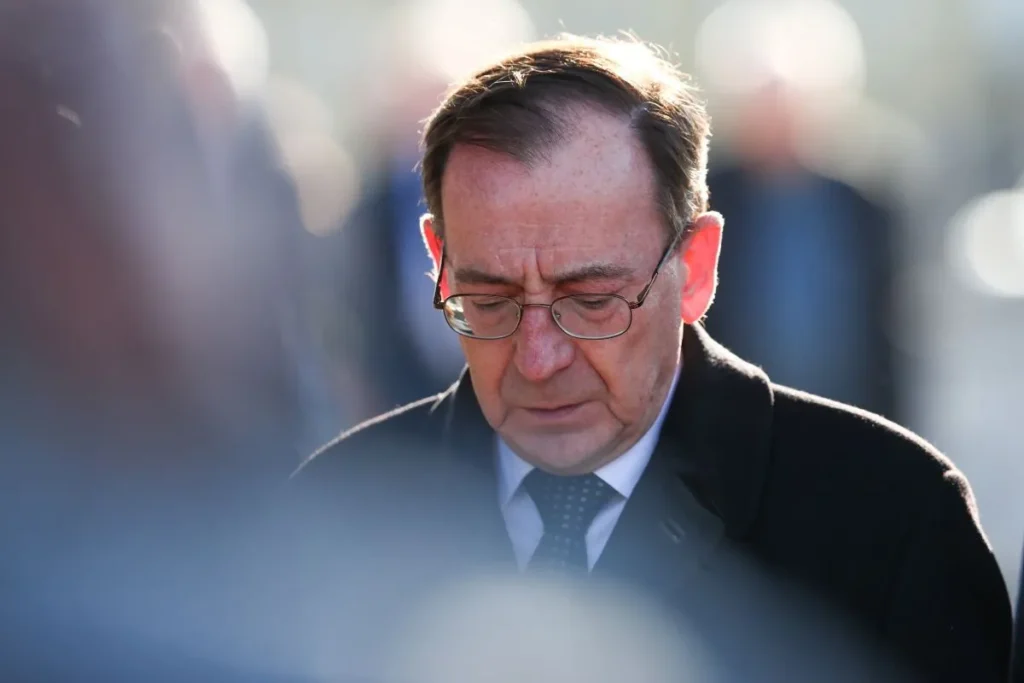
Poland’s Prosecutor General has requested the European Parliament waive the immunity of Mariusz Kamiński, stemming from a 2007-2009 investigation into the Kwaśniewski family’s property.
Investigation into Alleged Abuse of Power at CBA
Prosecutor General Waldemar Żurek has submitted a request to the European Parliament to lift the immunity of MEP Mariusz Kamiński (PiS) regarding actions taken during his tenure as head of the Central Anti-Corruption Bureau (CBA). The case centers on investigations conducted between 2007 and 2009 concerning the acquisition of a house in Kazimierz by Jolanta and Aleksander Kwaśniewski.
Kamiński responded by stating that the Sejm previously declined to waive his immunity in 2014 regarding the “Kazimierz villa” case, which he believes should have closed the matter. He attributes the renewed pursuit to the current government’s “blind hatred.”
The “Kazimierz Villa” Affair and Early CBA Operations
The Lublin Regional Prosecutor’s Office is investigating allegations that Kamiński, as head of the CBA, exceeded his authority by conducting surveillance operations without a factual or legal basis. This investigation is a continuation of the long-running “Kazimierz villa” case and the early years of the CBA, which was established in 2006, with Kamiński as its first director.
The investigation involved a controlled transaction facilitated by an agent known as Tomasz Małecki (later identified as Tomasz Kaczmarek, a PiS MP), who attempted to gain favor with the family managing the villa, owned by a friend of the Kwaśniewskis. The CBA believed the house ultimately belonged to the former president and sought to prove it.
Failed Undercover Operation and Previous Investigations
The operation involved offering twice the value of the 1.6 million złoty property, hoping the funds would reach the Kwaśniewskis. However, the transaction was disrupted in July 2009 when an intermediary removed 1.5 million złoty from a bag containing a tracking device, preventing authorities from tracing the money’s destination.
In 2022, the Katowice Regional Prosecutor’s Office dropped an investigation into the Kwaśniewskis’ assets, citing a “lack of sufficient evidence” of wrongdoing. This was a re-closure of the case, as a previous investigation from 2010 had been reopened in 2016 during the PiS government.
Parallel Investigations into CBA Leadership Conduct
Concurrently, investigations were underway regarding potential abuses of power by the then-leadership of the CBA. Prosecutor Przemysław Nowak of the National Prosecutor’s Office confirmed that the request to waive Kamiński’s immunity was submitted to the European Parliament on Tuesday, noting the investigation was initiated as early as April 26, 2010, based on a criminal complaint filed by Paweł Wojtunik, a subsequent head of the CBA.
In 2014, the Sejm again refused to waive Kamiński’s parliamentary immunity, with votes against the prosecution coming from members of the then-ruling PO-PSL coalition. A report from oko.press two years ago indicated the prosecutor’s office had revisited the case.
Allegations of Preconceived Intent and Improper Surveillance
Prosecutor Nowak stated that the actions taken by Kamiński as head of the CBA were “from the outset aimed at proving that the property belonged to the Kwaśniewski couple” and, contrary to regulations, did not focus on “identifying perpetrators of a crime, but rather led to the creation of a new criminal event.”
The first charge concerns initiating and approving baseless operational controls between June 2007 and October 13, 2009.
Details of Operational Control Requests
Specifically, the charges involve directing CBA officers to conduct surveillance activities under the code name “Krystyna,” issuing urgent orders for operational control, and requesting the Prosecutor General’s consent for such controls. The stated purpose was to initiate criminal proceedings against Jolanta and Aleksander Kwaśniewski.
The indictment encompasses 32 requests or orders for operational control, with controls carried out in 20 cases, denied in 11, and not implemented in one due to formal reasons.
Focus on Individuals Connected to the Kwaśniewskis
The surveillance activities primarily focused on Maria J. and her family, who were acquaintances of Jolanta Kwaśniewska and owned the house in Kazimierz Dolny until September 2007. Twenty of the 32 requests or orders targeted Maria J., with surveillance conducted “almost continuously” from October 2007 to August 22, 2009, including monitoring phone calls, correspondence, internet activity, computer contents, and surveillance of premises.
According to the prosecutor’s office, the CBA “adopted the thesis that the real owners of the house were the Kwaśniewski couple, a thesis that was never substantiated in any way.”
Allegations of False Information and Lack of Evidence
Other requests for operational control involved Maria J.’s son and Marek M., the buyer of the property in Kazimierz Dolny. One request targeted Jolanta Kwaśniewska, but was denied by the Prosecutor General due to a lack of factual basis. All requests reportedly contained the same factual and legal circumstances, alleging false claims of money laundering and tax crimes.
The prosecutor’s office stated that these requests were made despite a lack of results from previous surveillance and repeated denials of consent by the Prosecutor General.
Undercover Purchase Attempt and Lack of Justification
The second charge concerns initiating and ordering an undercover operation in July 2009 to acquire the property in Kazimierz Dolny, despite a lack of grounds for such action. The goal was to confirm the CBA’s belief that the Kwaśniewskis were the true owners. Kamiński approved and launched the operation, in which a CBA operative purchased the house from Marek M. for 1.6 million złoty, but the objective of proving ownership by the Kwaśniewskis was not achieved.
Kamiński requested the Prosecutor General’s approval for the covert purchase in July 2009, allegedly providing “false information” about a suspected money laundering and tax crime. The prosecutor’s office argues that the legal requirements for such operations – credible information about a crime and identifying perpetrators – were not met, and the operation was based solely on speculation and rumors. The property itself was not derived from criminal activity.
Potential Penalties and Kamiński’s Response
The alleged offenses carry a potential prison sentence of up to five years. Kamiński, now an MEP, responded to the news on X (formerly Twitter), criticizing Prosecutor Żurek and reiterating that he investigated the Kwaśniewskis’ assets nearly 20 years ago. He believes the Sejm’s 2014 decision not to waive his immunity should have ended the matter, attributing the renewed investigation to “hatred” blinding his opponents.
Background: Kamiński’s Previous Roles and Conviction
From 2015 to 2023, during the United Right government, Kamiński served as the coordinator of special services and, from 2019, as the Minister of Interior and Administration. In December 2023, the Warsaw District Court upheld convictions and two-year prison sentences for Kamiński and Maciej Wąsik, former heads of the CBA, related to operations during a 2007 “land affair.” They were also banned from holding public office for five years. President Andrzej Duda granted them clemency in January 2024, and Kamiński was elected to the European Parliament in June 2024.
The entire proceedings surrounding the Kazimierz Dolny property and its alleged connection to Aleksander and Jolanta Kwaśniewski originated from the “Oleksey tapes,” recorded in the autumn of 2006 by the security of businessman Aleksander Gudzowaty (who died in 2013, and Józef Oleksy in 2015). Former Prime Minister Józef Oleksy discussed the purchase of a property in Kazimierz Dolny with the owner of Bartimpeks, expressing doubts about Kwaśniewski’s ability to explain his assets.