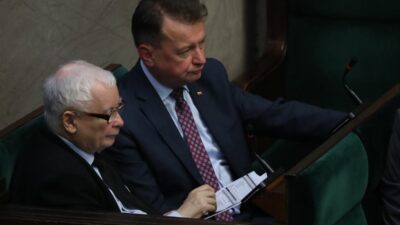
A CBOS poll conducted for PAP reveals that 46% of Poles identify political conflict and societal polarization as a major threat to national stability.
Political Polarization Dominates Concerns
According to a CBOS survey for the Polish Press Agency (PAP), 46% of respondents listed political dispute and societal polarization as one of the two greatest threats to the country’s stability.
The survey identified the international situation and security as the second most significant concern (42%), followed by the quality of public services like healthcare and education (31%).
Financial Situation and Demographic Crisis Also Worry Poles
Twenty-four percent of respondents cited the state of public finances and the demographic crisis as threats to stability. A further 4% indicated other problems, while 3% found it difficult to answer.
Election Campaigns Exacerbate Divisions
University of Warsaw political scientist Prof. Rafał Chwedoruk noted the high percentage identifying polarization, linking it to last year’s presidential campaign. He argued that campaigns “manipulate all gray areas,” forcing even smaller groups and their voters to take sides.
Chwedoruk observed that Karol Nawrocki’s victory paradoxically strengthened Donald Tusk’s leadership within the Civic Platform (PO), while the Law and Justice (PiS) party ultimately positioned Przemysław Czarnk as its de facto frontman.
Gender Differences in Perceived Threats
The study reveals differences in how men and women perceive threats to Poland. Women are more concerned about the international situation (47% vs. 38% for men) and the quality of public services (35% vs. 27%).
Conversely, men more frequently cite the state of public finances (29% vs. 20%) and the demographic crisis (28% vs. 21%).
Polarization Concerns Consistent Across Age Groups
Concerns about political polarization are evident across all age groups, with over 40% expressing this worry in each. The highest percentage was observed in the 55-64 age group (54%).
Politicians Benefit from Conflict
Chwedoruk believes that politicians’ responses to voter dissatisfaction with constant conflict are merely short-term fixes. Despite voters desiring fewer conflicts, escalating political disputes actually increase voter turnout.
Age-Based Variations in Threat Perception
Across all age groups, the international situation and security are identified as major threats, with results exceeding 40%, except for those aged 65 and over (35%). The youngest group (18-24) most frequently selected the international situation and security (43%), along with polarization (41%) and the quality of public services (39%).
Political Affiliation Shapes Threat Assessment
The poll also highlights political differences. 59% of left-leaning individuals and 51% of centrist respondents identified societal polarization as a threat, compared to 35% of those with right-wing views.
Right-wing respondents more often pointed to the state of public finances (34%) and the demographic crisis (29%).
Civic Coalition and Left Voters Most Worried About Polarization
Among Civic Coalition (KO) voters, 61% cited political dispute and polarization as a major threat, followed by the international situation and security (54%). For voters of the New Left and Razem parties, polarization also ranked first, with 59% and 62% respectively.
Razem voters also frequently expressed concern about the international situation (51%) and the quality of public services (45%). KO, Left, and Razem voters were less likely to cite the state of public finances (12-15%).
Wealthier Voters Less Concerned with Finances
The politologist noted that this voter base is wealthier than others, and therefore less concerned about public finances, and “more afraid of external threats.”
PiS Voters Focus on Public Services and Economy
Within the Law and Justice (PiS) electorate, the quality of public services (44%) was most frequently cited as a threat, followed by the international situation (34%) and the state of public finances (33%). Political dispute was identified as a threat by 32% of this group – less than in other opposition party electorates.
Chwedoruk emphasized that PiS voters are most concerned about the quality of public services, as they largely consist of middle-aged and older individuals. He added that PiS voters “have been stuck in the shadow of the dispute between KO and PiS for years,” becoming accustomed to it, and are more likely to trust the party’s polarizing messaging.
Konfederacja Voters Prioritize Public Finances
Voters of Konfederacja (Confederation) displayed a different response pattern. Both Konfederacja Wolności i Niepodległości (Konfederacja WiN) and Konfederacja Korony Polskiej (Konfederacja KP) most frequently cited the state of public finances (48% and 47% respectively). For Konfederacja WiN, the demographic crisis and security were also important (both 36%), while Konfederacja KP voters also expressed concern about political dispute (43%).
Chwedoruk noted that Konfederacja Korony Polskiej and Grzegorz Braun may face challenges due to their more inconsistent electorate, which is largely protest-driven. Maintaining this electorate long-term will be difficult for Braun unless prolonged crisis situations occur.
The survey was conducted between March 23 and 25 on a sample of 1000 people using CATI (computer-assisted telephone interviewing) and CAWI (computer-assisted web interviewing) methods.