


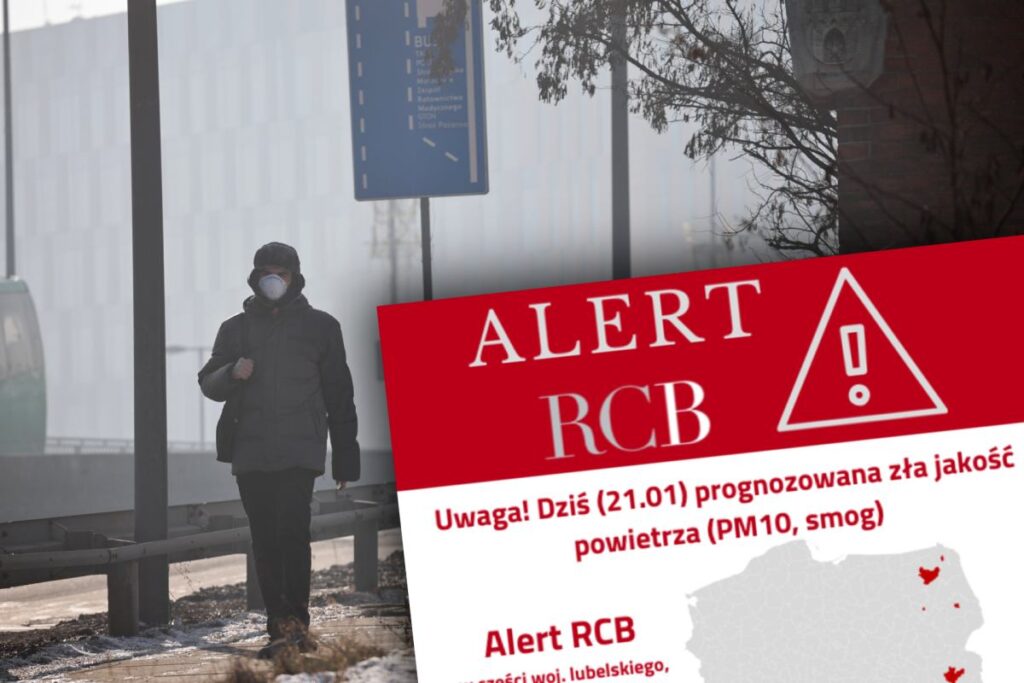
Poland battles record air pollution as government alerts lag behind WHO standards and public perception.
Poland’s Alert System Based on National Standards
The beginning of the year has brought cold weather and weak winds—ideal conditions for smog formation over cities. From Warsaw and Kraków to Wieliczka and Zamość, air quality standards are being exceeded daily, with a gray layer of pollutants visible over cities.
In recent days, Poland’s Government Security Center (RCB) has issued alerts about predicted poor air quality, recommending avoiding outdoor exertion. However, pollution maps show smog affects many more cities than those covered by recent alerts.
Differences Between Polish, EU, and WHO Standards
According to institutions responsible for alerts, the basis is exceeding the alarm level in Polish air quality standards. This level differs from stricter EU and WHO standards referenced by popular smog applications.
The Polish system has three levels for PM10 particulate matter: information (150 µg/m³ 24-hour average), alert (200 µg/m³), and alarm (300 µg/m³). In contrast, the EU sets only an acceptable daily level of 50 µg/m³, while WHO allows 45 µg/m³.
PM2.5 and PM10: Different Health Risks
For PM2.5—smaller and potentially more dangerous to health—WHO standards are even more restrictive, allowing a daily concentration no greater than 15 µg/m³. When PM2.5 reaches 100 µg/m³, as seen recently in Warsaw, WHO standards are exceeded by 600-700%.
Private vs. Public Monitoring Stations
Popular smog applications use measurements from numerous private stations, while GIOŚ (Main Inspectorate for Environmental Protection) issues alerts based solely on automatic stations in the State Environmental Monitoring network. Large cities like Warsaw have several dozen private measurement points alongside a dozen state stations, leading to different readings.
Poland to Align with EU Standards by 2030
Poland, like other EU countries, must implement updates to the Air Quality Directive, including stricter standards aligned with WHO recommendations. By December 2024, the alarm level for PM10 will be reduced from 150 µg/m³ to 90 µg/m³, and an alarm level for PM2.5 will be set at 50 µg/m³.
By 2030, the acceptable PM10 level will match WHO standards: 25 µg/m³ daily and 20 µg/m³ annual average. Local governments must adopt provincial Air Quality Action Plans by December 31, 2028, to ensure compliance with new standards by 2030.