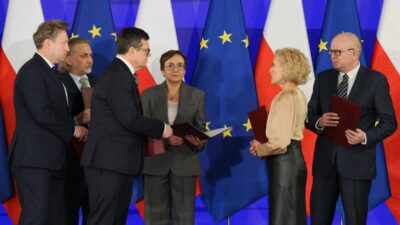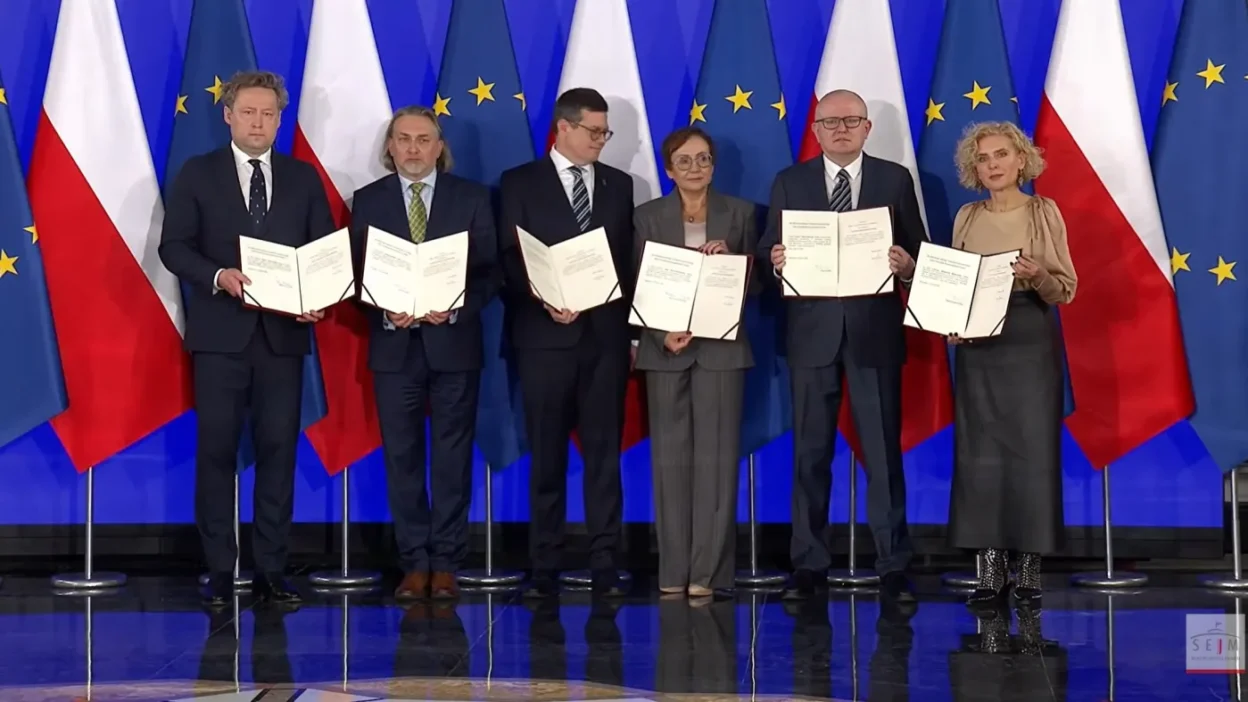
Newly appointed Constitutional Tribunal judges face a political and legal deadlock after refusing to take their oaths before the President, opting for a parliamentary ceremony instead.
Alternative Oath-Taking Fails to Resolve Issue
Judges selected by the Sejm for the Constitutional Tribunal, who chose a “correspondence” oath-taking without President Karol Nawrocki’s participation, have fallen into a political and legal trap with no clear exit.
If President Nawrocki wished to administer the oath to all six newly elected judges, he could have done so without analysis or delay. However, he has chosen not to, a decision that appears politically firm.
Tribunal’s Transformation into a Political Tool
Since the Tribunal shifted from a constitutional court to an instrument for political goals, the focus has moved away from appointing the best legal experts to selecting individuals who are politically reliable. The current ruling coalition also employed similar logic, choosing Krystian Markiewicz, a former head of Iustitia, known for advocating strict accountability for PiS reforms.
This confrontational choice has provoked the opposition, as Markiewicz’s presence is seen not as a means of rebuilding the Tribunal, but of maintaining a course of accountability feared by Jarosław Kaczyński and his party. A compliant Tribunal would allow PiS to effectively block unfavorable political and legal initiatives and justify legal disputes, even with Brussels.
Nawrocki’s Strategic Ambiguity
Karol Nawrocki has strategically refrained from stating he will refuse to accept oaths from the four remaining judges, though clarity would be beneficial. This lack of a clear decision allows him to maintain various options depending on how the situation evolves, without facing any immediate repercussions.
Forced to Seek Alternatives
Less than a month after the candidates were selected, the President’s ambiguous stance has forced the opposing side to seek alternative solutions to allow the nominees to enter the Constitutional Tribunal. The political pressure to “restore” the institution is significant, and expectations have been raised.
The newly elected judges now face a choice: wait for the President to relent under pressure, or embark on a lengthy legal battle in Polish or European courts, potentially repeating past scenarios where elected judges were unable to join the Tribunal due to a lack of oath-taking. They ultimately chose to comply with the coalition’s political expectations and attempt to force entry.
Who Truly Controls the Constitutional Tribunal?
The alternative oath-taking may not be legally sufficient. Legal and opinion-forming circles are divided on the matter, and the dispute will likely remain unresolved for years. Experts, lawyers, and politicians will entrench themselves in their positions, accusing each other of violating the constitution or even committing crimes.
Ultimately, control of the Tribunal rests with Bogdan Święczkowski, the President of the Tribunal, who alone determines whether the new judges can actually take their posts. His decision in this matter is clear.
Usurpers or Legitimate Judges?
The judges “sworn in” in the Sejm will attempt to enter the Tribunal, but the doors will remain closed. The opposition will label them as usurpers attempting to be judges without fulfilling the formal requirement of taking an oath before the President. This accusation will lead to legal disputes and accusations of breaking the law.
A forceful entry into the Tribunal is unlikely to succeed. Even with a permanent police presence, nothing would change. The Tribunal has become a battleground for brutal political maneuvering, where all tactics are permitted. Principles and constitutional norms are secondary to defending political interests.
A Broken Institution
Poland no longer has a Constitutional Tribunal as defined by the constitution, but rather an institution consumed by a war for political influence. Victory will not go to those with constitutional and legal justification, but to those who are stronger and more cunning. This institution is beyond repair. The only solution is a political reset, which is unlikely to happen given the current climate of tribal warfare and a lack of concern for the common good.