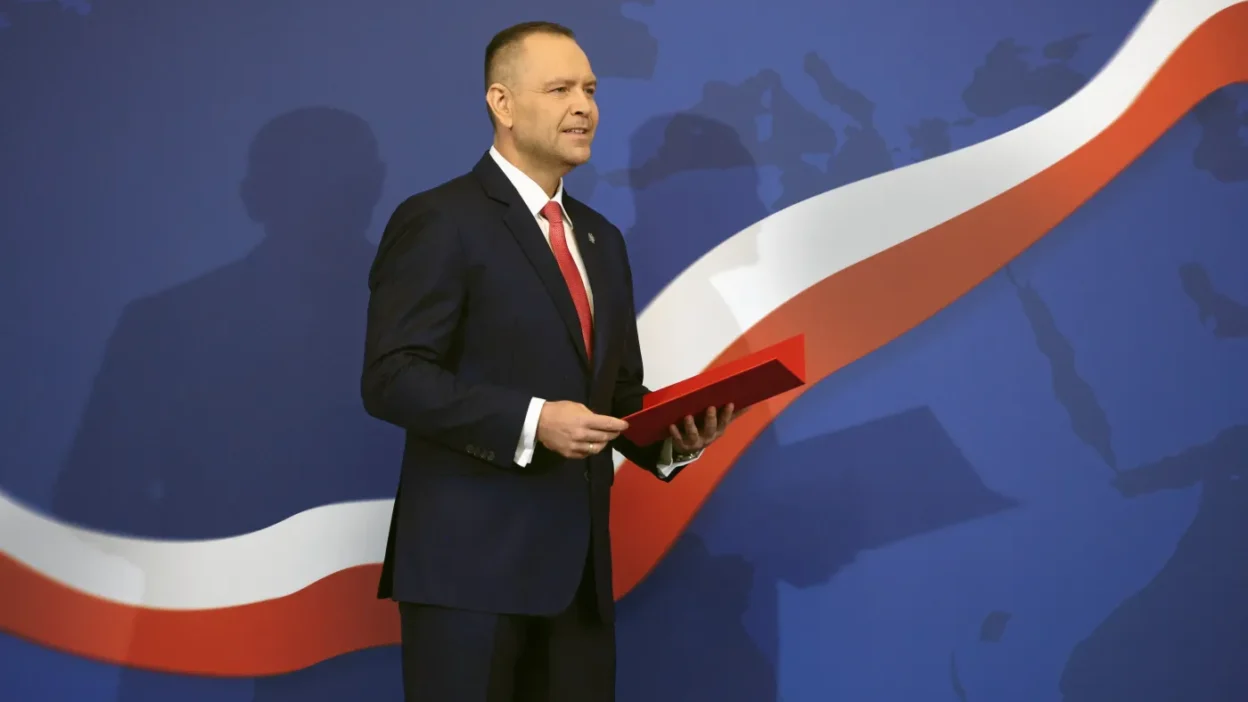
Polish President Karol Nawrocki has accused the government of attempting to deflect blame for failures in regulating the Zondacrypto cryptocurrency exchange scandal.
President Rejects Government’s Accusations
President Karol Nawrocki strongly responded on Monday to government accusations regarding the Zondacrypto affair, asserting that authorities are attempting to shift responsibility for the lack of control over the cryptocurrency market onto him.
“The government will not cover up its incompetence and helplessness with lies,” the President stated, referencing specific dates of actions taken by security services and his own decisions, in response to accusations concerning his veto of the crypto asset market law.
Timing of Security Agency Report
The President emphasized that the first communication from the Internal Security Agency regarding the cryptocurrency market did not reach the Presidential Chancellery until December 12, 2025 – eleven days after his veto on November 7th, and seven days after a confidential parliamentary session.
“To be clear: the first letter from ABW arrived at the Presidential Chancellery on December 12th, which was already after my veto decision,” Nawrocki stated, stressing he could not have based his decision on information that emerged later.
Government Manipulation Alleged
Nawrocki accused the government of attempting to manipulate facts and divert attention from its own negligence, arguing that the lack of effective oversight of the cryptocurrency market is the responsibility of government institutions, not the President.
“Hold yourselves accountable, not the opposition,” he appealed, highlighting the political dimension of the dispute.
Dispute Over Crypto Asset Law
The President’s veto of the law on November 7, 2025, became a central point of conflict between the Presidential Palace and the government. The proposed legislation aimed to regulate the cryptocurrency market in Poland and align national regulations with EU standards.
On December 1st, Karol Nawrocki vetoed the law, and on December 5th, the Sejm attempted to override his decision, but the ruling coalition failed to secure the required majority. Despite this, the government did not abandon the project, adopting an almost identical version on December 9th, which the Sejm approved on December 18th. Further attempts to override the veto also failed, leaving Poland without comprehensive regulations for crypto assets, potentially creating loopholes exploited by dishonest entities.
Russian Connections to Zondacrypto
The Zondacrypto case has taken on a new dimension with the emergence of information about possible links to the Russian Tambov mafia. According to intelligence services and media reports, the group allegedly took control of the exchange, indicating potential international threats.
The Tambov mafia is considered one of the most dangerous criminal organizations originating from Russia, linked to political elites associated with Vladimir Putin. Its potential involvement in the cryptocurrency exchange would mean using modern financial instruments for criminal operations.
Ongoing Investigation and Client Losses
The Katowice prosecutor’s office is leading the investigation, covering both Silesia and other regions of Poland. Available data indicates that tens of thousands of platform clients have suffered losses.
Zondacrypto’s Origins and Suszek’s Disappearance
Zondacrypto is a continuation of the BitBay exchange, one of the first platforms of its kind in Poland. Its founder, Sylwester Suszek, quickly built a significant business by capitalizing on growing interest in cryptocurrencies. Suszek disappeared in unexplained circumstances in 2022.
Following his disappearance, Przemysław Kral, previously associated with the company as a lawyer, took over management. He was responsible for moving operations to Estonia, aiming to operate in a more favorable legal environment. Media reports indicate Kral has left Poland and is currently residing in Israel. These changes in ownership and relocation did not prevent the problems now under investigation.