


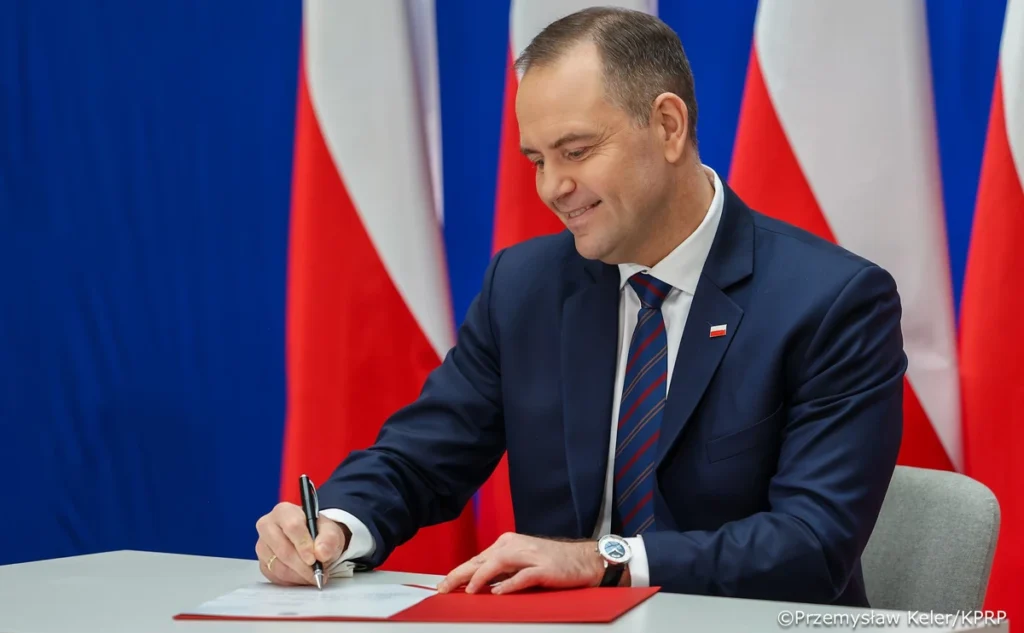
President Karol Nawrocki considers vetoes of legislation on judicial reform, agricultural subsidies, and cybersecurity measures.
Judicial Reform and KRS
President Karol Nawrocki is preparing to veto a bill that would significantly reform the National Council of the Judiciary (KRS). The government-backed project proposes changing how judicial members are selected and reducing politicians’ influence on the body responsible for judicial appointments. This reform aims to address years of conflict over the legitimacy of the current Council, which has become a major point of dispute between Poland and EU institutions.
Since 2018, fifteen judicial members of the KRS have been elected by the Sejm, replacing the previous model where judges selected their own representatives. This mechanism has been repeatedly criticized by the Court of Justice of the European Union (CJEU) and the European Court of Human Rights, which noted that such selection methods may violate judicial independence principles. The CJEU has emphasized in several rulings that national bodies responsible for judicial appointments must be free from political influence.
The government project proposes restoring a model where the judicial community would have decisive influence in selecting most KRS members. At the same time, it plans to expire the mandates of current Council members and hold new elections. This element raises the biggest doubts at the Presidential Palace, particularly regarding the status of judges appointed with the current KRS’s involvement.
Agricultural Subsidies (“Active Farmer” Bill)
President Nawrocki also plans to veto the “Active Farmer” bill, which aims to clarify the definition of an actively engaged agricultural producer. This clarification is significant when awarding direct subsidies under the European Union’s Common Agricultural Policy.
Poland distributes approximately 17 billion złoty in direct subsidies to farmers annually through the Agency for Restructuring and Modernization of Agriculture. The new regulations aim to limit the phenomenon of subsidies being claimed by individuals not actually engaged in agricultural production. However, critics argue that the proposed solutions may harm small and family farms that struggle to document full production activity under new criteria.
A veto of this bill would have both political and financial implications, as direct subsidies constitute a primary source of income for many farms. Poland has over 1.3 million agricultural holdings, most of which are family farms covering less than 10 hectares.
Ukrainian Refugee Protection
In contrast, President Nawrocki will support a bill that replaces the current special law regarding assistance to Ukrainian citizens. The special provisions, in effect since March 2022 following Russia’s full-scale invasion of Ukraine, have allowed Ukrainian citizens to obtain legal residency in Poland, access to the labor market, social benefits, and healthcare.
The new regulations would incorporate these provisions into the standard legal system. Ukrainian citizens would retain the right to legal residence and work, with the validity period of their status extended. The legislation would also introduce the possibility of applying for further legalization of residence until at least March 2027.
Cybersecurity Law
The president’s position regarding the amendment to the National Cybersecurity System Act, which implements the EU’s NIS2 directive, remains uncertain. The new regulations significantly expand the scope of entities subject to cybersecurity obligations.
The directive covers sectors including energy, banking, transport, healthcare, and digital infrastructure operators. According to estimates from the Ministry of Digital Affairs, the new regulations could cover tens of thousands of entities in Poland. The project also provides for the possibility of the Minister of Digital Affairs designating certain companies as high-risk suppliers, which could lead to orders to withdraw specific technologies from critical infrastructure.
Legal Implications
President Nawrocki has 21 days to sign a bill, veto it, or refer it to the Constitutional Tribunal. Overriding a veto requires a three-fifths majority vote in the Sejm with at least half of deputies present—practically requiring at least 276 votes, which is very difficult in the current parliamentary configuration.
Nawrocki’s decisions could significantly impact the pace of judicial reform, the agricultural subsidy system, and the implementation of EU regulations. The dispute surrounding the KRS remains one of the most important elements of the institutional conflict in Poland, with both domestic and international consequences.