


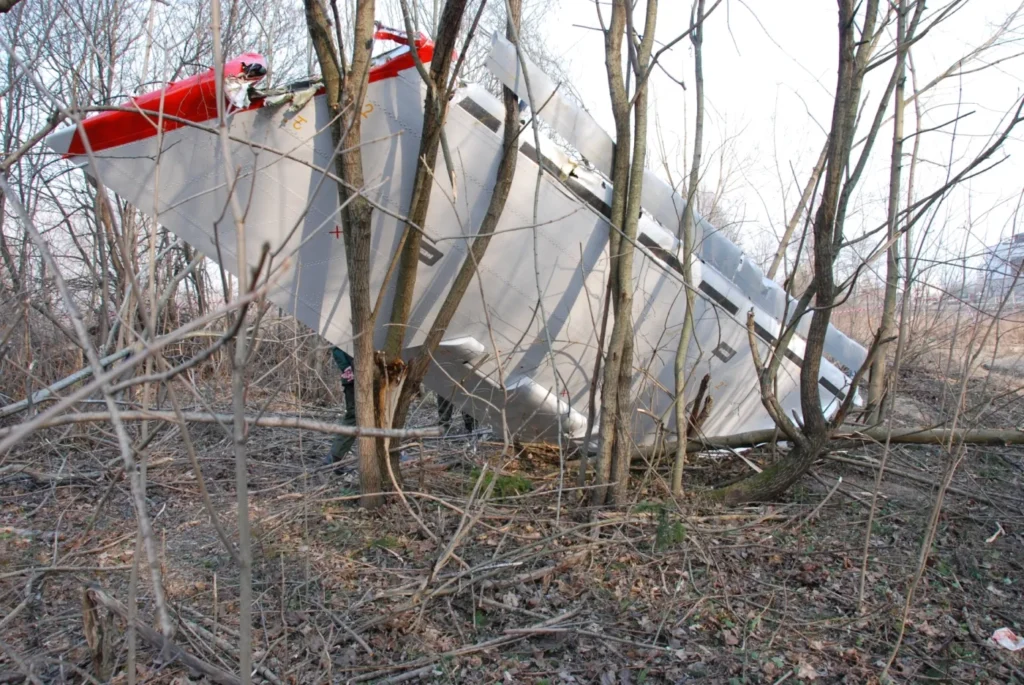
Sixteen years after the 2010 Smolensk air disaster, investigations and commemorations continue to fuel debate over the tragedy’s cause.
Smolensk 2010: The Disaster and Its Aftermath
On April 10, 2010, a Tu-154M aircraft belonging to the 36th Special Air Transport Squadron crashed at Severny Airport in Smolensk, Russia. The plane was carrying 96 people, including President Lech Kaczyński and his wife Maria, along with members of parliament, government officials, military leaders, and representatives of the Katyn families, en route to commemorations marking the 70th anniversary of the Katyn massacre.
All on board perished. The body of President Kaczyński was returned to Poland on April 11th, and his funeral, along with that of his wife Maria, took place in Krakow on April 18th, 2010, with both interred at Wawel Cathedral. Funerals for other victims followed in the weeks after the crash.
Initial Investigation and Conflicting Reports
Immediately following the disaster, investigations began. At the suggestion of the Russian side, Annex 13 to the Chicago Convention – governing civil aircraft and designating the crash site country as the lead investigator – was applied, along with its detailed procedures. The Russian commission MAK led the investigation under this framework.
Poland also conducted its own investigation, establishing the State Commission for Investigation of National Aviation Accidents, initially headed by Edmund Klich, the Polish representative to MAK, and later by Minister of Interior and Administration Jerzy Miller.
MAK Report and Findings
In July 2010, following the presidential elections won by Bronisław Komorowski, a parliamentary team was formed to investigate the Smolensk disaster. Led by Antoni Macierewicz, the team consisted solely of PiS (Law and Justice) MPs and became a proponent of alternative theories, often suggesting the crash was an act of sabotage.
The MAK report, released on January 12, 2011, attributed the crash to the flight crew’s failure to initiate a go-around despite being repeatedly informed of deteriorating weather conditions at Smolensk Airport, which were below minimums. The report also cited a descent below the minimum descent altitude for a second approach and inadequate response to TAWS warnings, leading to a collision with obstacles.
MAK also noted the presence of General Andrzej Błasik in the cockpit until impact as adding psychological pressure. The report’s claim of alcohol in Błasik’s blood drew protest from the Polish side. Macierewicz dismissed the report as fundamentally false.
The Miller Report: Polish Findings
Polish authorities deemed the MAK report incomplete and biased, submitting their own observations. Concerns were raised regarding errors in air traffic control at Smolensk Airport and the lack of information provided by Russia.
The Polish side attributed the crash to a failure to divert to an alternate airport, insufficient information regarding vertical visibility, and a delayed go-around command. The report also suggested the crew was misinformed about their position and course. The actions of air traffic controller Nikolai Krasnokutsky were also questioned, potentially indicating an attempt to conceal shortcomings in Russian air traffic management.
Further Investigations and Controversies
The report by the State Commission for Investigation of National Aviation Accidents, led by Jerzy Miller, released on July 29, 2011, identified numerous irregularities on the Polish side, as well as the responsibility of Russian air traffic controllers and inadequate airport equipment. Miller emphasized that the crash was the result of a confluence of circumstances.
The commission determined the aircraft was technically sound until impact. Examinations of the TAWS and flight management systems in the US confirmed their proper functioning.
The commission concluded the Tu-154M crew was not attempting to land, but rather performing a practice approach in dense fog. However, the go-around command was issued too late – at an altitude of 39 meters – and a 5-second delay occurred between the command and the crew’s response, during which the aircraft continued to descend while the terrain ahead rose.
Ultimately, the aircraft collided with a birch tree after initiating a go-around too low, resulting in a wing fracture, a half-roll, and a crash. A key difference from the MAK report was the identification of errors by Russian air traffic controllers in providing inaccurate information about the aircraft’s position and course.
Subsequent Developments and New Reports
Following the release of the Miller report, the 36th SPLT was disbanded, charges were filed against two of its commanders, and the Minister of National Defence, Bogdan Klich, was dismissed and replaced by Tomasz Siemoniak.
On April 7, 2012, the parliamentary team led by Antoni Macierewicz presented a summary of its two-year investigation, concluding that the crash was caused by two strong shocks on board the aircraft – to the left wing and inside the fuselage – rather than a collision with a birch tree.
The undersecretary of state in the Ministry of National Defence, Władysław Kosiniak-Kamysz, dissolved the Smolensk sub-commission. A 20-person team, led by Colonel Leszek Błach, investigated the work of the sub-commission and released a report in January 2024, finding that the sub-commission cost the state treasury over 81 million złoty and led to 41 criminal complaints.