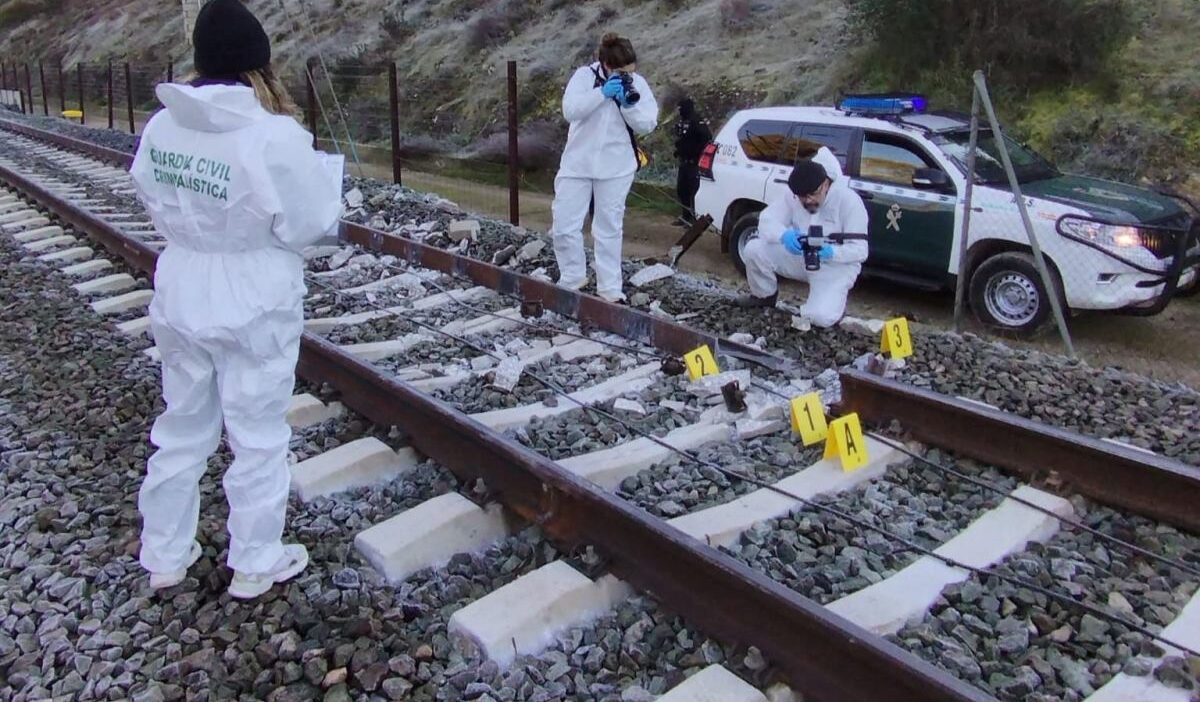
High-speed train collision in Spain kills 39, injures 120; missing track segment fuels sabotage theories.
Train Disaster in Andalusia
The tragedy occurred on Sunday evening, January 18, in the town of Adamuz in Andalusia, about 200 kilometers north of Malaga. As a result of one high-speed train derailing and colliding with an oncoming train, at least 39 people died. More than 120 passengers were injured, with several in critical condition. This was the deadliest train accident in Spain since 2013. Both trains were carrying a total of about 400 people.
Railway traffic on one of the key lines connecting Madrid with Andalusia was suspended, affecting the operation of more than 200 trains.
Published Photos of Tracks. One Detail Draws Attention
Spanish Civil Guard published photos from the disaster site. These photos drew the attention of the public and experts. The photographs show a clear section of the track where a section of rails is missing, and concrete sleepers are crushed and severely damaged.
The photos immediately sparked a wave of comments. Internet users are considering possible causes of the train derailment. However, Spanish authorities emphasize that it is too early to draw definitive conclusions at this stage.
Speculation About Sabotage Emerges
Although politicians and investigators call for restraint, speculation about possible sabotage has appeared in the public sphere. Some analysts point this out, noting similarities in track damage to previous sabotage acts known from other countries, including Poland.
“Railway track after the disaster in Spain. 39 victims. I am curious about the official findings, as it resembles the one in Poland after Russian saboteurs used explosives and then fled to Belarus,” wrote analyst Jarosław Wolski. For now, however, Spanish authorities do not confirm any of these hypotheses.
Tracks Renovated for 700 Million Euros
Spain’s Transport Minister Oscar Puente announced that the section where the accident occurred was renovated in May 2025. About 700 million euros were invested in the modernization. The route was straight, and the speed limit on it was 250 km/h.
According to carriers, the trains were moving much slower – one was traveling at about 110 km/h, the other at about 200 km/h. Excessive speed and human error have been preliminarily ruled out. One of the trains underwent a technical inspection just three days before the disaster.
Victim Identification Ongoing
Dozens of rescuers, firefighters, and medical services worked at the disaster site. Due to the difficult, mountainous terrain, the rescue operation was exceptionally complicated. Police set up a point in Córdoba where victims’ families can provide DNA samples for identification of the deceased.
As reported by the Polish Ministry of Foreign Affairs, there is currently no information that Polish citizens are among the victims or injured. The exact causes of one of the largest railway disasters in Europe in recent decades will be known after the investigation commission completes its work.