


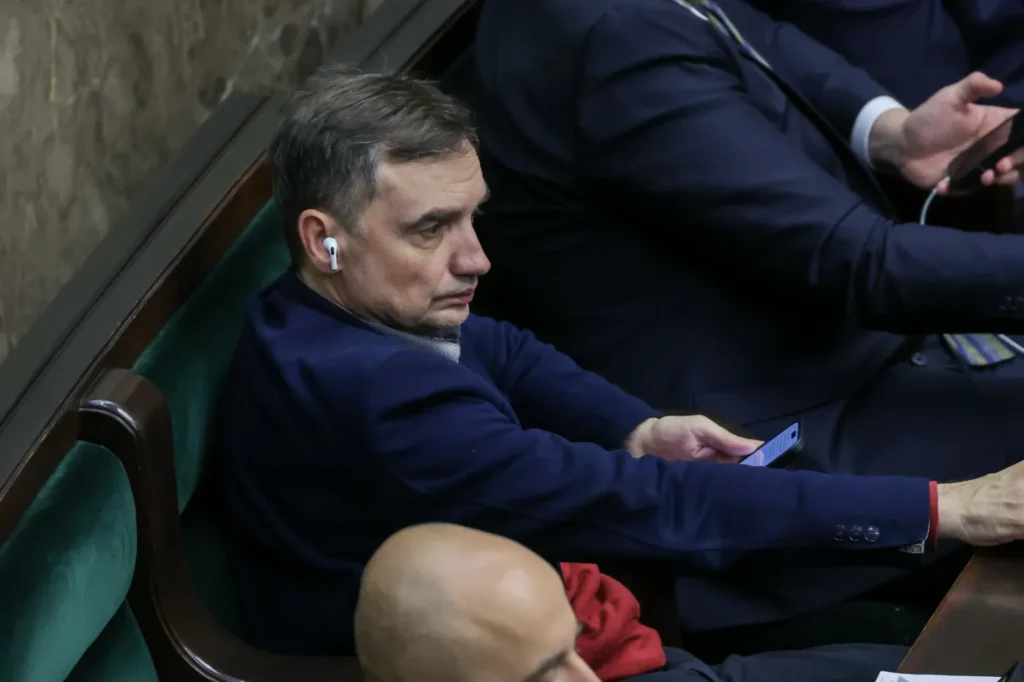
Poland’s ruling coalition is moving to initiate State Tribunal proceedings against Zbigniew Ziobro, former Minister of Justice, citing constitutional and criminal offenses.
Coalition Seeks Tribunal for Ziobro
Minister of Interior and Administration Marcin Kierwiński stated that any legal tool is appropriate to address the alleged misconduct of Zbigniew Ziobro during his tenure. He also expressed hope for Ziobro and Marcin Romanowski’s swift return to Poland.
Zbigniew Konwiński, head of the Civic Coalition parliamentary club, announced that a motion for a State Tribunal for Ziobro will be submitted to the Sejm on Wednesday, signed by MPs from the governing coalition parties: Civic Coalition, The Left, Polish People’s Party, Poland 2050, and the Center.
Details of the Accusations
The motion against Ziobro contains a total of 51 charges, including 25 related to alleged constitutional violations and 26 linked to suspected common crimes. The document exceeds 250 pages, includes 117 pieces of evidence, and anticipates the questioning of 68 individuals before the Commission for Constitutional Responsibility.
Jarosław Urbaniak, secretary of the Civic Coalition club, has been designated as the representative of the motion’s proponents.
Prosecutor General’s Notification and Prior Announcements
At the end of November, Prosecutor General Waldemar Żurek informed the Speaker of the Sejm about the charges against Ziobro. The prosecution indicated this notification could serve as a basis for the Sejm to consider whether the alleged legal violations constitute a constitutional offense, potentially leading to Ziobro’s accountability before the State Tribunal.
Sejm Speaker Włodzimierz Czarzasty had previously announced the intention to submit a preliminary motion for Ziobro’s referral to the State Tribunal.
State Tribunal Process
A motion to hold a Member of Parliament accountable before the State Tribunal requires a preliminary submission signed by at least 115 MPs. The Sejm Speaker forwards this motion to the Commission for Constitutional Responsibility, which initiates proceedings. The Commission submits a report to the Sejm with a recommendation for or against accountability before the State Tribunal. The Sejm then votes on the matter, requiring a three-fifths majority (276 votes) with at least half of the statutory number of MPs present.
Ziobro’s Response
Ziobro, when questioned about the potential State Tribunal proceedings, stated he would return to Poland to defend himself and present the facts, alleging the government intends to silence him and suppress the truth.
International Protection and Recent Developments
Ziobro was found to be outside of Poland when the Sejm agreed to his detention and temporary arrest, and a prosecutor issued an arrest warrant. He subsequently received international protection in Hungary.
Allegations in the Justice Fund Case
Regarding the Justice Fund case, prosecutors accuse Ziobro of leading a criminal organization and abusing his position for criminal purposes, alleging 26 offenses including issuing unlawful directives to subordinates to secure grants for favored entities and interfering with the competition process.
European Arrest Warrant and Legal Challenges
To date, the court has not ruled on the prosecution’s request for a European Arrest Warrant for Ziobro. A wanted notice has been issued, following the District Court for Warsaw-Mokotów’s approval of an arrest warrant in February, which then led to the EAW request.
Both an appeal against the arrest warrant and the EAW request are currently being processed in the Warsaw Regional Court. Defense attorneys have sought the recusal of judges assigned to the case, and the appeal regarding the arrest warrant is now before a panel of three judges. The court also addressed motions for recusal in the EAW matter, and recently rejected a defense request to suspend proceedings on the EAW, which is now under appeal.
Hungarian Leader’s Statement
Following the parliamentary elections in Hungary, Peter Magyar, leader of the winning TISZA party, announced that Ziobro and Marcin Romanowski, also under protection in Hungary during Viktor Orbán’s government, would not remain in Hungary for long.