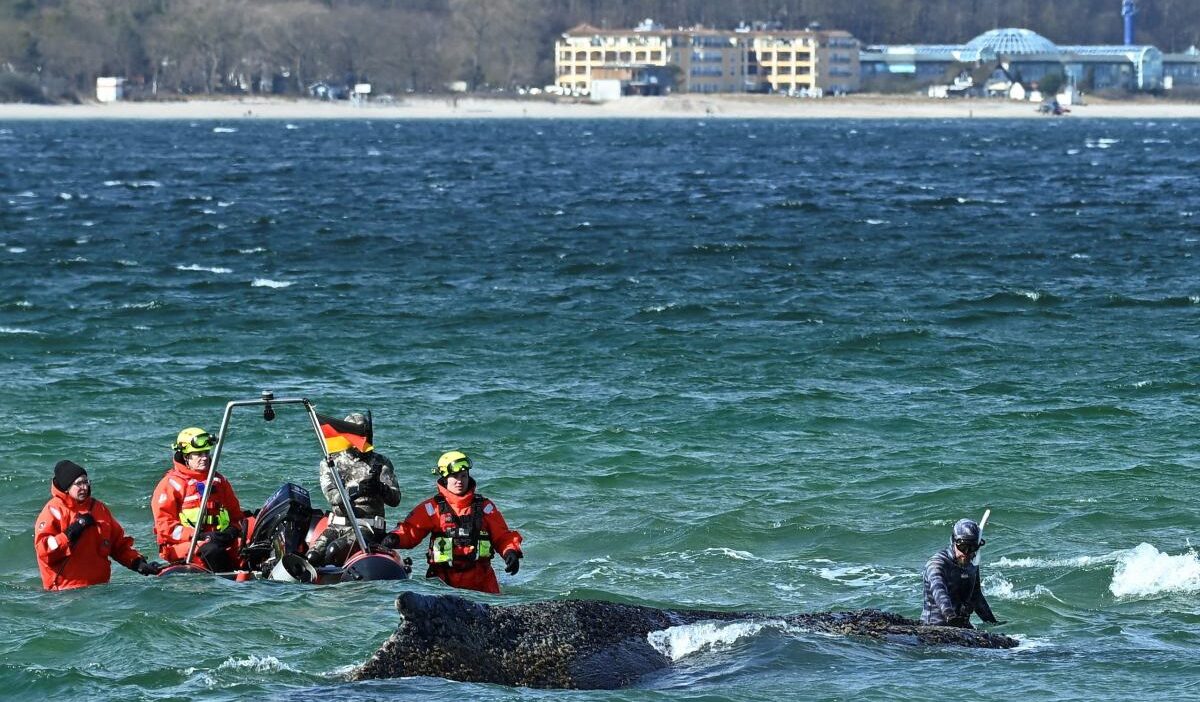
A humpback whale stranded off the coast of Germany near Wismar is unable to free itself, and its condition is rapidly deteriorating, experts say.
Whale Unable to Self-Rescue
German experts confirmed Tuesday that the humpback whale, stranded near Wismar on the Baltic Sea, cannot free itself. The whale is lying in very shallow water.
The water level is currently 1.40 meters, with the whale situated in a 30-centimeter deep, soft seabed. Approximately 40 centimeters of the whale’s back remains above water. Experts estimate the whale would need 60 centimeters more water to float free.
Deteriorating Condition and Lack of Forecast Improvement
Unfortunately, no improvement in water levels is forecast for the next four days; a slight decrease is expected. The whale also lacks the strength to attempt self-rescue.
Experts describe the situation as deeply distressing, emphasizing the suffering of the animal. The whale has been wandering in the Baltic Sea, outside its natural habitat, for several weeks and has been stuck in shallow water for over a week.
Rescue Attempts Ruled Out
After a renewed assessment on Tuesday morning, experts have ruled out the possibility of rescuing the approximately 12-15 meter whale and transporting it to the North Sea.
Unsuitable for Transport, Further Decline
Stephanie Gross of the Institute for Wildlife Research stated the whale is unsuitable for transport, as lifting it could cause severe skin damage and increased suffering. Existing organ damage is also suspected.
The whale’s condition worsened Tuesday, showing no response to approaching boats and a deterioration of its skin condition.
Unique Global Case, Future Preparedness
Researchers note this is a remarkably rare event, potentially the first documented case of a humpback whale becoming stranded four times. The low water level prevents it from reaching deeper waters.
Till Backhaus, Minister of the Environment for Mecklenburg-Vorpommern, proposed collaboration with neighboring coastal states – Lower Saxony and Schleswig-Holstein – to prepare for similar incidents in the future, emphasizing the need for a coordinating function.
Post-Mortem Examination Planned
Once the whale dies, scientists will conduct a thorough examination to determine the cause of death. The University of Rostock has expressed interest in obtaining the whale’s skeleton.