


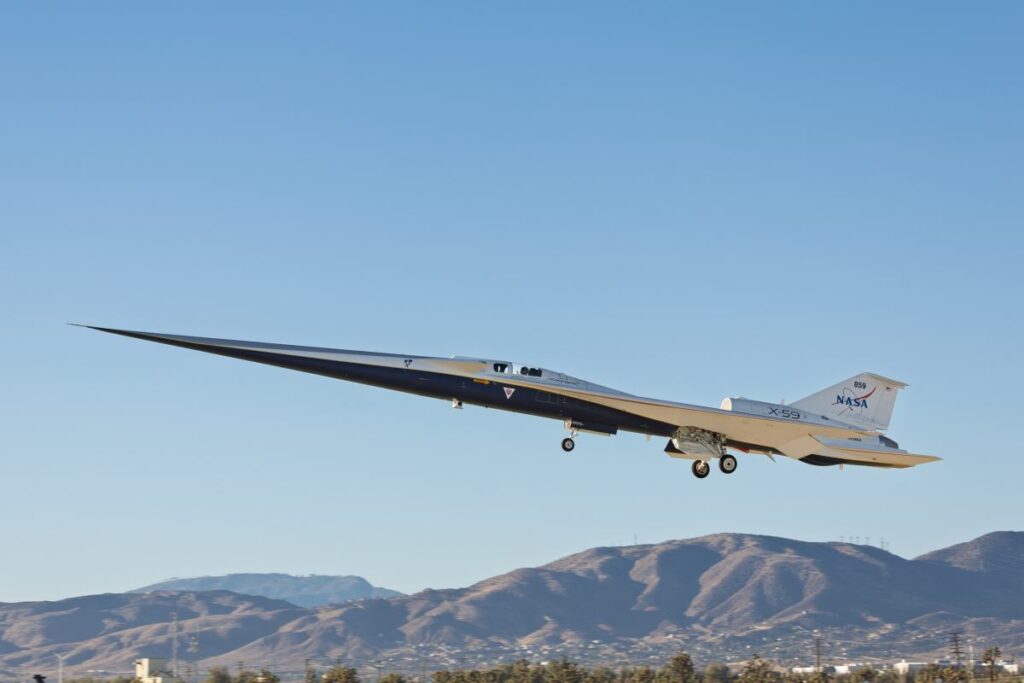
The Lockheed Martin X‑59, NASA’s supersonic research plane, had its inaugural flight on October 28 from Palmdale, California.
First Flight and NASA’s Initial Silence
On 28 October the Lockheed Martin X‑59 took off from Palmdale, California. U.S. government agencies were closed due to a missing fiscal‑year budget, so NASA was not actively working and did not release photos or recordings. Lockheed Martin conducted the first flight on its own account.
Design to Minimise Sonic Booms
The X‑59 is unusually long and slender, with an extremely extended nose, small canard wings in front of the cockpit, delta‑shaped wings and similarly shaped tailplanes. These features are meant to produce as little shock‑wave as possible when the aircraft crosses the sound barrier.
How Sonic Booms Form
Even with a streamlined shape, aircraft push air ahead of them—especially along the nose, leading edges and any protrusion from the hull—and pull air behind them. The faster the aircraft, the more compressed the air in front and behind. When breaking the sound barrier, the separate pressure waves can no longer keep apart and merge into a single, large wave—the sonic boom. The boom is heard as a deep bass noise and is present continuously while aircraft remains supersonic, becoming louder with larger or faster planes.
Historic Lessons in Shock‑Wave Impact
In the 1950s, high‑speed experimental and military aircraft became routine and the expectation was that the sonic boom would be largely attenuated by high altitude. However, bombers such as the B‑58 Hustler and the experimental XB‑70 Valkyrie still generated powerful booms at ground level. U.S. SST experiments found the boom to be irritating and occasionally harmful to people and buildings, creating public opposition and contributing to the abandonment of mass supersonic passenger flight.
Modern Efforts and Future Commercial Supersonic Travel
After five years of development, the X‑59 is now in flight. A two‑phase testing program will first measure the boom produced over specially prepared test sites, then examine its impact on selected towns. The data will inform legislative discussions in Washington that could allow private companies to build commercial supersonic aircraft and establish the necessary legal framework, potentially enabling U.S. firms to dominate a segment of air transport.
Boom Technology’s OverTure Aiming to Deliver Big‑League Speed
Founded in 2014, Boom Technology has built on earlier research to pursue its Overture supersonic passenger aircraft. From spring 2024 through winter 2025 the company tested assumptions with the small experimental XB‑1. Early 2025 saw two supersonic flights with the goal of a minimal boom; the XB‑1 was then withdrawn. The first Overture prototype flight is slated for 2027, though this date is uncertain because new engines, called Symphony, are still being tested individually. Construction of the full test stand just began and is expected to finish in 2026. Given the project’s ambitions, a rapid transition from no engine to flight in two years seems unrealistic.
Is There a Market for Supersonic Passenger Flights?
Boom Technology argues that demand exists, targeting corporate directors and ultra‑rich passengers. As operating costs are high, the ticket price for Overture is envisioned to be comparable to business‑class fares on conventional jets, with flight times roughly halved. The company projects demand for a few hundred such aircraft, but this depends on the ability to fly supersonically over populated areas. If the sonic boom cannot be effectively muted, the concept cannot be pursued. The X‑59 tests will be critical in verifying this assumption.