


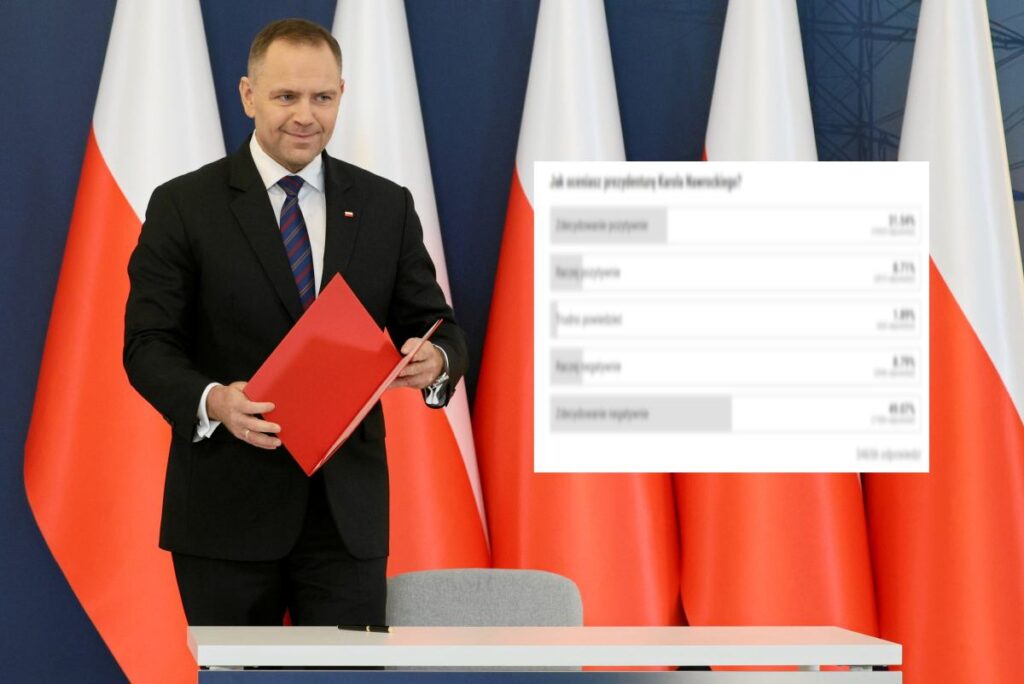
A survey following a US diplomat’s reaction to a presidential veto reveals strong public sentiment toward President Karol Nawrocki.
Survey Shows Strong Public Reaction
A survey appeared under a text about the reaction of an American diplomat to the presidential veto, which in a short time collected tens of thousands of responses. It concerned the overall assessment of Karol Nawrocki’s actions and quickly became a measure of public sentiment.
The results show not only emotions related to a single decision, but also a broader picture of the president’s perception. The distribution of votes clearly indicates where criticism dominates and where support appears.
Critical Assessment Clearly Dominates
Over 49 percent of voters chose the definitely negative answer, making it the most frequently chosen option in the entire survey. This shows that a significant portion of voters critically assess Karol Nawrocki’s presidency. The scale of the advantage of negative responses shows that this is not just a reaction to a single event.
The rather negative response also achieved a high score. This distribution of votes shows the predominance of negative assessments among participants in the survey.
Positive Votes Are in the Minority
Definitely positive assessment was marked by slightly over 31 percent of voters. A minority, but at the same time the largest group among those declaring support for the president. The result suggests the existence of a stable electorate that clearly positively evaluates his actions.
The rather positive response collected significantly fewer responses. This shows that people favorable to the president more often choose decisive declarations than a moderate position.
Emotions Dominate Over Neutrality
The ‘hard to say’ option was chosen by less than 2 percent of voters, which is a marginal result. Such a low percentage of neutral responses shows that Karol Nawrocki’s presidency evokes clear and unambiguous emotions.
The vast majority of voters already have a defined opinion. This picture indicates a high level of engagement and careful following of politics. The president’s decisions are widely commented on and rarely go unnoticed.
This is also a signal that the next actions of the head of state will be evaluated with equal intensity.