


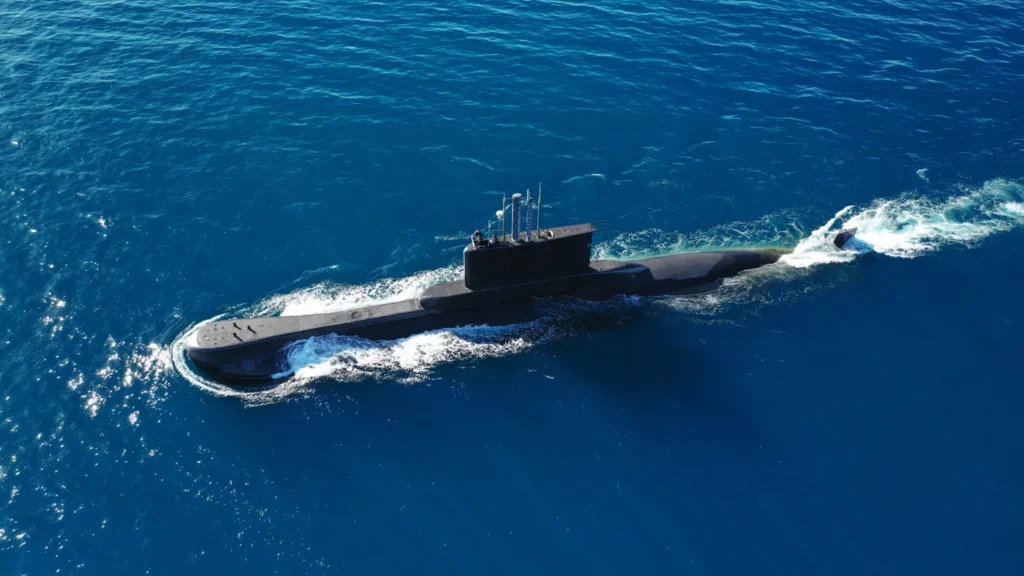
Sweden has been selected to provide submarines for the Polish Navy, with the first vessel expected in 2030, following a competitive bidding process.
Swedish Submarines for Polish Fleet
Two A26-type submarines are currently under construction at Saab’s shipyards in Karlskrona, Sweden, for the Swedish Navy; the same type has been chosen for the Polish Navy.
Swedish company officials and engineers assure they can meet the delivery deadline of the first submarine in 2030.
Orka Program Selects Swedish Design
Deputy Prime Minister and Minister of National Defence Władysław Kosiniak-Kamysz announced late last year that Sweden and its A26 Blekinge-class submarines were selected as the partner in the Orka program, aimed at acquiring new submarines for the Polish Navy.
Sweden prevailed over competitors from Italy, France, Spain, Germany, and South Korea.
Intergovernmental Agreement and Contract Negotiations
An intergovernmental agreement has been signed between Poland and Sweden, and contract negotiations are underway, expected to conclude in late spring.
Politicians from both Baltic Sea nations emphasize that cooperation on submarines is a key element of the developing Polish-Swedish strategic partnership.
Contract Finalization Expected Soon
According to Peter Sandwall, Sweden’s Deputy Minister of Defence, negotiations regarding the submarine order may be finalized in late spring or early summer, paving the way for the contract’s signing.
Polish defense industry companies, particularly those within the Polish Armaments Group, will be involved in both the construction and subsequent maintenance of the submarines.
Maintenance and Repair Capabilities Crucial
Swedish engineers and military personnel emphasize the importance of developing adequate capabilities for maintaining and repairing the submarines on both sides of the Baltic Sea.
Advanced constructions like submarines require frequent and regular overhauls; currently serving Swedish Navy submarines undergo dockings approximately every two years for repairs or minor modernizations.
Karlskrona: A Historic Naval Base
The new submarines for Poland and Sweden will be built in Karlskrona – a city of approximately 30,000 located on several islands in the archipelago off Sweden’s south coast, and the Swedish Navy’s most important base.
Founded in the 17th century to support the developing fleet of the then-European power, the ice-free port, located several hundred kilometers south of Stockholm, allowed for easier control of the Baltic Sea and shipping routes to the North Sea.
Karlskrona Today: UNESCO Heritage and Saab’s Hub
Today, Karlskrona is a UNESCO-listed baroque city and port, as well as the largest base for the Swedish Navy – including the submarine flotilla – and a key shipyard for Saab.
The city’s life revolves around the base and shipyard, with a large portion of the population connected to them; naval officers and engineers are often close acquaintances due to their shared military background.
Saab’s A26 Submarine: A Modern Design
The A26-class submarines being built in Karlskrona represent Saab’s latest design, building on nearly a century of submarine construction for the Swedish Navy.
The shipyard is now part of Saab Kockums, which is changing its name to Saab Naval; previously, from the early 21st century until 2014, the company was owned by the German TKMS group, but was repurchased by the Swedes in 2014 due to its strategic importance.
Initial Delays and Cost Increases
Shortly after Saab acquired Kockums, the Swedish government ordered new submarines in 2015 to replace older A17-class vessels.
The new project was named A26, with the Swedish Navy initially scheduled to receive two Blekinge-class submarines in 2022 and 2024; however, neither submarine has yet left the shipyard, with current delivery dates set for 2031, and significant cost increases.
Addressing Past Issues and Future Prospects
Shipyard workers attribute the delays to past ownership changes and the policies of the former German owner, TKMS, a manufacturer of its own U212-class submarines.
Saab representatives now state that the program is back on track, and the ambitious delivery date of the first Polish submarine in 2030 is achievable.
“If we weren’t prepared to carry out such a project, our country wouldn’t be so eager to get involved in the Orka program,” stated Mats Wicksell, head of the Karlskrona shipyard.
Gap Filler and Training Submarine
The Polish Navy will receive a training submarine before the completion of the new vessels.
The agreement with Sweden includes a “gap filler” – an A17-class submarine that Polish submariners can use for training before the new equipment arrives; this submarine is comparable in age to the ORP “Orzeł,” currently serving in the Polish Navy.
The Swedish Södermanland submarine is in better condition, having undergone a thorough overhaul and modernization.
Modular Construction and Rapid Deployment
Saab engineers state that the shipyard has been expanded to accommodate the simultaneous construction of multiple submarines.
This allows for the rapid commencement of construction of the first Polish submarine immediately after the formal order is placed.
Modular Design for Flexibility and Modernization
All submarines built at the Karlskrona shipyard are modular, assembled from individual hull sections like building blocks.
This approach allows for design flexibility and future modernization, as demonstrated by the addition of an air-independent propulsion (AIP) module to older Swedish submarines during major overhauls.
Rigorous Testing and Safety Features
The first A26 submarine will undergo rigorous testing before entering service with the Swedish Navy, including extended submerged periods on the Baltic Sea floor and detonation tests to assess its shock resistance.
The results will inform improvements to subsequent submarines, including those destined for Poland, before their completion.
Noise Reduction and Vibration Isolation
Key infrastructure on the A26 is mounted on rubber bases to minimize the impact of shocks.
The submarine’s engines are also mounted on rubber bases within specially constructed Polish-made Base Group enclosures, further reducing noise and vibration; engineers claim that vibrations from the engine at full throttle are so minimal that a coin balanced on the engine cover would not even move.
AIP System for Extended Submerged Operations
In addition to conventional diesel engines, the A26 submarines are equipped with an AIP system based on a Stirling engine.
Stirling engines operate using an external heat source and generate virtually no noise because they do not involve fuel combustion.
They can operate for several weeks without access to atmospheric air, allowing the submarine to remain submerged for extended periods.
Silent Operation and Oxygen Supply
The heat for the AIP system comes from burning liquid oxygen, stored in tanks on board the A26.
The combustion process is controlled and nearly silent, with the resulting carbon dioxide released into the water, where it dissolves without creating detectable bubbles.
Armament and Special Operations Capabilities
Swedish A26 submarines can launch heavy and light torpedoes (533 mm and 400 mm, respectively) and deploy sea mines.
They can also transport 11 additional personnel beyond the crew, enabling the transport and deployment of special forces teams.
The submarine is equipped with a Multi-Mission Portal, a special airlock for deploying special operators, launching underwater unmanned vehicles (UUVs), or laying sea mines.
Submarine Specifications
The portal is located on the bow of the submarine, next to the torpedo tubes, with a dedicated compartment behind it for storing UUVs, mines, or additional bunks for commandos.
The submarine has a submerged displacement of approximately 1,900 tons, is about 66 meters long, and nearly 7 meters wide.
The rear half of the submarine houses machinery, including the propulsion system, while the front section contains living and working spaces for the crew, and the bow houses the weapon compartment.
Crew and Rapid Mission Preparation
The submarine crew consists of 26 sailors, but it can operate with a reduced crew of 17.
Peter Östbring, commander of the Swedish submarine flotilla, emphasizes that the entire process of preparing the submarine for a mission – fueling, replacing liquid oxygen tanks, replenishing supplies, and loading torpedoes, mines, UUVs, or special forces – takes only 6 hours.
This is a crucial capability, as preparing other submarines for a mission can take up to 30 hours, leaving them vulnerable to attack while in port.
Challenges of the Baltic Sea Environment
Rear Admiral Johan Norlen, commander of the Swedish Navy, stresses that Swedish submarines must be adapted to operate in the Baltic Sea, which is a challenging environment due to its small size, shallow depth, varying salinity and temperature, and hundreds of islands.
The Baltic Sea also experiences very heavy ship traffic, with around 4,000 vessels per day – several times more than the English Channel.
This traffic includes vessels from the Russian Navy, some of which pose a threat to underwater cables and pipelines.
Designed for Baltic Operations
Military personnel and Saab engineers agree that Swedish designs are primarily intended for operations in the Baltic Sea – they are adapted to dive and hide even in very shallow areas.
Poland’s Current Submarine Capabilities
Within the Orka program, offers were submitted by manufacturers from 6 countries; Sweden’s offer beat out French Scorpene submarines, Italian U212 NFS submarines, German-Norwegian U212CD submarines, and South Korean KSS-III Batch 2 submarines.
Currently, the Polish Navy has only one outdated submarine, the ORP “Orzeł,” built in the USSR in 1985.
The submarine requires regular repairs, and if it is retired without the Swedish proposal, the Navy will have no equipment for training or maintaining submariner skills.