


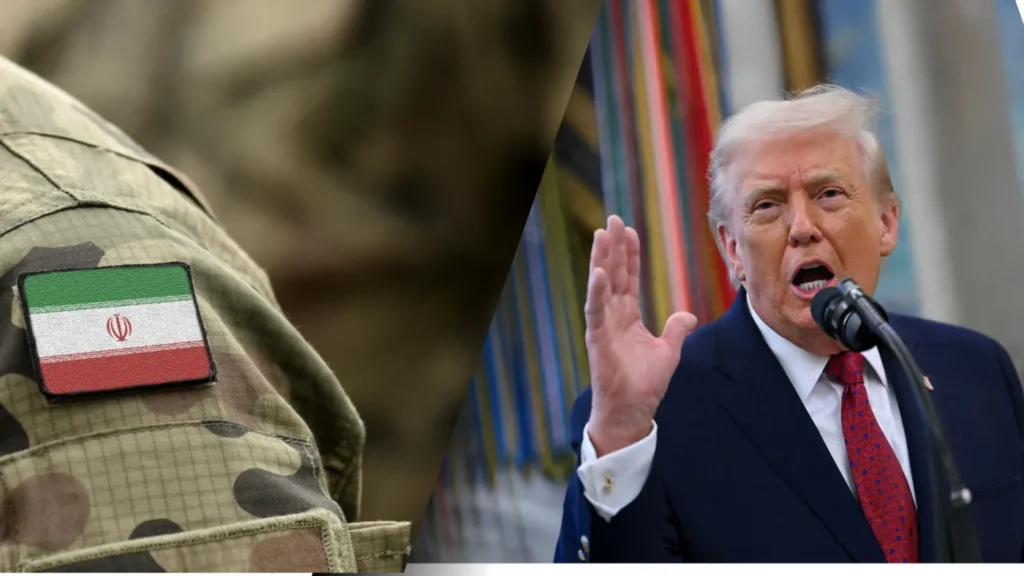
The US, which once threatened Europe with troop withdrawals, now seeks support for its operations against Iran, according to a Polish general.
Europe Proved Useful for the Attack on Iran
An attack on Iran by the United States would be difficult without the ability to use military bases located in Europe. These bases played an important role in the initial phase of the military operations.
The significance of European military bases in the attack on Iran was highlighted by the Center for Eastern Studies. By conducting a detailed analysis of the equipment needed to launch Operation Epic Fury, OSW experts pointed to the use of bases in Italy and the United Kingdom. From Italy, 12 F-16CJ fighters, specializing in countering enemy air defense, were taken, and from the United Kingdom, approximately 30 F-35 and 36 F-15E aircraft. Simultaneously, about 50 aerial refueling aircraft were deployed in European bases, taking advantage of the hospitality of Portugal, the United Kingdom, Germany, Spain, Italy, Greece, and Bulgaria. It is estimated that about 20 percent of all air forces engaged in the fighting at the beginning of Epic Fury were previously stationed in Europe.
Withdrawing Troops from Europe, Now Changing Approach
President Donald Trump made it clear from the beginning of his term that Europe would have to take its security more seriously. One element of the pressure was the threat of withdrawing some of the U.S. troops permanently stationed on the Old Continent.
Matthew Whitaker, the U.S. ambassador to NATO, said in May 2025, “The United States has wanted to reduce the number of soldiers in Europe for over 30 years, and President Trump just said: enough, this will happen and it will happen now, everything will be done in an orderly manner, but we will no longer tolerate sluggishness in this situation… We simply have to face the practical consequences.” The decision in October 2025 to reduce the number of U.S. troops in Romania fueled fears that these threats would be put into action. Then, the U.S. Congress stepped in. In mid-December, it passed a law preventing the president from permanently reducing forces in Europe below the level of 76,000 soldiers. As reported by the end of 2025 by the U.S. European Command (EUCOM), there were 80,000 U.S. soldiers stationed in Europe.
Discussions about withdrawing U.S. troops subsided in early 2026 when the United States began trying to change the government in Venezuela and then heated up the atmosphere around Greenland. In March, when Operation Epic Fury began, Donald Trump began to change his approach to European allies.
Europe Needed to End the War?
Initially, the Americans wanted to use European bases for the attack on Iran, but some countries of the Old Continent refused to cooperate. Spain and the United Kingdom acted this way, although the latter changed its mind after the Iranian attack on the Akrotiri base in Cyprus. After two weeks of bombardments, Donald Trump turned to NATO allies to get involved in unblocking the Strait of Hormuz.
“We have something called NATO. We were very nice. We didn’t have to help them with Ukraine. Ukraine is thousands of miles away from us (…) But we helped them. Now we will see if they will help us. Because for a long time I have been saying that we will be for them, but they will not be for us. And I am not sure if they would,” President Trump said in an interview with the Financial Times.
Germany and Greece refused to participate in the military security of shipping through the Strait of Hormuz. The French are focusing on diplomacy for now, while the British, represented by Prime Minister Starmer, announced that although they are keen on unblocking shipping routes, “they will not be drawn into a war.”
“We are cooperating with all our allies, including European partners, to develop a realistic joint plan that will allow us to restore freedom of navigation in the region as soon as possible and mitigate the economic consequences,” Prime Minister Starmer declared.
US Goal: Pull Allies into the War
Meanwhile, the change in American rhetoric does not surprise General Bogusław Pacek. In his opinion, it was only a matter of time before the US recognized that it needed Europe after all. He also does not believe that European countries would now want to retaliate against Donald Trump for his threats from a few months ago.
“I do not think that an eye-for-an-eye mentality would prevail, because the fear of threats from Russia is too great to allow any games with the United States, even if Trump’s rhetoric would justify it. This is a matter of risk assessment. Today, getting involved in the war around the Iranian issue is extremely risky from the point of view of a possible attack on any country that appears there,” General Pacek said.
However, the general draws attention to an aspect that British Prime Minister Starmer also mentioned in his speech, saying that it will be difficult to make any allied military action in the Middle East a mission for the entire NATO.
“The matter is debatable, because the United States was not attacked. Even if American soldiers are attacked in American bases, it will be difficult to justify it on the basis of defense, although Trump will easily raise the argument that American soldiers are dying there. This will be decided by politicians,” the military man said.
He recalls similar situations from the past, namely the wars in Iraq and Afghanistan. In those cases, Washington managed to assemble international coalitions, although it was not easy. Now, when the war with Iran is not going the American president’s way, the general believes that the US wants to apply a similar scheme as in those conflicts.
“I think that first of all, Donald Trump will want to show the international nature of this operation in Iran, and secondly, to spread the costs. If one day of the operation costs 1.5 billion dollars, that means that after 2 months of the war, its cost will be the same as the aid to Ukraine for 2 years. Therefore, predicting that this war may last, from the point of view of the United States, the best solution is to involve other countries in this war,” said General Bogusław Pacek.