


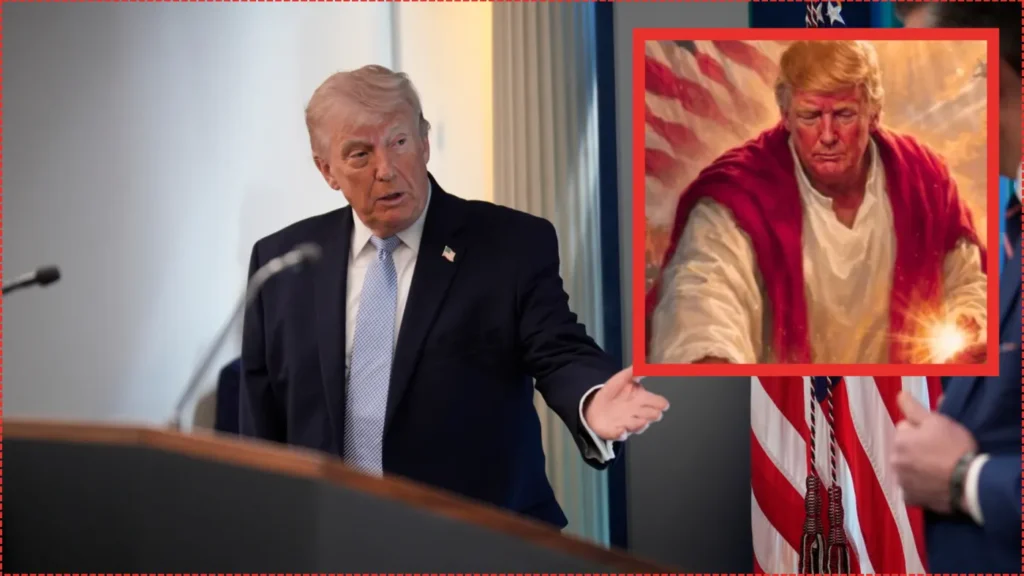
A controversial image portraying Donald Trump as a Christ-like figure sparked public debate and criticism before being removed from his social media.
Image Sparks Immediate Reaction
The publication of an unusual graphic depicting Donald Trump in the role of Christ immediately triggered a reaction from the public and politicians. The image of the U.S. president healing a sick person appeared on social media shortly after his harsh words regarding Pope Leo XIV.
After several hours, the graphic was removed, but the debate it ignited continued.
Visual Composition and Symbolism
The image shared on Truth Social showed Donald Trump in a white robe and red cloak, with his hand placed on the forehead of a sick man. Luminous rays emanated from his hands, clearly evoking religious iconography. The background featured symbols strongly associated with American identity – the Statue of Liberty, the Lincoln Memorial, the U.S. flag, and silhouettes of soldiers styled as angels.
The composition also included figures of a nurse, a veteran, and a praying woman, suggesting a narrative of healing not only an individual but the entire society. Political communication experts note that such visual messages – especially in the age of generative artificial intelligence tools – are increasingly used to build strong emotions and simplified narratives.
Origin and Initial Support
The author of the graphic was not definitively identified, but a nearly identical image was previously published on Instagram by Nick Adams – a right-wing political commentator associated with the movement supporting Donald Trump. Adams, known for his unconditional support for the former and current president, accompanied the graphic with a suggestive caption indicating “healing America.”
Nick Adams was previously nominated for the position of U.S. Ambassador to Malaysia and later served as a special envoy for the promotion of American values. His activity on social media has repeatedly caused controversy due to his overly enthusiastic portrayal of Trump’s actions.
Criticism and Accusations of Blasphemy
The reaction from the public was immediate and largely critical. Brilyn Hollyhand, co-chair of the Republican National Committee’s youth advisory council, described the publication as “egregious blasphemy.” He emphasized that faith should not be a tool of political messaging.
Riley Gaines, a former swimmer and social commentator, publicly questioned the president’s motives, asking if he truly identified with such symbolism. Criticism came not only from political opponents but also from parts of conservative circles, demonstrating the scale of the controversy.
Trump’s Explanation
After several hours, the graphic disappeared from Donald Trump’s profile. The president addressed the matter during a conversation with reporters, explaining that he did not see any religious references in it.
“It wasn’t a depiction of me as Jesus. I thought it was me as a doctor. It had to do with helping people and activities related to the Red Cross,” he said.
Trump emphasized that his political actions bring real social effects. As an example, he cited the situation of a person who – thanks to tax changes regarding tips – was able to obtain additional funds for cancer treatment. During the same situation, the president handed a food delivery worker $100, which was seen as an element of building an image close to ordinary citizens.
Context: Attack on Pope Leo XIV
The publication of the graphic was not an isolated incident. Just an hour earlier, Donald Trump had sharply criticized Pope Leo XIV, accusing him of weakness towards crime and suggesting that his election as head of the Catholic Church was indirectly possible thanks to Trump’s presidency.
The relationship between politics and religion has been a significant element of Donald Trump’s narrative for years. He has repeatedly emphasized his belief in the special role of religion in public life in the United States, stating that “God is proud of his actions.” During speeches, he also referred to international conflicts, using religious rhetoric, which met with mixed reactions both domestically and abroad.
Religious Rhetoric in Trump’s Circle
Religious symbolism also appears in the statements of people close to the president. Paula White-Cain, his spiritual advisor, compared Trump to Jesus during one speech at the White House, pointing to similarities in the context of “betrayal” and “false accusations.” This statement was met with enthusiastic acceptance among some supporters.
Experts point out that such narratives can mobilize the religious electorate, but at the same time carry the risk of alienating more moderate voters. In an era of growing social media and visual messaging, the line between political and symbolic messaging is becoming increasingly blurred.