


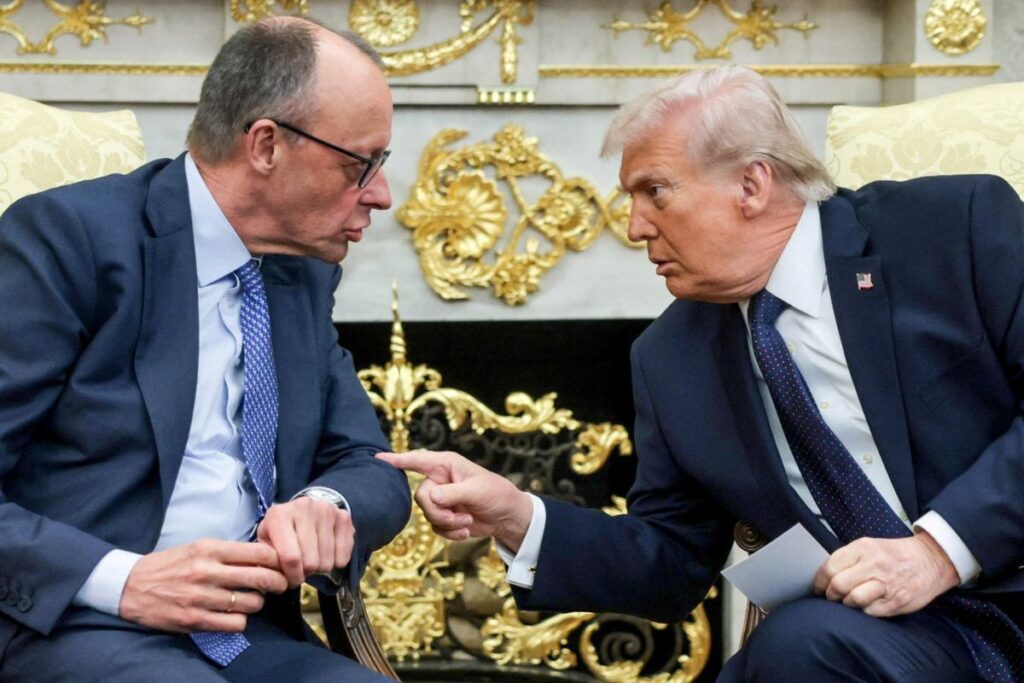
German media report deteriorating transatlantic relations following the Pentagon’s decision to withdraw approximately 5,000 troops from Germany, signaling a rift between President Trump and Chancellor Merkel.
Pentagon’s Troop Withdrawal Signals Strained Ties
The decision by the Pentagon to withdraw around 5,000 American soldiers from Germany signifies worsening transatlantic relations and indicates a breakdown in the previously amicable relationship between U.S. President Donald Trump and German Chancellor Friedrich Merz, according to German media reports on Saturday, May 2nd.
Potential Cancellation of Missile Deployment
“FAZ” reports that the U.S. may forgo the installation of medium-range missiles in Germany. “Frankfurter Allgemeine Zeitung” notes the Pentagon’s decision to reduce the number of U.S. troops in Germany within a year “represents a reversal of the reinforcement that occurred under the presidency of (former U.S. President) Joe Biden” following Russia’s full-scale invasion of Ukraine in 2022.
The newspaper suggests the planned deployment of American medium-range missiles in Germany, agreed upon in 2024 by Biden and then-Chancellor Olaf Scholz, will likely be canceled, including plans for Tomahawk missiles.
Germany’s Strategic Importance
Germany is the second-largest host nation for U.S. forces stationed outside the United States, after Japan. Key bases include Ramstein, a crucial logistical hub for Europe and the Middle East, the largest U.S. military hospital outside the U.S. in Landstuhl, and the largest U.S. military training area outside the country in Grafenwoehr. Stuttgart houses U.S. EUCOM and AFRICOM headquarters, while Wiesbaden hosts the U.S. Army Europe headquarters.
Deteriorating German-American Relations
“FAZ” assesses that the troop withdrawal “worsens German-American relations and may have tangible consequences for the regions affected.” The newspaper recalls that relations between Trump and Merz deteriorated rapidly in recent days due to the situation in Iran.
Merkel’s Directness Deemed “Imprudent”
“Sueddeutsche Zeitung” observes that Trump and Merz previously appeared to respect each other as individuals who expressed their opinions frankly and directly. However, “it now seems that since they began openly commenting on each other’s actions regarding Iran, the stage of friendship has ended,” the newspaper assesses.
Criticism of Merkel’s Approach
According to the newspaper, neither leader is acting responsibly. “Merz set himself two goals: to appear resolute towards the U.S. president and, at the same time, to keep him, even at the cost of excessive politeness, as a necessary ally of Germany and NATO. (…) (Merz’s) criticism of the United States, even if factually correct, serves at most one of these goals,” the paper contends.
Scholz’s Cautious Diplomacy Contrasted
The newspaper notes that Scholz, Merz’s predecessor, always carefully chose his words and “would likely have refrained from such a statement.” “Sueddeutsche Zeitung” states that in relations with the “narcissistic” U.S. president, “Merkel’s directness is imprudent,” and NATO “remains undoubtedly useful and effective, but there is no certainty that it will cope with the current shocks.”
Putin Call’s Potential Influence
“The deepening estrangement is primarily attributable to Trump, who treats allies like vassals and continues to seek evidence to confirm his thesis that European countries are useless freeloaders. At the same time, it is clear that the war with Iran has significantly weakened Europeans’ willingness to exercise restraint in their statements,” states “SZ”.
Personal Animosity and Shifting Alliances
The newspaper believes Trump took Merz’s criticism of the United States very personally, and there was “more than a grain of truth” in the Chancellor’s words. “Because the current U.S. president is largely guided by personal sympathies and antipathies, which can change from minute to minute, Merz is now a problem. And with him, Germany and Europe,” it reads.
Possible Troop Reductions in Other European Nations
“However, it cannot be ruled out that the telephone conversation that Donald Trump had with Vladimir Putin this week also played a significant role. Trump described it as ‘long’ and ‘good,’ adding that he had proposed a ceasefire to Putin. It is possible that in return for such a step, Putin demanded something that Trump was already considering: a reduction in the number of American soldiers in Europe,” “SZ” speculates. Trump has also recently spoken about the possibility of withdrawing U.S. troops from Italy and Spain.