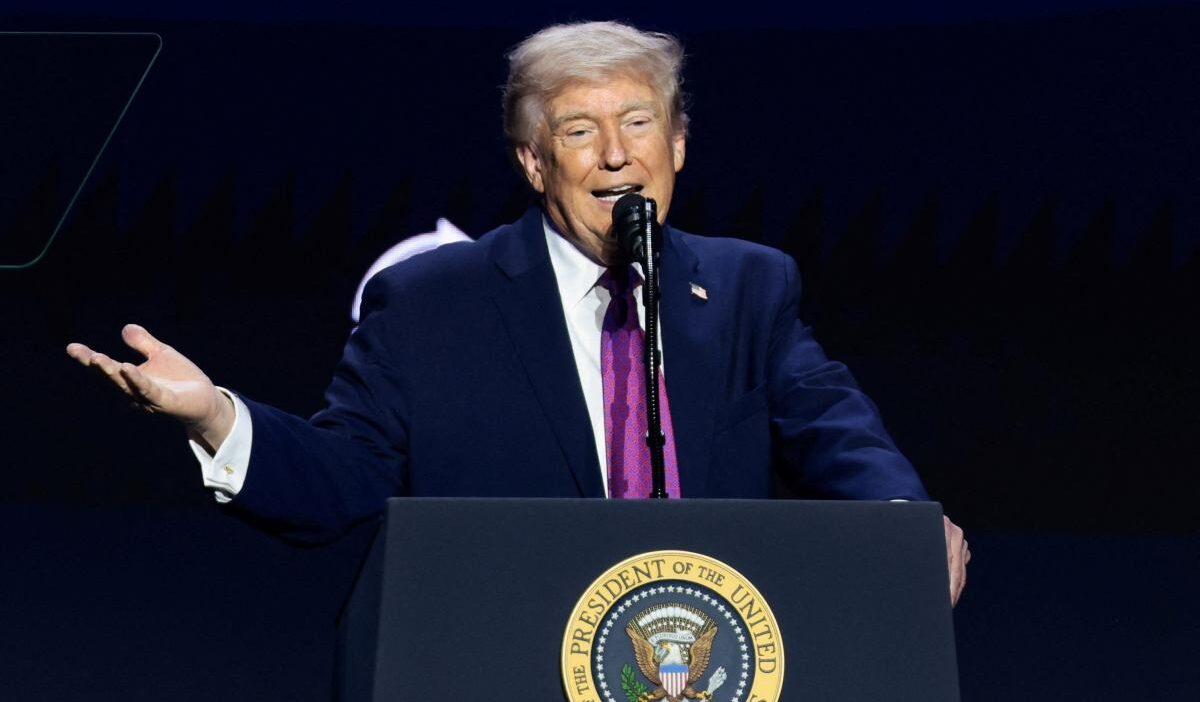
President Trump has ordered the U.S. Navy to target any vessels in the Strait of Hormuz and asserted full American control over the vital waterway.
Trump Issues Order Regarding the Strait of Hormuz
“There is no room for hesitation. Our minesweepers are already clearing the strait of mines. I order to continue these actions on a threefold scale,” the U.S. President emphasized in a Thursday post.
Trump issued an order to the U.S. Navy stating, “We have full control over the Strait of Hormuz.”
Internal Strife in Iran
In a subsequent post, Trump stated that “Iran has a huge problem figuring out who is really in charge and they are getting lost in it themselves.” He added, “There is a fierce internal struggle between the ‘hardliners’ who are suffering serious losses on the battlefield, and the ‘moderates’ who are not so moderate (although they are gaining in importance). It’s all completely chaotic.”
Strait Blockade Until Agreement
Trump further assured that the U.S. has “full control over the Strait of Hormuz.” “No ship can enter or leave it without the consent of the United States Navy. The strait is tightly blocked until Iran agrees to a deal,” he added.
Mine Removal Timeline
The removal of mines could take up to six months.
Pentagon Estimates on Mine Removal
“The Washington Post” reported earlier that the complete removal of mines laid in the Strait of Hormuz by Iran could take up to six months, citing Pentagon estimates.
This assessment by the Department of Defense means that the economic consequences of the current conflict could persist until the end of the year or even longer, the newspaper emphasized. Three officials stated that a high-ranking Pentagon representative shared the estimates with members of the House Armed Services Committee during a secret briefing on Tuesday. The presented timeframe reportedly caused frustration among both Democrats and Republicans.
Potential Economic and Political Impacts
This signals that gasoline and oil prices may remain elevated long after any peace agreement is reached. This could also have political consequences, especially for Republicans, in the face of the upcoming November congressional elections.
Iran’s Mine Deployment and Location Issues
“NYT”: Iran is unable to locate all the charges.
CNN reported that Iran began laying mines in the Strait of Hormuz in March, as the U.S. and Israel conducted attacks on the country. Tehran, however, denied these reports.
Details of Mine Placement
Lawmakers were told that Iran may have laid 20 or more mines in or near the strait. Some of them were deployed remotely using GPS technology, which made it difficult for U.S. forces to detect them during placement, a senior defense official said. The rest were reportedly deployed by Iranian forces using small boats.
Challenges in Locating Mines
According to the “New York Times,” it appears that Iran is unable to locate all the charges it has deployed. It is unclear what plan the U.S. military will implement to clear the waterway. Officials mentioned the possibility of using helicopters, drones, and mine diver teams.
U.S. and Iran Jointly Clearing Mines
As of Friday, Trump stated on Truth Social that “Iran with the help of the USA has already removed or is removing all naval mines.” Admiral Bradley Cooper, who heads the U.S. Central Command, also confirmed that day that U.S. forces are clearing the Strait of Hormuz. He was unable to say how many mines Iran had placed on the waterway, but assured that the number is within U.S. capabilities.