


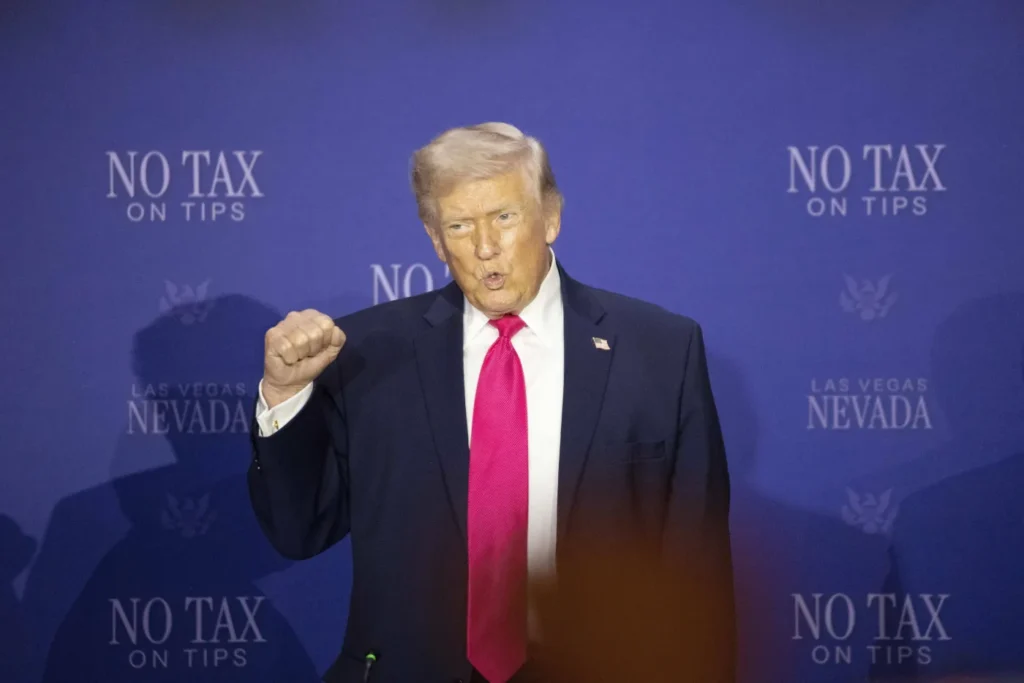
During a Phoenix rally, Donald Trump asserted the US handled a crisis in the Strait of Hormuz alone, criticizing NATO’s delayed offer of help.
Trump Criticizes NATO Response
Donald Trump, speaking at a rally in Phoenix, criticized the US relationship with NATO, suggesting the alliance was ineffective during tensions around the Strait of Hormuz. He claimed the US resolved the situation independently and that allied support arrived too late.
Trump recounted a purported phone call from NATO representatives after the crisis in the Strait of Hormuz had nearly concluded. He sarcastically stated, “Now, when the situation in the Strait of Hormuz was almost over, I received a phone call from NATO asking if we needed help. Thank you very much, NATO.”
Delayed Assistance Claimed
Trump asserted he told NATO officials that assistance would have been useful “two months ago, but now I really don’t need it,” adding the alliance was “absolutely useless” at a critical moment. This aligns with his broader rhetoric emphasizing imbalances in transatlantic relations and criticizing European partners’ financial commitment to defense.
Narrative and Accuracy Concerns
Observers noted the “absurd” nature of Trump’s narrative to his supporters, pointing out inconsistencies – specifically, that Trump did not seek NATO assistance two months prior to any alleged attack on Iran. He reportedly made a unilateral decision without consulting allies or his own parliament.
Disputed Conversation with Rutte
The veracity of Trump’s claim regarding a phone call is unclear. Reports indicate that NATO Secretary-General Mark Rutte did not contact Trump on the date he described. Simultaneously, discussions were underway within an international coalition regarding a potential operation to secure navigation in the Persian Gulf.
Multinational Security Initiative
France and the United Kingdom are leading an initiative to deploy a multinational defensive mission to protect commercial ships and counter threats like naval mines in the region. The Strait of Hormuz, handling approximately 20% of global oil transport, remains a volatile area with significant implications for global energy markets and international security.
US Costs and Alliance Asymmetry
Trump reiterated his argument that the US bears disproportionate costs for the security of its allies, stating Washington spends hundreds of billions of dollars annually on defense, potentially reaching a trillion dollars. He claimed, “They need us. They need us very much,” suggesting an asymmetrical relationship favoring European partners.
“America First” Policy and Global Role
This narrative is central to his “America First” foreign policy, which prioritizes limiting US involvement in international conflicts and renegotiating alliance commitments. Experts note that while the US contributes the largest share of NATO funding, the alliance also provides strategic benefits, including access to military bases in Europe and operational support worldwide.
Iran Negotiations and Nuclear Program
Trump linked tensions in the Persian Gulf to potential negotiations with Iran, stating a deal was close, though “you never know with Iran.” He claimed a potential agreement would involve the US acquiring Iran’s enriched uranium, describing it as “scooping out the nuclear dust with excavators and taking it home.” Tehran denies negotiating under such terms.
Trump also addressed reports of potentially unfreezing $20 billion for Iran, assuring there would be “no money exchange.” This relates to disputes surrounding the 2015 nuclear agreement, from which the US withdrew during his presidency.
MAGA Mobilization and US Global Policy
The Phoenix rally aimed to appeal to supporters of the MAGA movement, who increasingly question US involvement in foreign conflicts. Trump sought to convince them that American presence on the international stage is essential for defending “civilization,” vowing to further strengthen US military dominance.
Experts highlight the tension between isolationist sentiments within American society and the traditional role of the US as a global security guarantor. Amid rising tensions in the Middle East and competition with China and Russia, this debate remains central to US public discourse.