


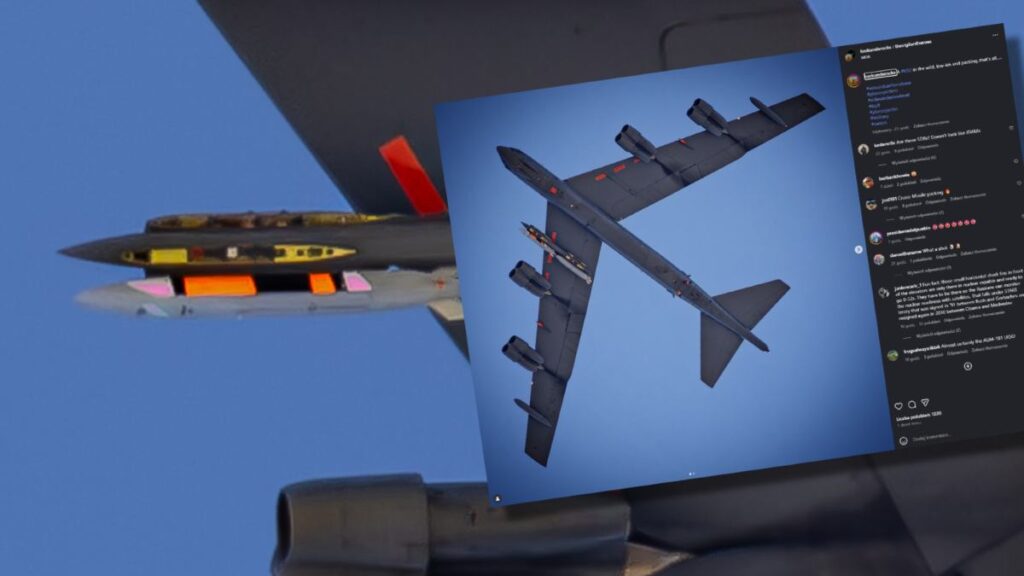
A photograph of a B‑52 carrying secret SRBMs over an unpopulated area near the Nellis Air Force Range went viral on October 29, 2023, while former President Trump hinted at renewed nuclear weapons testing.
The B‑52 Deployment
On October 29, 2023, a B‑52 Stratofortress flew over the Owens Valley, California–Nevada border, carrying two large, weapon‑ready rockets. The aircraft, operating within the region around the Edwards Air Force Base and the Nellis Air Force Range, is routinely used for advanced flight technology testing.
The aircraft features distinctive triangular protrusions behind its tail that identify it as a platform designed for nuclear weapons carriage, installed after the New START treaty with Russia required verification of B‑52 deployments.
A Photographer’s Moment of Exposure
Conventional photographers in a nearby unpopulated zone captured sharp images of the aircraft and its payload, as the flight took place in clear daylight and at a low altitude that allowed ground observers to photograph the plane.
The photo was shared on Instagram by aircraft photography enthusiast Ian Recchio, highlighting the aircraft’s characteristic tail design.
Trump’s Nuclear Test Announcement
Earlier that day, Trump posted a cryptic social‑media message announcing that he had ordered the Pentagon to “restart nuclear testing immediately.”
While the statement’s exact intent is unclear, a likely interpretation is an increase in tests of weapons designed to carry nuclear payloads, such as the Long‑Range Stand‑Off missile (LRSO).
LRSO Development and Deployment
The LRSO program, focused on a thermonuclear warhead, has been under development for more than a decade. Initial work began in 2012, stalled for budgetary reasons, then resumed in 2017 with funding to Raytheon and Lockheed Martin.
By 2020, the first variants were selected, with nine experimental flight attempts reported in late 2022. In 2023, the system reportedly achieved positive performance verification, though detailed specifications remain tightly classified.
Officials estimate that the U.S. Air Force may need around one thousand LRSO missiles to meet strategic requirements, with a unit cost approaching $14 million. The program’s full operational introduction is slated for no earlier than 2027, and the missiles are expected to remain in service for several decades.