


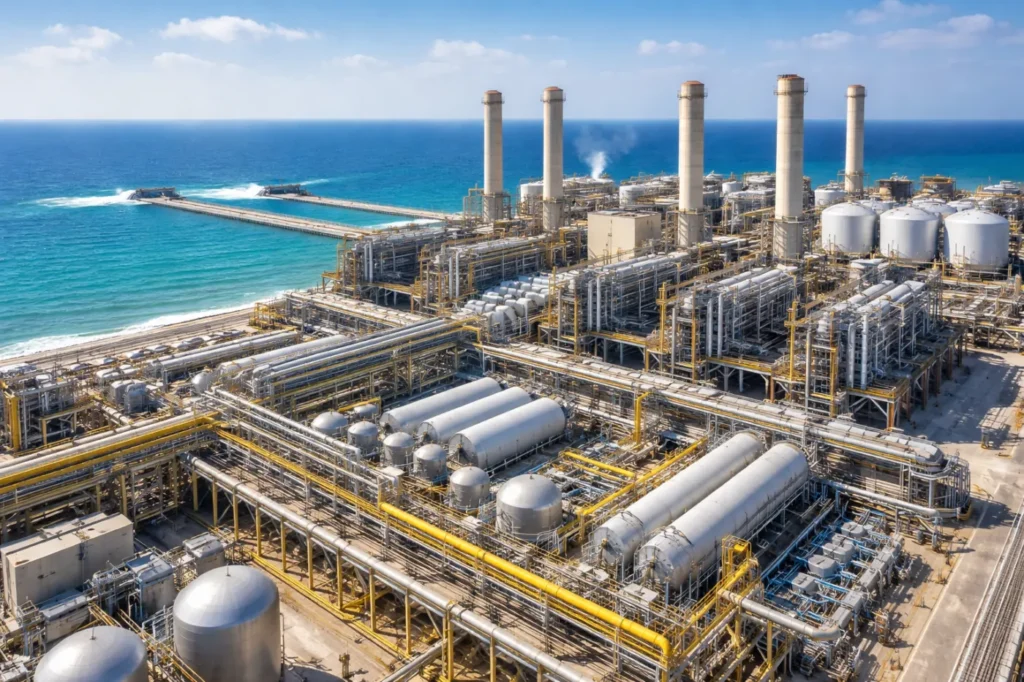
Donald Trump has threatened strikes against Iranian energy infrastructure, including desalination plants, prompting warnings of a potential humanitarian disaster in the region.
Threat to Iranian Energy Infrastructure and Water Supply
Donald Trump announced potential strikes against Iranian energy infrastructure, specifically targeting desalination plants. Analysts warn this could trigger a cascade of events leading to a severe humanitarian crisis.
The threat to Iran’s energy infrastructure, including water desalination facilities, has raised serious concerns among security analysts and water resource experts. While the declaration aligns with Trump’s rhetoric of intimidation, its realization could have consequences extending beyond military dimensions.
Desalination Plants: A Critical Lifeline
Trump suggested the possible destruction of Iranian power plants, oil fields, and strategic installations, including desalination plants. These facilities, often overlooked in media reports, are fundamental to the functioning of regional states.
Desalination plants convert seawater into potable water, frequently using reverse osmosis technology. In the Middle East, this is not an alternative solution but a basic necessity; life in many metropolises would be impossible without them.
Domino Effect and Regional Instability
Experts emphasize that even limited strikes on these facilities could create a domino effect. Installations consist of interconnected systems – water intake, filtration, and power supply. Damage to one element could paralyze the entire system.
The destruction of desalination plants would immediately restrict access to drinking water for millions. Given the region’s minimal rainfall and insufficient natural water resources, the consequences would be dramatic.
Dependence on Desalination in the Gulf States
In major metropolises like Dubai, Abu Dhabi, and Doha, desalination systems provide virtually the entire water supply. Kuwait relies on this source for approximately 90% of its drinking water, Oman for around 86%, and Saudi Arabia for about 70%. Damage to Iranian facilities would therefore cause an immediate humanitarian crisis in that country, including lack of drinking water, sanitation problems, and paralysis of hospitals and urban infrastructure.
This would quickly lead to mass migrations, state destabilization, and a large-scale health crisis.
Potential Iranian Retaliation and Asymmetric Response
Analysts point out that the greater threat lies in Iran’s potential response. Tehran possesses capabilities for missile and drone attacks that could reach similar infrastructure in Gulf states.
Iran could strike at the civilian foundations of regional states, forcing them to exert political pressure to end the conflict.
Iran’s Water Crisis and Exacerbated Risks
Iran’s current water situation is exceptionally difficult. After several years of severe drought, water levels in reservoirs supplying Tehran have fallen below 10% capacity in some areas. Over-exploitation of groundwater and climate change exacerbate this problem.
The situation is complicated by previous attacks on fuel infrastructure around Tehran, leading to emissions and acid rain that may affect soil and water systems. In these conditions, any further blow to water infrastructure would have multiplied effects.
Vulnerability of Infrastructure and Systemic Risk
Desalination plants are among the most vulnerable elements of critical infrastructure. They are not specially protected to a greater extent than urban areas, making them easy targets for attacks.
Importantly, these systems are interconnected; a failure in one plant can increase the load on others, leading to a breakdown of the entire network. In extreme cases, this could lead to a complete collapse of the water supply system in a country.
“Kingdoms of Salt Water”: A Hidden Weakness
While Gulf states are primarily associated with oil, their real basis for survival is access to water. The development of desalination technology has enabled the emergence of modern metropolises in desert areas, but has also created a new dependence.
Experts refer to these countries as “kingdoms of salt water” – powers built on technology requiring enormous energy inputs. This is a civilizational achievement, but also a serious strategic weakness.
Attacks on Civilian Infrastructure and International Law
Striking installations providing access to drinking water would violate international humanitarian law. The Geneva Convention clearly prohibits attacking objects essential for the survival of the civilian population, such as water systems and purification plants.
Such actions could be classified as war crimes. Similar violations are already observed in other conflicts, such as Russia’s repeated attacks on critical infrastructure in Ukraine.